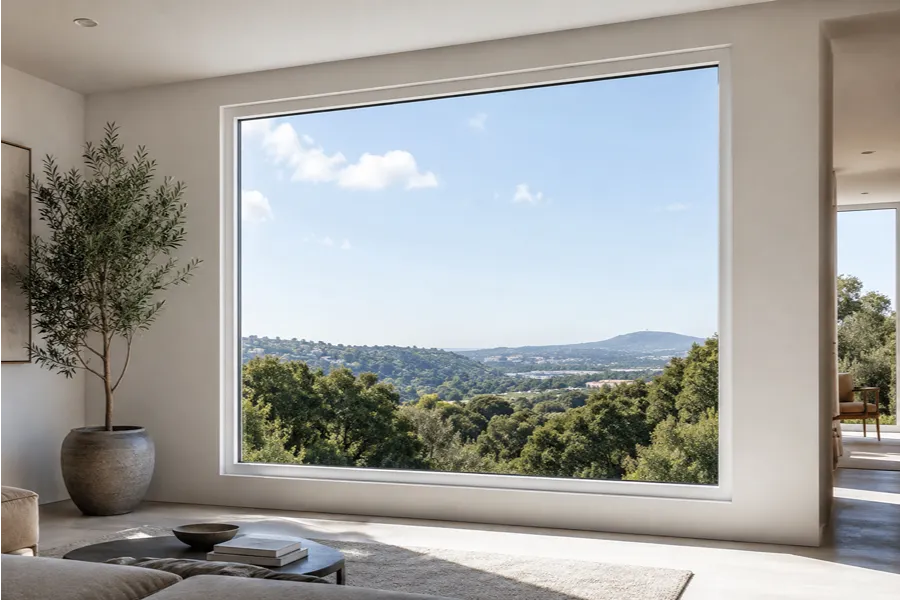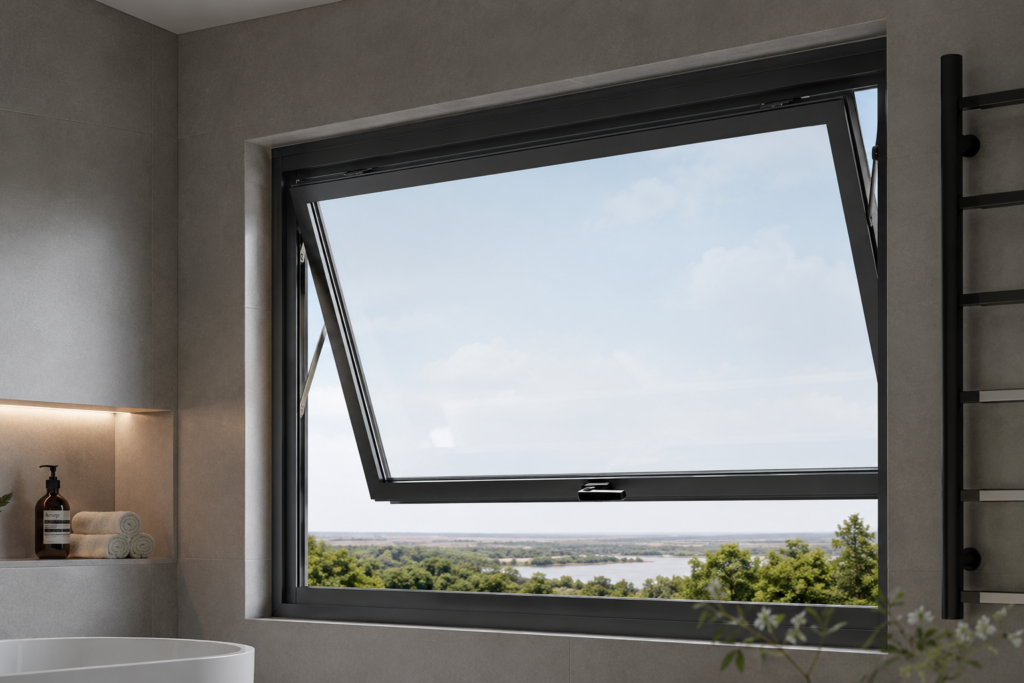
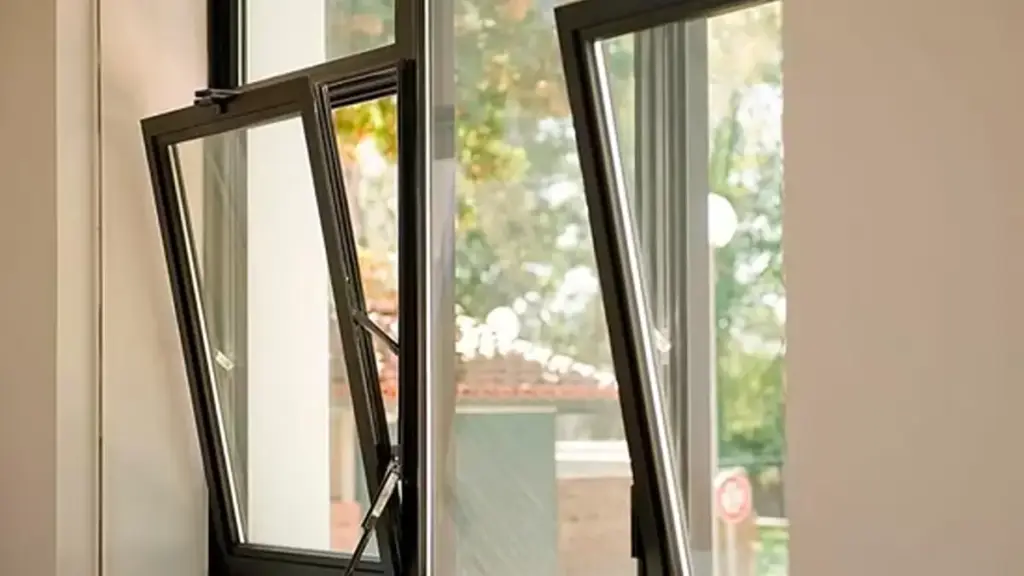
A tilt and turn window is one sash on espagnolette hardware that opens two ways. Turn it inward like a casement, or tilt it from the top with the lower corners held. That dual geometry is why tilt and turn window sizes are quoted differently from slider or awning dimensions. The sash carries its own mass on a hinge side and a stay bearing. Width and height stop being free choices and become hardware questions.
This guide separates the four numbers hiding inside one order. It sets out the published size limits, explains why narrow leaves cause trouble on site, and shows the weight arithmetic behind a hardware choice. Limits are given in millimeters with an inch equivalent, since one drawing is read in two unit systems. Every number below is a published value you can open, a figure from our own product pages, or a calculation written out in full.
How Tilt and Turn Sizes Are Measured
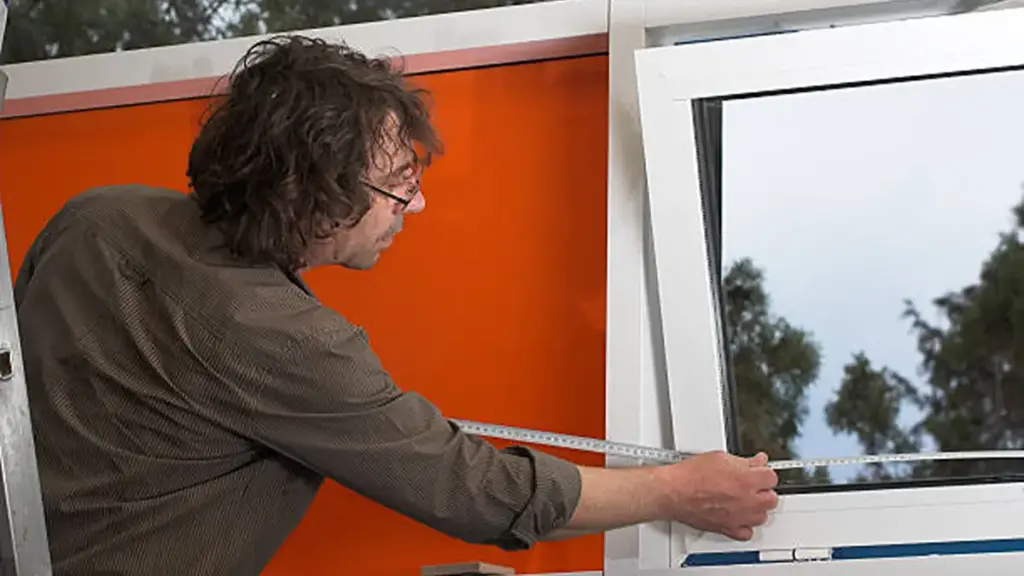
Four rectangles sit inside one tilt and turn order, and only one of them decides whether the hardware holds.
Sash width and sash height measure the moving leaf. Hardware makers rate their systems against those two dimensions plus the mass of the finished sash. Roto states its aluminum tilt and turn envelope at the sash. The published maximum is 1,600 mm (63 In) of width, 3,000 mm (118 In) of height, with load tiers up to 300 kg (661 libbre). None of those numbers describes the wall.
Frame size adds the profile to the sash. The product pages we publish give wall widths by series. A Q35 occupies 132 mm (5.2 In), a K90 occupies 90 mm (3.5 In) and an F16 occupies 116 mm (4.6 In). Two openings with identical sash dimensions can need different amounts of structure around them, and that matters on a thin partition or a retrofit into an existing rough opening.
Unit size is what the fabricator builds and crates. Opening size is what the framer leaves in the wall, and it is larger: spessori, anchorage and perimeter sealant take up the difference.
Which Number Carries the Hardware Check
A drawing-review rule we apply on every tilt and turn order is one column per dimension. The sash line is the one the hardware check runs against. Put sash width and height where the load rating is verified. Put unit size where the crate and glazing are specified, and opening size on the installer’s drawing.
Tilt Mode Has Its Own Dimension
Tilt geometry is bounded by the stay, not by the width you draw. Roto lists a maximum tilt range of 190 mm (7.5 In) on the Roto AL line. That is how far the top of the sash travels inward before the lower corners stop it. Widening the leaf does not widen that gap. A narrow sash and a wide sash on the same hardware can deliver a comparable tilt aperture, while glass area and locking points move independently of it.
Published Size Limits for Tilt and Turn
The only size ceilings in this window type that carry a public document are the hardware load ratings.
Roto’s aluminum hardware page describes a uniform hinge side carrying sash weights up to 130 kg (287 libbre) at sash heights up to 3,000 mm (118 In). Above that sit separate tiers at 160 kg, 200 kg and 300 kg (353, 441 E 661 libbre). The published envelope is 1,600 mm of sash width, 3,000 mm of height and 300 kg of weight. Opening types cover tilt and turn, turn only, and tilt before turn.
Siegenia’s aluminum page states turn and tilt hardware for sash weights up to 200 kg (441 libbre) on a 16 mm (5/8 In) hardware groove. It notes that the 200 kg capacity keeps complete turn and tilt or tilt before turn functionality. Roto’s page lists a turn-only variant beside the tilt and turn option, so a weight class alone does not guarantee the tilt mode on a heavy triple-glazed leaf.
| Hardware Line | Published Sash Weight | Published Dimension Limits | What It Decides |
|---|---|---|---|
| Roto AL, uniform hinge side | Fino a 130 kg (287 libbre) | Sash heights up to 3,000 mm (118 In) | Default build on a mid-size sash |
| Roto AL, upper tiers | 160, 200 E 300 kg (353-661 libbre) | Envelope 1,600 mm (63 In) di 3,000 mm (118 In) | Wide or tall single leaves |
| Roto AL, tilt geometry | Not a weight figure | Maximum tilt range 190 mm (7.5 In) | Ventilation aperture in tilt mode |
| Siegenia ALU 200 | Fino a 200 kg (441 libbre) | Per un 16 mm (5/8 In) aluminum groove | Heavy leaf that keeps both modes |
Neither page lists a minimum size or a stock grid. Read the Roto AL hardware page E the Siegenia ALU 200 page side by side and the pattern is clear. The documented boundary is a weight class with an envelope attached, not a set of catalogue sizes.
What a Buyer Can Lock From Those Two Pages
A sash at 1,500 mm (59 In) wide sits inside the width envelope Roto publishes. What decides the hardware is the mass of the leaf, not that width. That is defensible in a submittal, because the number can be opened and printed. A retail chart cannot do that for tilt and turn window sizes.
What the Envelope Leaves Out
Load ratings cover the completed sash: bicchiere, sash profile and the hardware fixed to it. They do not cover wind pressure on the face, the mass of an integrated screen, or the lifting gear that gets a unit to a high floor. The Q35 and K90 pages we publish list wind pressure resistance at Level 9 for the whole series, which is a series rating and not a per-size rating. A large leaf on a tall building still needs an engineer’s check on anchorage and glass makeup.
Standard Size Bands and What They Mean
A standard size is a purchasing habit, and in this window type it buys less than it appears to.
Charts circulating online list widths such as 600, 900 E 1,200 mm as though a standards body had fixed them. We could trace none of those grids to a factory document or a code. The documented limits here are the hardware envelope above and each fabricator’s own tooling. That is why tilt and turn window sizes quoted as standard still need a millimeter check before the drawing is released.
What does exist is a quoting culture. Our quote sheets take sizes to the millimeter. The published minimum on the Q35 spec sheet and its K90 sibling is 2 mq (Di 22 piede quadrato), not a list of stock sizes. North American buyers usually send a nominal retail size and add the fitting allowance at the opening, which is how most of our inch-market orders arrive. Neither approach is wrong until one schedule mixes both.
Where a Band Genuinely Helps
Bands help logistics and spares, not hardware. Repeat one width across a floor and the profile cuts, mesh frames and screen assemblies share setup time. A distributor holding replacement parts can stock one sash size of hardware instead of many. That is a purchasing case, not a standard.
| Published Series | Spessore della parete | Glazing Build | Tilt and Turn Listed | Published MOQ |
|---|---|---|---|---|
| Q35 thermal break flat window | 3.0 mm, 6063-T5 | 5+27A+5 double glazed | SÌ, inward opening with inward tilting | 2 mq (Di 22 piede quadrato) |
| K90 bridge cut casement | 2.2 mm, 6063-T5 | 5+27A+5 double glazed | SÌ, apertura verso l'interno e inclinazione verso l'interno | 2 mq (Di 22 piede quadrato) |
Both rows carry the same glazing build, so both land in the same weight band per square meter of glass. The F16 series sits beside them at 3.0 spessore della parete mm, 116 mm (4.6 In) of wall occupancy and a 5+25A+5 build. It is listed for outward opening, so it sits outside this hardware class. Our product pages give a minimum order and no maximum leaf size, because the ceiling here belongs to the hardware tier you select.
Why Very Narrow Sashes Cause Problems
A narrow leaf usually fails in use, not on paper, and no hardware page warns you with a number.
No maker publishes a minimum width, so the honest answer is a case-by-case check. In tilt mode the sash pivots along its bottom edge and the top swings inward, so a narrow leaf reaches a comparable aperture with a sharper corner movement. The same locking pressure then runs through a shorter espagnolette run.
Four Checks to Run on the Plan
- Turn swing: the leaf sweeps into the room, so a counter, handrail, appliance or basin inside that arc makes the second mode unusable.
- Handle clearance: in a multi-light group, handles on neighboring sashes can meet when both are open, and a pedestal handle needs its own space to turn.
- Flusso d'aria: because the tilt aperture is capped by hardware, several narrow leaves buy locking points instead of ventilation.
- Cleaning reach: the turn mode exists so both faces can be wiped from inside. A narrow leaf between two fixed lights still delivers that, at the cost of another mechanism.
Our review rule is blunt. If a narrow sash cannot use both modes in the finished room, the job wants a smaller turn-only leaf or one operating sash beside a fixed light. Nostro tilt and turn versus casement guide compares both types.
Sizing the Hardware From Sash Weight
Weight ends more tilt and turn specs than width does, and the arithmetic is short enough to run from an opening schedule.
Glass dominates the mass. Float glass weighs about 2,500 kg per cubic meter (156 lb per cubic foot), so mass scales with thickness. UN 5 mm lite carries roughly 12.5 kg per square meter (2.6 lb per square foot). The build published on our Q35 and K90 pages is 5+27A+5, two 5 mm lites with an air space. That glazed area carries about 25 kg per square meter (5.1 lb per square foot) before spacer, sealant, sash profile and hardware are added.
Take a 1,200 di 1,500 mm sash, O 47 di 59 In. Glazed area is 1.8 mq (19 piede quadrato), so the glass is about 45 kg (99 libbre). Add the sash profile, espagnolette, stay and handle, and the completed leaf sits above that figure but inside the 130 kg (287 libbre) livello. Now run the ceiling backwards: 130 kg divided by 25 kg per square meter is 5.2 mq (56 piede quadrato) of glazing. That is an upper bound, because it assumes the frame and hardware weigh nothing.
| Fare un passo | What You Do | Worked Figure, 1,200 di 1,500 mm Sash |
|---|---|---|
| Take the sash | Use sash width and height, not the opening | 1.2 m by 1.5 M, so 1.8 mq (19 piede quadrato) |
| Weigh the glass | Ask for the finished unit mass per m² | Two 5 mm lites, Di 25 kg per m² |
| Multiply | Glazed area times unit mass | About 45 kg (99 libbre) of glass |
| Add the leaf | Profilo, espagnolette, stay, maniglia, schermo | Above 45 kg, confirmed per unit |
| Confrontare | Total against the published tier | Inside 130 kg (287 libbre), or move up a tier |
Why the Rule of Thumb Needs a Second Source
IL 12.5 kg figure is arithmetic from a density constant, so laminated panes, rivestimenti, warm edge spacers and gas fills sit above it. A thicker outer lite can move a spec across a tier boundary without changing one dimension on the drawing. Our quote sheets carry the finished insulated glass unit mass, the number worth placing in front of the hardware check.
How Tilt and Turn Window Sizes Interact With Mass
Area scales faster than the perimeter supporting it, so mass climbs steeply as tilt and turn window sizes grow past the mid band. A leaf that doubles in both directions quadruples its glass mass while the hinge side stays the same length. That is why two projects with the same glazed width can sit on different hardware lines. Width alone answers the wrong question.
When a Design Outgrows a Single Sash

Once tilt and turn window sizes cross the published envelope, the usual answer is to divide the opening instead of forcing the hardware.
Three moves stay inside documented limits. Step the hardware up, since the upper tiers carry 160, 200 E 300 kg and one rival line holds 200 kg with both modes intact. Drop the tilt function where ventilation comes from elsewhere and run a turn-only leaf, which removes the stay and the tilt geometry from the spec. Or keep the glazed width and split it, so one sash operates beside a fixed light that carries no moving load.
Three Ways to Split an Opening
A mullion with two sashes keeps both leaves operable and halves the load per hinge group. A transom puts a fixed band above an operating leaf, which suits stairwell and bathroom layouts where reach matters more than clear glass. A fixed center with tilt and turn flanks keeps the view line and puts moving hardware where someone stands. Each option adds one fabrication line and takes mass off a single leaf.
What The Split Must Still Deliver
Splitting changes what each leaf contributes to an escape opening, so have the architect or site supervisor re-check it once the mullion position is fixed. Nostro egress window requirements guide covers the net clear area, clear height, clear width and sill limits that have to survive the split.
Inward swing needs room too. A tall leaf in a small bathroom reaches its fixtures before it reaches the turn position. Cleaning both faces from inside is why many projects specify this hardware at all.
Ordering Custom Tilt and Turn Sizes
A custom size is a documentation job, and the opening schedule decides more of the engineering than the profile does.
Nostro tilt and turn windows range is built to order. The fields a quotation needs are the ones that also decide the engineering: unit size, quantità, requisiti di vetro, colore del telaio, hardware line, opzione dello schermo, opening direction and destination country. Send those eight and the hardware tier can be checked against the calculated sash mass before a drawing is issued, non dopo.
Size changes several lines at once. Glazing mass moves the hardware tier, and sash dimensions set the mesh and screen assemblies. A wider leaf raises the wind load case, which is where glass makeup and anchorage get reviewed together. Color and finish rarely move an order on their own, but a non-standard coating quoted beside a non-standard size lengthens the paperwork.
What We Do Not Quote From a Chart
We do not publish a lead time tied to a size. IL 15 day figure in the quote strip on this site is a general baseline, and we confirm it order by order. Dimensional tolerance is a shop-drawing item. There is no industry size grid to point at. We state the tolerance for the series on the drawing instead of quoting a figure an installer cannot verify.
Four Things That Must Be Written Down
- The hardware tier and its published load rating, shown next to the sash dimensions.
- Sash size, unit size and rough opening size in three separate columns, not one.
- The finished insulated glass unit mass per unit, taken from the glazier instead of estimated.
- The dimensional tolerance and its inspection point, stated for the series you ordered.
Settle those four on the schedule and tilt and turn window sizes stop being a debate about catalogue numbers. The size that survives a project is the one where mass, geometry and documentation agree.
Domande frequenti
What is the largest tilt and turn window available?
The published ceiling on the Roto AL aluminum hardware line is about 1,600 mm (63 In) wide by 3,000 mm (118 In) high in a single sash. Its load tiers run to 300 kg (661 libbre). Above that envelope the opening is divided with a mullion or transom, because the limit sits with the hinge side, not the profile.
Can tilt and turn windows be made to custom sizes?
SÌ, within the hardware envelope. We quote these units to the millimeter instead of to a stock grid. The published minimum order on our Q35 and K90 product pages is 2 mq (Di 22 piede quadrato). A custom size still needs its sash mass checked against the hinge tier.
Is there a minimum tilt and turn size for code compliance?
No hardware maker publishes a minimum width or height for this mechanism. Residential codes state it the other way round, as a clear opening. The IRC wording our egress guide works through uses net clear area, clear height, clear width and sill height. Our egress guide works through those figures and the code edition behind them. Check the edition your local authority applies: a very narrow leaf can serve ventilation and still fail an escape requirement.
How thick should the glass be in a large tilt turn sash?
Thickness is set by added weight and wind load, not by size alone. Our published build is 5+27A+5, two 5 mm lites at roughly 25 kg per square meter (5.1 lb per square foot) of glazed area. Thicker lites, laminated panes or a triple-glazed unit push the completed sash toward the next hardware tier. Ask for the finished unit mass before choosing.
Which hardware supports the heaviest tilt and turn sash?
The published aluminum figures run to 300 kg (661 libbre) on Roto AL across its upper hinge tiers. Siegenia ALU 200 states 200 kg (441 libbre) with full turn and tilt or tilt before turn function retained. Both are stated at the completed sash, so the practical limit is the tier your calculated mass falls under.