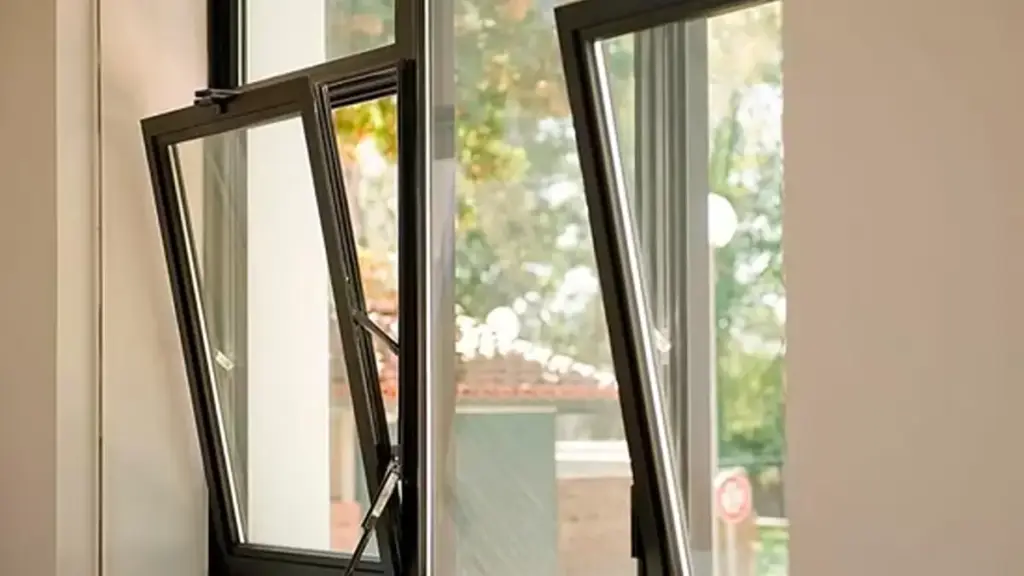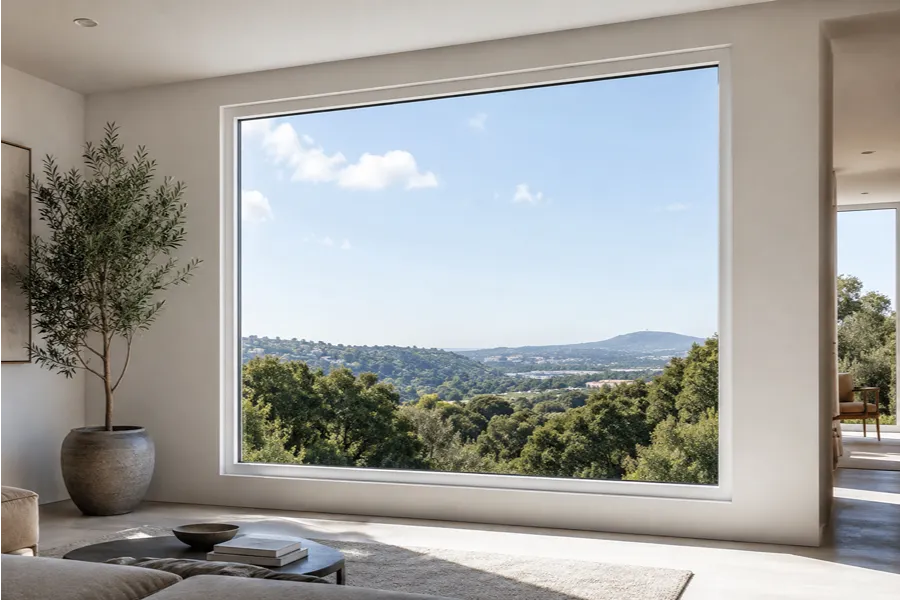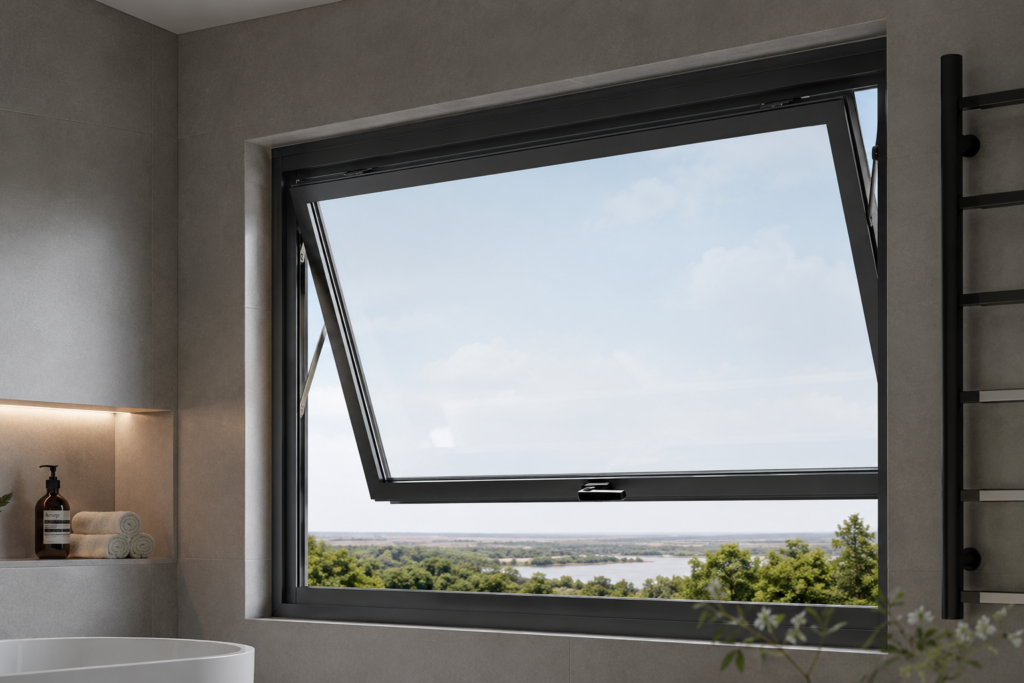
Aluminum wins window projects for strength, خطوط الرؤية ضئيلة, and a 40-year service life without rot. Then the energy model runs, and the same metal that carries the glass turns out to conduct heat about 800 times faster than the polyamide strip inside a proper frame. That contradiction is the entire reason thermal break windows exist.
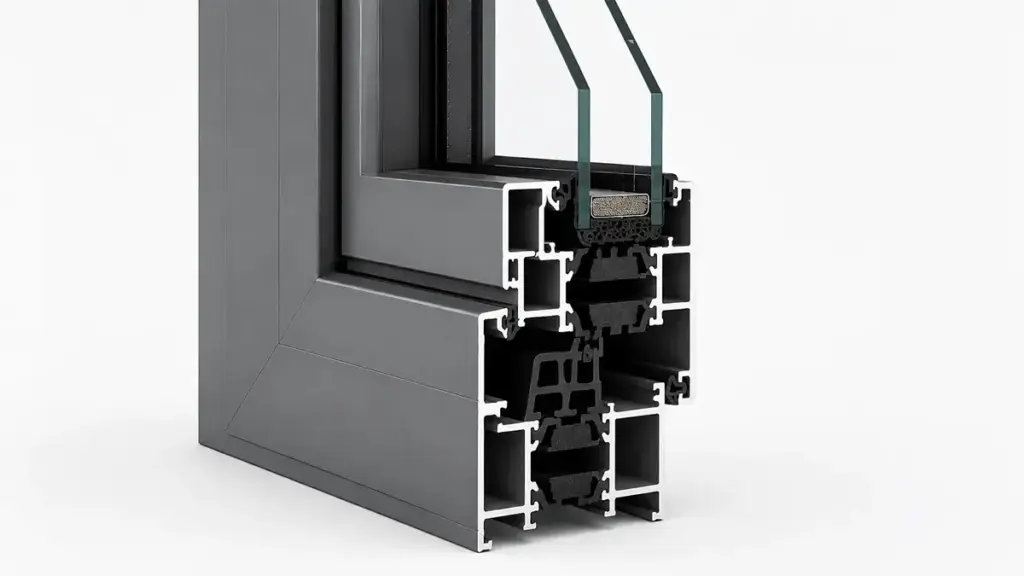
A thermal break is a bar of glass-reinforced nylon clamped between the interior and exterior halves of an aluminum profile. It stops the metal from acting as a bridge that pumps warmth out in winter and pulls heat in during summer. This guide covers how the bar works and what each break width delivers. It also shows where the dew-point math leaves a thin break short, and when thermal break windows are the wrong buy.
Why Aluminum Needs a Thermal Break

A solid aluminum frame is a heat pipe. The frame carries roughly 25 ل 30 percent of a window’s area, so an unbroken profile can undo most of what a good glass unit achieved.
Aluminum is the strongest common window material per unit of weight and the thinnest to frame a large opening. It is also one of the most thermally conductive metals in ordinary building use. The 6063-T5 alloy behind most window extrusions conducts at roughly 209 ث / م · ك. Pure aluminum reaches 237. Compare that to the polyamide used in a break bar at about 0.25 ث / م · ك, or to rigid PVC at 0.16, and the gap becomes obvious.
Heat always moves from the warm side to the cold side, and it takes the path of least resistance. In a single-piece aluminum frame, that path is direct metal from the warm interior surface to the cold exterior surface. The frame becomes a short circuit around the insulation the glass provides.
The frame’s share of the window drives the damage. A typical casement puts 25 ل 30 percent of its area in framing, and a grid or a sliding meeting stile pushes that higher. On a double-glazed window with a center-of-glass U-value near 0.28 (الملكية الفكرية), a solid aluminum frame can drag the certified whole-window rating to 0.55 or worse. The glass did its job. The frame threw the heat straight through the edge.
In a mild, dry winter the conduction is a comfort annoyance. In a cold one it becomes frost at the frame line and water on the sill. The fix is not to abandon aluminum. It is to cut the metal path, and that is exactly what thermal break windows do.
How the PA66 GF25 Bar Works
The break is a rigid nylon strip, not a foam. It has to conduct almost nothing while expanding and contracting at nearly the same rate as the aluminum gripping it.
Every serious thermal-break window uses the same core idea. Extrude the profile as two separate aluminum pieces, an inner skin and an outer skin. A bar of low-conductivity polymer joins them, carrying structural load while resisting heat flow. The metal stays strong on each side. The heat path gets blocked in the middle.
That bar is almost always PA66 GF25, polyamide 6.6 loaded with 25 percent glass fiber. The base nylon conducts at about 0.25 ث / م · ك, roughly 800 times less than the aluminum around it. The glass-fiber loading matters for a second reason. Plain nylon expands about three times faster than aluminum as temperature swings, which would crack the joint within a few seasons. Glass reinforcement pulls the expansion coefficient down toward aluminum’s range, so the two skins and the bar between them move together instead of tearing apart.
How the Bar Gets Locked In
A factory does not glue the bar in place and hope. The dominant method is roll-bonding. Each aluminum skin carries a machined channel with two thin retaining lips. The bar, its edges knurled or toothed, sits between the two channels. A roll-bonding press then folds the aluminum lips over the bar’s toothed shoulders, cold-welding the assembly into one rigid profile. Done correctly, the joint resists shear loads that approach the strength of the parent metal.
The alternative is cast-in, where liquid polymer is poured into the channel and cured, or the older pour-and-debridge process that saws a cut after casting. Cast-in can seal well but depends on resin quality and cure control. For a buyer comparing supplier quotes, the practical question is which bonding method a factory uses and whether it can prove the joint.
That proof has a name. The European standard EN 14024 defines mechanical performance tests for the bar-to-profile joint, including shear strength, and it is the report a serious extruder can hand over. ال equipment makers that build roll-bonding lines publish the same logic: bond strength comes from the geometry of the knurl and the pressure of the roll, not from adhesive. A supplier who cannot show a shear test or name its process is selling a thermal break in the brochure only.
Thermal Break Width and Performance Bands
Wider bar, lower frame U-value. The step from 14.8 مم ل 34 mm roughly halves how much heat leaks through the frame.
Break width is the single specification that separates a code-passing window from a cold-climate one. The bar width sets how long and how thin the heat’s route through the frame must be, so the number drives the frame’s U-value (Uf) directly. The table below maps common bar widths to the Uf bands the industry reports. It also lists the whole-window Uw those frames typically reach with a double Low-E argon insulating glass unit.
These are generic planning ranges, not certified values for any single product. A specific profile’s real Uf depends on its internal chambers, the number of bars, and the glass edge detail. Use the table to pick a break width on a drawing before requesting quotations, then hold the supplier to NFRC or ISO calculations for the exact assembly.
| Break Bar | Typical Frame Uf (واط/م²ك) | Whole-Window Uw with Double Low-E Argon | Realistic Use |
|---|---|---|---|
| Solid, no break | 5.5–6.8 | 3.5 and worse | Interior partitions, mild dry climates |
| 14.8 مم | 2.4–3.2 | 2.4–2.9 | Entry thermal break, mild winters |
| 18 مم | 2.0–2.6 | 2.0–2.4 | Common mid-range EU spec |
| 24 مم | 1.6–2.2 | 1.8–2.2 | Cold climate, condensation margin |
| 34 مم | 1.2–1.8 | 1.2–1.8 | البيت السلبي, deep-freeze winters |
Why Width Is Not the Only Lever
A wide bar in a poorly designed profile still underperforms a narrower bar in a well-built one. The internal geometry matters as much as the number. Multi-chamber frames trap still air in cavities that add resistance beside the bar. A vertical isotherm, where the bar lines up straight through the frame depth rather than at an angle, keeps the cold face from sneaking around the edge. Gasket continuity and the warm-edge spacer at the glass boundary each contribute a slice of the final rating.
That is why two windows both sold as “24 mm thermal break” can carry different NFRC labels. The bar width is a starting filter for a specification, not a guarantee. When you compare supplier submittals, match the break width, the chamber count, and the certified whole-window number together. Treat any quote that leads with bar width alone as incomplete.
How a Thermal Break Changes Whole-Window U-Value
Regulators do not rate the frame alone. They rate the whole window, and the frame’s edge leak often decides whether you clear the code line.
The number that appears on a compliance form is the whole-window U-value, sometimes written Uw or U-factor. It blends three sources of loss: the glass center, الإطار, and the linear thermal bridge where glass meets frame at the edge. A thermal break lowers two of those three at once: the frame term and the edge term. That is why its effect on the certified rating is larger than the frame’s 25 percent area share would suggest.
The edge deserves its own attention. Heat leaks along the sash-to-frame boundary at a rate measured by the psi-value, a linear thermal-bridge coefficient. A well-broken frame with a warm-edge spacer holds psi in the 0.06 ل 0.10 W/m·K band. The same glass in a solid frame can push past 0.30. That edge leak is invisible in a center-of-glass spec and very visible on a whole-window label, and it is the difference between clearing a code target and missing it.
For a buyer, the practical consequence is simple. Never accept a center-of-glass or frame-only number as proof of compliance. In the US market, the rating that matters is the NFRC whole-window U-factor for the exact assembly, because that is what an inspector or a Title 24 reviewer will check. In the EU the equivalent is the certified Uw under EN standards. The top tier is Passive House, where the Passive House Institute sets a whole-window Uw under 0.8 واط/م²ك, frame and edge included.
Take a fixed window with a center-of-glass U-factor of 0.28 و أ 25 percent frame share. With a solid aluminum frame at a metric Uf of 6.0, or IP 1.06, the whole window lands near 0.55. Swap to a 24 mm break at metric Uf 1.8, or IP 0.32, and the same glass yields a whole-window figure near 0.32. The glass never changed. Cutting the metal path did.
Condensation Control and the Dew Point
Condensation is a surface-temperature problem. A thin break can stop heat loss and still leave the frame cold enough to sweat.
Water condenses when a surface sits below the dew point of the adjacent air. Indoor air at 20°C and 50 percent relative humidity has a dew point near 9°C. If the interior face of the frame drops below that line, moisture appears on it. A solid aluminum frame in a cold winter pulls its interior surface far below 9°C, and the result is streaks, mold at the sill, and frozen frames.
A thermal break raises the interior surface temperature by blocking the cold that the outer skin carries inward. But the width matters, because a thin break only lifts the surface so far. The estimate below runs a simplified surface-temperature calculation for frames at several break widths. It assumes an indoor 20°C at 50 percent humidity, an outdoor design temperature of −20°C, and a standard interior surface film resistance. The figures are illustrative, not certified ratings, and real results shift with humidity and glass-edge effects.
| Frame Build | Assumed Frame Uf | Interior Surface at −20°C Outdoor | Versus 9°C Dew Point |
|---|---|---|---|
| Solid aluminum | ~6.0 | About −11°C | Heavy frost |
| 14.8 mm break | ~3.2 | About +3°C | Still condenses |
| 24 mm break | ~1.6–2.2 | About +9 to +12°C | Borderline, near dew point |
| 34 mm break | ~1.2 | About +14°C | Dry with margin |
Read the middle rows carefully, because this is where most competitor content stops at “thermal break equals no condensation.” أ 14.8 mm entry-level break cuts heat loss and still leaves the frame below the dew point in a hard winter. If a project’s real worry is a wet sill, the honest answer is that the dew-point margin, not the mere presence of a break, is what solves it.
Thermal Break vs Clad vs Vinyl Frames
A thermal break buys aluminum its insulation without giving up its strength. The alternatives trade one advantage for another.
Once a buyer accepts that the frame must be broken, the next question is which broken frame. Three families dominate the spec sheet, and each solves the conduction problem differently. The wrong pick usually comes from comparing them on price alone while ignoring climate and span.
Thermal-Break Aluminum
This keeps a full aluminum profile and inserts the PA66 bar described earlier. You retain aluminum’s strength-to-weight, its slim sightlines, its resistance to warping, and a 40-year-plus service life, and you cut the heat path. The trade is cost. A broken-aluminum frame runs meaningfully more than solid aluminum of the same shape, and the gap widens as the bar gets wider.
Aluminum-Clad Wood
A clad-wood frame wraps an interior timber frame in an exterior aluminum shell. Wood insulates far better than metal, so the assembly reaches strong U-values with a warm interior aesthetic. The price is the highest of the three, and the timber interior carries a maintenance and moisture burden that a pure aluminum or vinyl frame does not. For a clear head-to-head on structure, يكلف, and weather behavior, see our comparison of aluminum-clad wood versus thermal-break aluminum.
فينيل (Unplasticized PVC)
Vinyl conducts almost nothing on its own, so a multi-chamber vinyl frame hits good U-values with no added bar and at the lowest cost. Its weakness is structure. Vinyl is stiff but not strong, so large sliding panels and wide spans need steel reinforcement inside the chambers, which quietly reintroduces a thermal bridge. Vinyl also expands more with temperature swings than aluminum, which limits very large fixed lights. For a mild-climate residential casement it is a strong value pick; for a floor-to-ceiling glazing wall it is not the right tool.
The clean way to choose: vinyl when cost and insulation dominate and spans are modest. Thermal-break aluminum wins when you need strength, إطارات ضئيلة, or large glass alongside good U-values. Clad wood earns its premium only when the interior aesthetic justifies it.
Where a Thermal Break Pays Off
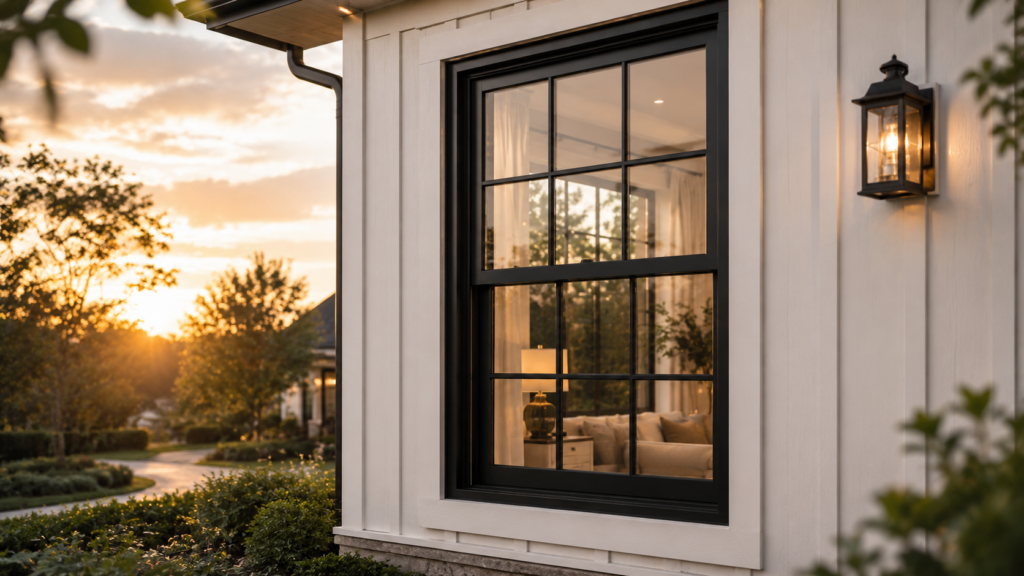
A thermal break earns its cost where the temperature difference across the frame is large and sustained. Elsewhere it can be a margin mistake.
Thermal break windows pay back fastest in climates with long, cold heating seasons and in projects chasing Passive House or a strict energy code. There, the frame runs a real temperature gradient for months, the dew-point margin protects the interior finish, and the energy saving compounds. It also pays off on large fixed lights and slim commercial sightlines where vinyl cannot carry the span and a solid frame would fail the rating.
For a US buyer, the code line makes the decision concrete. Texas enforces the 2021 IECC, which caps the vertical-window U-factor at 0.40 in the hot-humid Zone 2 around Houston and 0.30 in Zone 3 around Dallas. California’s Title 24 lets a high-performance assembly offset a prescriptive miss through the whole-building path, which turns a certified low Uw into design freedom on large glazing. A thermal break is often the cheapest way to hit those numbers without shrinking the glass.
When Not to Specify a Thermal Break
Here is the honest part most supplier blogs skip. In hot, cooling-dominated climates, the window’s job is to reject solar heat, not to hold warmth in. Much of the Gulf Coast, the US Southeast, جنوب شرق آسيا, and the Gulf states sit in this zone. There, the SHGC (معامل اكتساب الحرارة الشمسية) drives comfort and energy load far more than the U-factor. A well-designed non-break or narrow-break frame with solar-control Low-E glass can beat a heavy 34 mm break on cost while meeting the code. Buying a Passive-House frame for a shaded, mild-winter villa is spending margin on a number nobody will test.
The other skip case is interior and non-thermal applications. أبواب الجيب, internal partitions, and closet systems gain nothing from a break because both faces of the frame sit at the same temperature. Specify solid aluminum there and save the thermal-break budget for the genuine building envelope.
Where the decision is real, ال OPUOMENDW Q35 broken-bridge casement and the wider K90 series sit in the 14.8 ل 24 mm band. That band fits cold-climate residential and mid-rise facade work. Route a project with a specific break-width requirement straight to the aluminum window range so the submittal matches the energy model from the first quotation.
الأسئلة المتداولة
What is a thermal break in aluminum windows?
A thermal break is a rigid bar of glass-reinforced nylon, usually PA66 GF25, clamped between the inner and outer halves of an aluminum window profile. It blocks the metal path that otherwise conducts heat straight through the frame, while the aluminum keeps carrying structural load. The result is a lower frame U-value and a warmer interior surface.
Do thermal break windows really save energy?
نعم, where the frame carries a real temperature difference. A solid aluminum frame can push a whole-window U-factor past 0.55 even behind good glass; أ 24 mm break can pull the same window into the 0.30s. The saving is largest in cold climates with long heating seasons and smallest in mild, shaded, cooling-dominated regions.
How wide should a thermal break bar be?
Match the width to your climate and target rating. أ 14.8 mm bar suits mild winters and entry-level codes, 18 ل 24 mm covers most cold-climate residential work, و 34 mm reaches Passive House territory. Width is a starting filter, not a guarantee. Always confirm the certified whole-window number for the exact profile.
Do thermal break windows prevent condensation?
Only if the break is wide enough to hold the interior frame surface above the dew point. A thin 14.8 mm break cuts heat loss but can still leave the frame below the dew point in a hard winter, so it sweats. Condensation control is a surface-temperature margin problem, and that usually pushes a cold-climate spec toward 24 mm or wider.
Is thermal break aluminum better than vinyl?
For strength, خطوط الرؤية ضئيلة, and large glass, نعم. Vinyl insulates well and costs less, but it needs steel reinforcement for wide spans, and that reinforcement reintroduces a thermal bridge. Thermal-break aluminum keeps its structural advantage at good U-values. Vinyl wins on price for modest residential openings; aluminum wins where the frame must carry more.
Which climates actually need thermal break windows?
Cold and mixed climates with real heating seasons and strict U-factor codes, such as northern US, كندا, the UK, and northern Europe. حار, cooling-dominated regions care more about solar heat gain than frame conduction, so a lighter break with solar-control glass often meets the code at lower cost. The dew-point margin, not the label, is what tells you how wide to go.