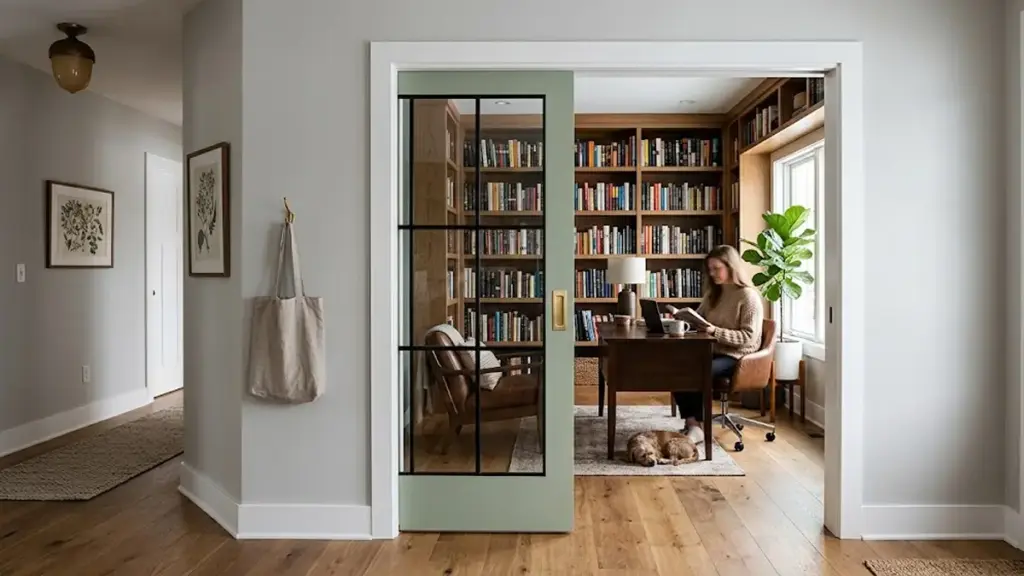
Pocket door cost is set by two things most quotes leave out: the condition of the wall you cut into, and the weight class of the hardware carrying the panel. Two identical-looking slabs can end up a $1,200 apart in delivered project cost, because one rides on plain bushings inside an open stud bay and the other rides on precision ball-bearing hangers locked into a reinforced steel cassette.
This guide breaks that number into the parts a buyer can control: three material buckets, the standard-versus-custom premium, retrofit risk, and a landed-cost worksheet for importers. Installed-project figures are North American planning ranges compiled from remodeling cost guides, not quotes from our factory. Dimension tables, hardware anatomy, and framing steps live in our dedicated pocket door guides, linked where each cost driver shows up.
Pocket Door Cost Ranges at a Glance
A single pocket door typically runs $500 à $1,850 installed in open-wall new construction and $1,200 à $3,500 in a finished-wall retrofit. Load-bearing work climbs past $4,500 before you touch a finish.
| Project Scenario | Typical Installed Range | What Sets the Number |
|---|---|---|
| Open-wall new construction, single panel | $500 à $1,850 | Frame mounts between exposed studs; no demolition, no drywall patch, no repainting. |
| Finished-wall retrofit, non-load-bearing | $1,200 à $3,500 | Demolition, stud alteration, cassette insertion, then taping, mud, texture, and trim. |
| Load-bearing wall retrofit | $2,500 à $4,500+ | Temporary shoring, an engineered header, and sometimes a permit plus an engineering review. |
| Double-pocket pair, one opening | $2,000 à $4,250 | Two cavities and a parallel track; the rough opening roughly doubles along with the hardware count. |
| Remodel with walls already open | $500 à $1,500 | The pocket frame goes in during a trade window the crew is already paying for. |
Read these as planning envelopes rather than a price list. Wall condition moves the total more than door style does: un $1,400 solid-core panel hung in an open stud bay can finish cheaper than a $400 hollow-core panel dropped into a finished partition with a drain pipe behind it. Schedule the pocket frame for the phase when the wall is already open, and you skip the demolition and patch labor that inflates most retrofit budgets.
Slab, Matériel, and Frame: Three Cost Buckets
Materials divide into three independently priced buckets: the door slab ($30 à $1,200+), the slide hardware ($40 à $350, ou $350 à $900 for architectural soft-close sets), and the pocket frame or cassette ($80 à $1,600). Raw materials for one opening usually land between $150 et $3,150.
- Door slab: Commodity hollow-core panels start near $30. Solid-core, custom-molded, and designer glass leaves run from a few hundred dollars up past $1,200. Poids, not looks, is what the next two buckets respond to.
- Slide hardware: Piste, cintres, and the bottom guide cost $40 à $350 in standard sets. Architectural hardware with soft-close dampeners and precision ball bearings moves to $350 à $900.
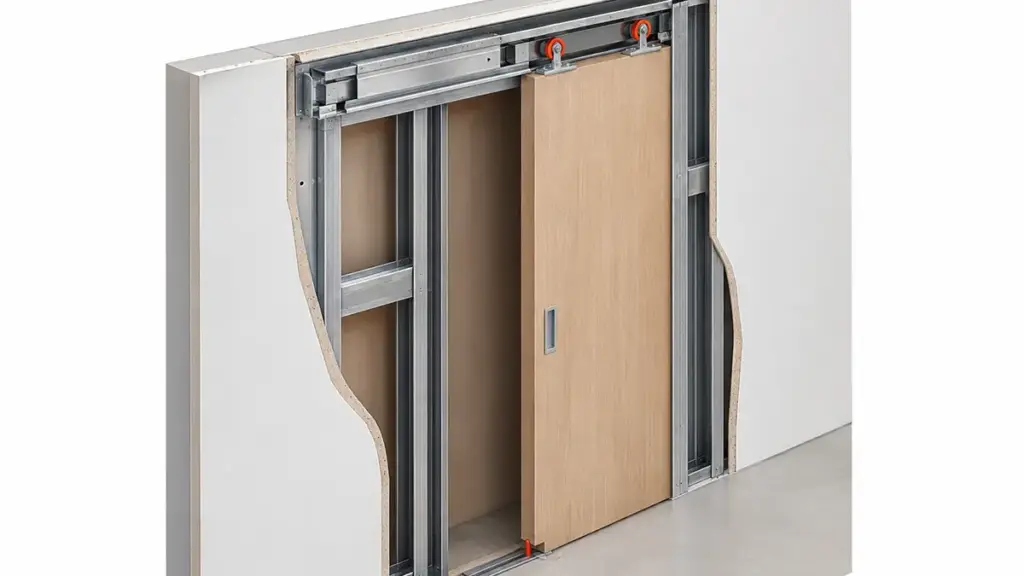
- Pocket frame or cassette: Engineered-wood kits begin around $80. Galvanized-steel cassette frames sit in the middle, and heavy-gauge aluminum or architectural assemblies reach $1,600. The frame is what keeps a finished wall from flexing at the pocket line.
Buyers mix these buckets freely, and that is where pocket door cost goes wrong first. The hardware weight rating must meet or beat the actual panel weight, including glass. An under-rated hanger set on a heavy slab does not fail on day one; it sags slowly, rubs the split stud, and shows up as a warranty claim a year later.
| Hardware Weight Class | Typical Capacity | Bearing Type | Where It Belongs |
|---|---|---|---|
| Light-duty | 60 livres (à propos 27 kilos) | Plain bearing or bushing | Hollow-core interior panels, placards, powder rooms. |
| Standard residential | 150 à 200 livres (68 à 91 kilos) | Bushing or basic ball bearing | Solid-core and typical residential panels in daily use. |
| Robuste | 200 à 250 livres (91 à 113 kilos) | Upgraded ball bearing | Dense solid-core panels and tall custom leaves. |
| Commercial | 250 à 400 livres (113 à 181 kilos) | Precision ball bearing | Wide panels, inserts en verre, and partition duty. |
Track material, roller construction, and guide geometry are covered part by part in our pocket door hardware guide, including how to calculate load rather than guess at it. One specification point matters more to cost than any finish choice: Opomendw builds pocket door leaves and frames on aluminum profiles instead of engineered wood. Aluminum takes on no moisture, so it does not swell, chaîne, or carry mold in bathroom and laundry cavities, and it holds stated dimensions across a production batch, which keeps a reorder matching the first order.
Standard vs Custom Sizes: What the Premium Buys
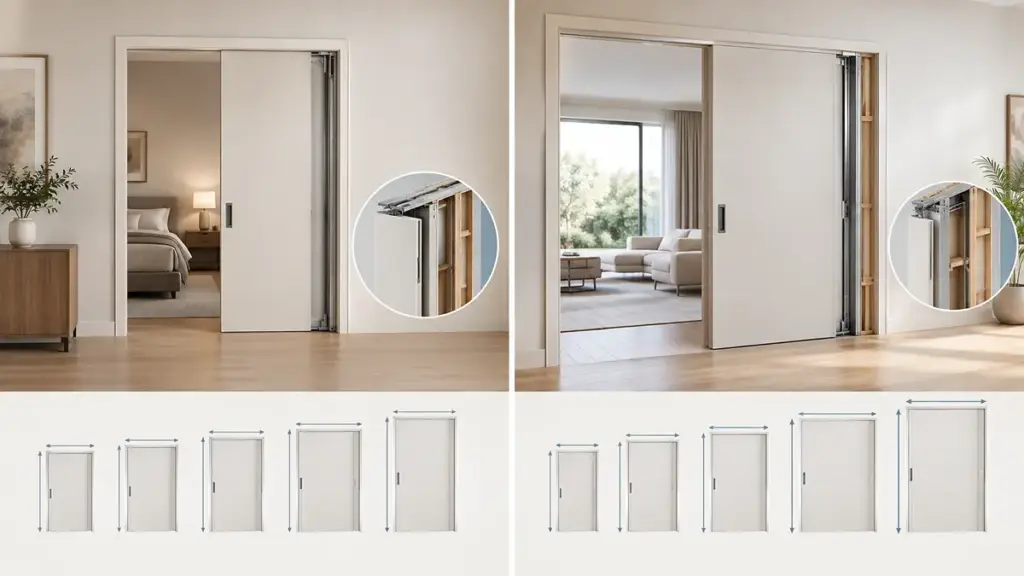
Stock widths and an 80-inch height keep every part off-the-shelf. Stepping outside them adds fabrication time, and on the install side a 15% à 25% premium in specialized labor.
- Stock dimensions: Single panels run 24 à 36 pouces de large, avec 24, 28, 30, 32, et 36 inches the common residential sizes. Height is usually 80 pouces, avec 84 et 96 inches available for taller openings. Slab thickness is 1-3/8 ou 1-3/4 pouces, set by the frame and hardware system.
- Framing math: Plan the rough opening at twice the slab width plus 1 à 2 pouces, et 4 à 4.5 inches taller than the slab. Most standard frames suit 2×4 murs à colombages; deeper cavities need a matching wall system.
- Coût installé, standard sizes: $450 à $1,850 in open walls, $1,350 à $2,950 retrofitted into finished walls.
- Custom premium: Bespoke slab and frame packages cost $800 à $2,000+ in materials alone. Oversized and taller panels demand heavier track, higher-rated hangers, and a deeper cavity, which is where the labor premium comes from.
Designing around stock sizes avoids custom fabrication lead time and keeps installer hours down. Double-pocket pairs deserve a note here, since they are often misquoted: two panels retract into two cavities on opposite sides of one opening, so the rough opening widens to roughly twice the clear width, and both cavities have to be clear of utilities. Full dimension tables and rough-opening formulas are in our pocket door sizes guide. A 96-inch panel, Par exemple, costs more mostly in hardware class and freight cube, not in extra board.
Wall Framing and Retrofit Cost
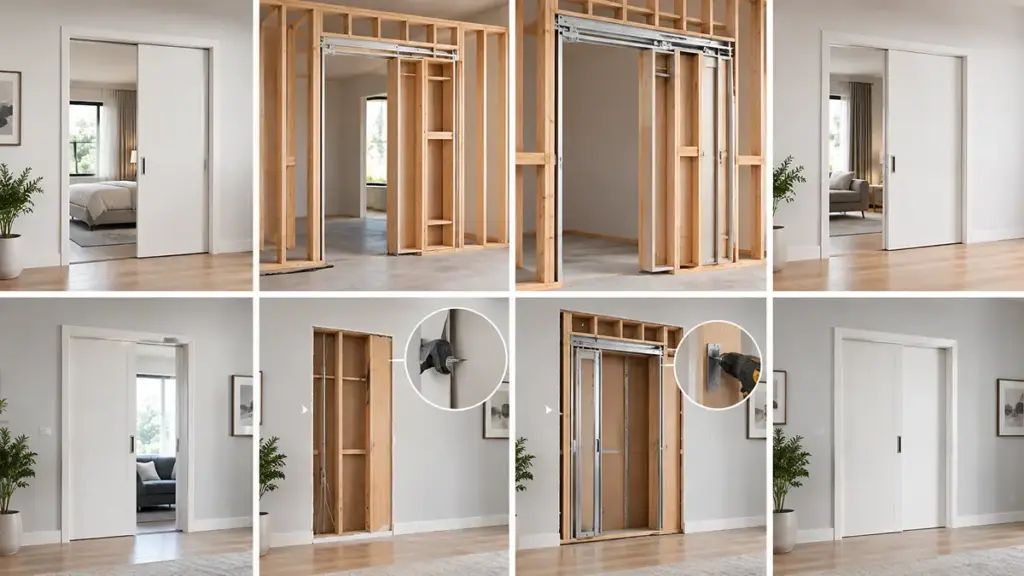
The wall, not the door, causes most overruns. Cutting into a finished partition adds a $900 à $1,800 premium over open framing, and utility relocation inside the cavity is the biggest single risk line.
- Open-wall framing: $500 à $1,500. Crews anchor the frame to exposed studs, mount the track, and hang the panel before the drywallers arrive.
- Non-load-bearing retrofit: $1,200 à $3,500, covering demolition, stud extraction, cassette insertion, and surface restoration.
- Load-bearing retrofit: $2,500 à $4,500+, including an engineered header at $500 à $2,000 plus shoring and review.
- Utility relocation: Rerouting switches and wiring costs $500 à $1,000+; supply lines, drains, or ductwork add $500 à $1,500 per trade.
- Trade rates: General contractors $50 à $120 par heure, skilled carpenters $70 à $150 in high-cost markets, drywall specialists $50 à $100.
A professional install runs in a fixed order: breach drywall on one side, pull the studs in the pocket path, set the header, level the track, hang and adjust the panel, add guides, s'arrête, poignées encastrées, and any soft-close unit, then close the wall with multiple coats of compound and re-cut the casing. Compound needs drying time between coats, so crews return over two or three days, and that calendar is why retrofit labor outruns material cost so often. A few millimeters of track misalignment makes a door roll on its own or rub a split stud, which is why the leveling step is billed as precision work rather than basic carpentry.
Inspect before you order materials. A stud-finder pass plus a look from the attic or crawlspace tells you whether the pocket path is clear, and whether the wall is load-bearing, because a structural header changes the space left for the cassette. Older construction often hides irregular framing, notched studs, and shallow cavities that need correction before any frame will fit. If a finished wall cannot be opened cleanly, our write-up on replacing a pocket door without wall demolition covers the salvage routes and what each one costs in hardware rather than in drywall.
For buyers specifying units instead of hiring crews, cavity depth is a specification line, not a field surprise. Confirm finished wall thickness against the frame kit you are quoting. A frame sized for a 2×4 wall will not fit a 2×4 wall standing behind fresh re-sheathing, plaster, or back-to-back tile.
Landed Cost for Importers
Price by sellable unit, not by container. Duty, chargeable weight, damage reserve, and final-mile surcharges decide whether a bulk deal clears your margin.
A pocket door kit bundles a door leaf, metal track, cintres, guides, and sometimes glass. Those parts can fall under different classifications, and a shipment that mixes them may need line-by-line treatment at entry. Look up candidate codes in the official Harmonized Tariff Schedule search, then have your customs broker confirm the code for your exact construction before you build a price model on it.
Duty percentages applied to Chinese-origin building products changed repeatedly through 2025 et 2026, and stacked programs differ by entry date. Treat any single figure in a worksheet as a snapshot: hold duty as a variable line, re-check the rate on the day you file, and keep the right to re-quote a customer order if the rate moves between order and entry.
Entered value generally rests on the price paid at the port of exportation, with certain packing and commission elements counted in, while international freight and insurance can be excluded when they are separately established. Get your broker’s ruling on your packing terms before you publish a price list. Ocean entries also carry a Merchandise Processing Fee and a Harbor Maintenance Fee; both are assessed per entry and both adjust by calendar year, so pull the current minimum and percentage for the year of entry rather than reusing last year’s model.
Incoterms decide where your liability starts. EXW gives the lowest factory number and puts origin handling, export clearance, and every delay at the port on your side. FOB shifts export clearance to the supplier and leaves you free to shop the freight rate. DDP reads simplest on a spreadsheet and usually costs the most once the seller prices your risk for you. We ship FOB as standard, which keeps freight selectable for the buyer.
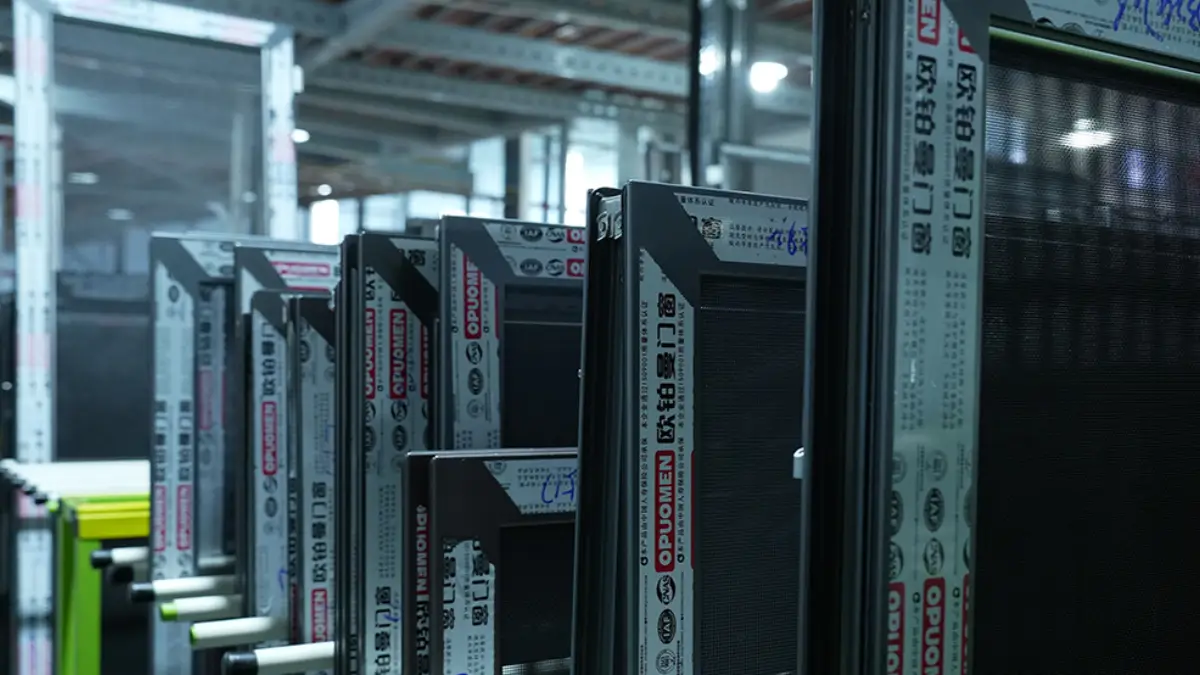
Pocket doors are freight-sensitive goods. The cartons are long, flat, and awkward, so carriers bill dimensional weight and a container of frames can hit cube limits well before it hits payload. Budget for final-mile surcharges too: liftgate service, limited-access delivery, and residential or jobsite addresses each add a line the ocean rate never showed you. Set a damage reserve of 1.5% à 2% of goods value and model currency movement across the production window, because a bent track or a scratched panel face ruins a complete kit rather than one part of it.
| Worksheet Line | What to Capture | Why It Moves Margin |
|---|---|---|
| Ex-works unit price | Slab, hardware class, frame or cassette, conditionnement, each quoted separately. | Bundled quotes hide which component you are actually re-ordering. |
| Origin handling and inland freight | Trucking to port, warehousing, export documentation, port charges. | Oversized cartons attract higher handling tiers than standard joinery. |
| Ocean freight | Chargeable weight, not actual weight; confirm per carton dimension. | Cube limits, not payload, decide how many units fit in a container. |
| Duty and entry fees | Rate on entered value, plus Merchandise Processing Fee and Harbor Maintenance Fee. | Rates and fee minimums change by year and by entry date. |
| Insurance and damage reserve | Cargo cover plus 1.5% à 2% of goods value held back. | One damaged kit is a total loss; unbudgeted write-offs eat the tier discount. |
| Final-mile delivery | Liftgate, limited access, residential or jobsite surcharge. | These land after the deal is closed and were never in the ocean quote. |
| Sellable unit count | Total cost divided by units that pass inspection, not units ordered. | Rejects reprice the whole batch if you counted at the ordered quantity. |
Once the worksheet totals up, apply your target gross margin. A unit at $595.97 landed needs a retail price of $916.88 to clear a 35% gross margin, since $595.97 divided by 0.65 gives that figure. Round to your price ladder, then check it against the installed ranges at the top of this page: resale price has to leave room for the installer’s labor as well as your own overhead.
From Quote to Delivery: Locking the Cost Baseline
Cost control is sequence control: approve a sample, freeze the specification in writing, then inspect production against that frozen document.
- Inquiry and sampling. State slab construction, finished wall thickness, hardware weight class, and whether soft-close is in scope. Vague inquiries get vague quotes.
- Sample approval. Cycle the panel repeatedly, measure the clear opening, check the finish edge, and confirm the guide engages without lift. Sign off the sample with photographs and a dated record.
- Specification freeze. Put dimensions, profile finish, glass make-up, hardware brand and model, étiquetage, and packaging in one written document both sides reference.
- Pre-shipment inspection. Check against the frozen specification and the approved sample, with an agreed sampling plan covering operation, finition, and carton markings.
- Delivery and after-sales. Agree spare hanger and guide allocation, conditions de garantie, and the documentation your customs entry will need.
Change one line after the freeze and the repricing reaches past the unit. A heavier slab forces a higher hardware class; a higher hardware class changes carton dimensions; different carton dimensions move chargeable weight and entered value. That chain is why buyers who approve a sample early pay less per unit than buyers who correct a specification mid-production.
Foire aux questions
How much does it cost to install a pocket door?
Most single-panel projects fall between $800 et $2,500 installé, with open-wall new construction at the low end around $500 à $1,850. Retrofitting into a finished non-load-bearing wall typically runs $1,200 à $3,500, and a load-bearing wall climbs past $4,500 once an engineered header and utility relocation enter the job.
Are pocket doors more expensive than regular hinged doors?
Oui. A standard hinged interior door commonly costs $150 à $700 installé, while a pocket door project spans roughly $500 à $3,500 depending on wall condition. The gap comes from framing the cavity, patching and refinishing the wall, and matching hardware capacity to panel weight, not from the door leaf itself.
Can you add a pocket door to an existing finished wall?
Oui, and it is the version that costs the most. Attendre $1,200 à $3,500 for a non-load-bearing partition, since the crew must open the wall, remove studs, insert the cassette, and restore the surface. A structural header adds $500 à $2,000, and any wiring, piping, or ductwork in the pocket path is priced per trade.
Is a pocket door cheaper than a sliding barn door?
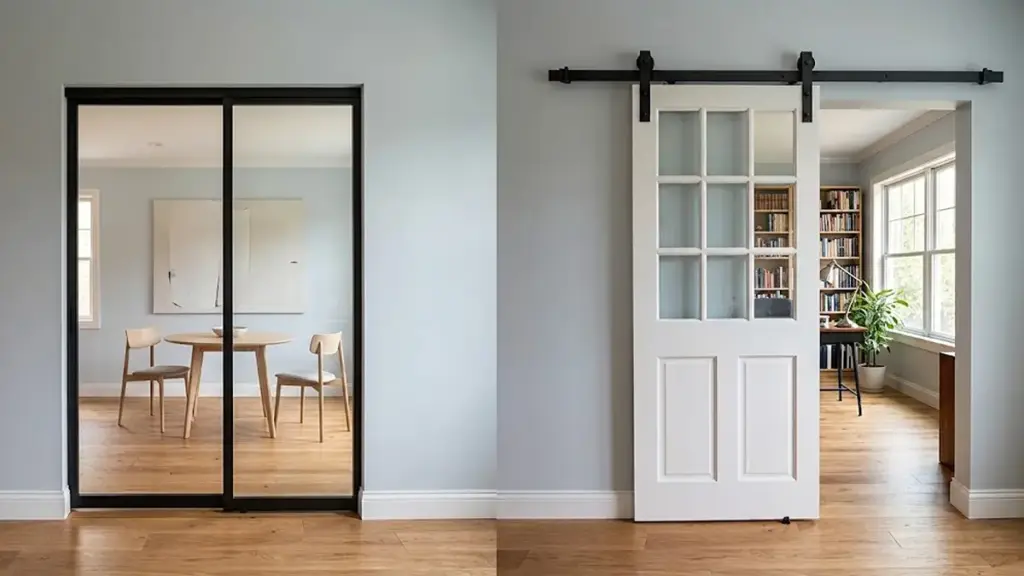
Usually not, and the retrofit gap is the widest. A surface-mounted barn door avoids wall work entirely, so installed totals commonly sit at $500 à $1,200. A pocket door needs a clear cavity and finished framing, which puts the same project at $500 in open walls and $1,200 à $3,500 once a finished wall is opened. Barn doors also seal less well, since the panel rides outside the opening.
Do pocket door quotes include the frame and hardware?
Not always, and this is the most common source of a surprise second order. Suppliers sell three forms: slab only, slab with hardware, and a complete frame kit with rough framing, piste, cintres, et des guides. Confirm which form a quote covers, then verify wall thickness and hardware weight class before the order, because the frame kit is also the freight-sensitive line in your landed cost.
Pensées finales
Pocket door cost follows wall condition and hardware class more closely than it follows door style. Economical kits and light tracks do lower an opening budget, but paired with a heavy panel they sag, lier, and eventually pull finish off a wall, and the repair costs more than the hardware you saved. Two quotes for what looks like the same door differ because of weight rating, cassette construction, and whatever is sitting inside the cavity.
If you stock or specify these systems, request a sample unit and the hardware specification sheet, then fit the panel to the wall thickness you actually build to. Our team can quote custom dimensions, finitions, and FOB pricing for your next order, with the production window stated on the proforma rather than assumed.