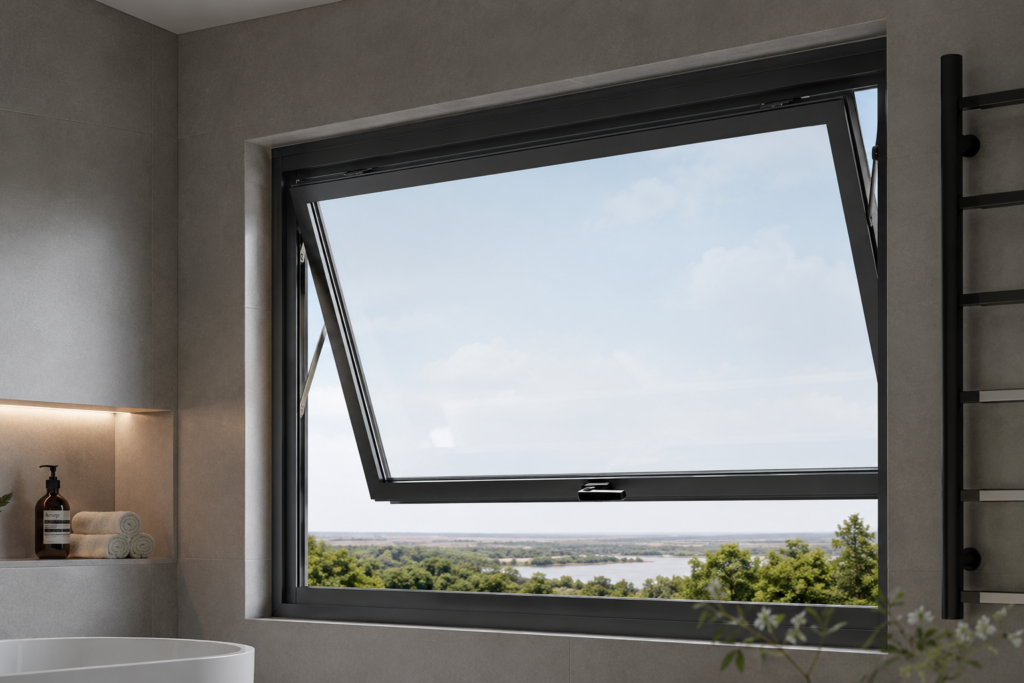
A slab door vs prehung unit is the same door on two different invoices. The difference is who squares the frame. A slab arrives as the leaf alone. A prehung unit arrives hinged into a frame somebody else built and checked. Order the wrong form and you pay in carpentry hours, in cubic metres of freight, or in a door that never latches.
This guide runs the comparison the way our quote desk runs it. What each form includes, what each costs against published figures, what each does to a container, and where aluminum construction overrides the wood-door rules most articles assume.
What a Slab Door Actually Includes

A slab is the leaf alone: no frame, no hinges, and no lock bore unless you order one.
A slab is the door panel with nothing attached. No jamb, no hinges, no strike, and on most orders no hole drilled for the lockset. It is the right buy when a frame already stands in the wall and stays there.
That makes it an importer’s decision rather than a homeowner’s. A homeowner keeps the jamb because removing it means repainting a room. A container buyer decides for two hundred openings at once, and the choice moves between the factory, the freight line, and the site crew.
The Machining Your Installer Still Owns
An unprepared leaf carries three operations across the ocean. Mortising the hinge pockets. Boring for the lockset. Beveling the hanging edge. Our frame guide states the trade plainly: slab replacements require hand-cutting hinge mortises and beveling edges to fit existing, cadres non standards.
Non-standard is the operative phrase. A frame that has carried a door for years has settled, been repainted, and had its hinge screws tightened by hand. Your new leaf meets that history, not the drawing that described it.
Ask which preparation ships with the leaf. Factory boring and mortising are dimensioned against your signed sheet. Done on site, they are dimensioned against whatever the wall turns out to be.
Where a Slab Earns Its Place
A leaf-only order fits one situation: the frame is sound and the leaf is what wore out. Hotel corridors, dormitory floors, and rental stock replace leaves on a cycle and keep jambs for decades.
Our measurement guide puts the supplier side in writing: slab-only orders suit timber and aluminum-wood leaves. Most factory quotes assume the assembled unit unless the order says otherwise. Silence buys prehung at prehung prices.
What a Prehung Door Adds to the Box
A prehung unit is the leaf, le cadre, and the hinge line squared once, indoors, by the people who made both.
A prehung door, also called a pre-hung unit or complete door unit, is the leaf already hinged into its frame. The assembly carries hinge jamb, montant de frappe, tête, the stop the door closes against, and on exterior work the sill and weatherstrip. Corner joints and hinge spacing are set on a bench, checked before a crate closes.
Our frame guide gives the buyer-side consequence in one line: prehung systems provide a factory-machined jamb, arrêt, et un ensemble de dalles qui réduisent le temps d'installation. It does not claim the unit arrives cheaper. It arrives with somebody else’s tolerance problem already solved.
Jamb Depth Is a Wall Measurement
An assembled unit brings a depth you must match before ordering. Walls framed on 2×4 studs with drywall take a 4-9/16 in jamb. Walls framed on 2×6 take 6-9/16 dans. Those are the figures our frame guide works from, and they defeat more frame orders than height or width does.
Order the shallow jamb into a deep wall and the frame sits proud, so casing has to be built up. Order the deep jamb into a shallow wall and the crew frames the wall out to meet the door. Both land on the same punch list.
Rough Opening Follows the Unit
Standard framing leaves a rough opening 1-1/4 à 2 in wider and taller than the nominal door. That gives the installer room to shim and plumb. UN 36 par 80 in prehung unit wants an opening near 38 par 82 à 82-1/2 dans.
A leaf-only order asks the opposite question. It must fit an opening that already exists, cut for another door, by another crew, in another year. That is the whole difficulty of the slab route, and it is a site condition rather than a product defect.
Cost and Install Time Compared
The price gap sits in the product. The time gap sits in the skill standing on site.
Most slab door vs prehung arguments open with a percentage nobody can show their working for. These are the retail ranges we publish in our solid core vs hollow core cost breakdown, in US dollars, materials and labour kept apart.
| Line Item | Published US Retail Range | What the Price Covers |
|---|---|---|
| Hollow-core slab | $30 à $150, custom to $400 | Leaf only, no frame or hardware |
| Solid-core slab | $70 à $250, premium to $500 | Leaf only, denser core and edge |
| Prehung, cré de creux | $150 à $500 | Leaf, cadre, charnières, factory alignment |
| Prehung, solid-core | $250 à $900 | Same package at the heavier core |
| Carpenter labour | $100 à $350 par porte | Setting, plomberie, enveloppe, garniture |
| Hardware and finishing | $15 à $100+ par ouverture | Lockset, extra hinges, paint or stain |
Read the product lines against the labour line. The assembled unit costs several times the bare leaf at the low end of each range, and the labour figure does not fall to match. Our published position is that labour stays similar for both forms, because alignment, enveloppe, and trim drive the clock either way.
What the Delta Actually Buys
Not hours. It buys the operations that go wrong in hands. Mortising a leaf, boring to a backset, and beveling an edge are each one chance to open a return. Squaring a jamb into a rough opening is one chance to leave a door that will not latch, behind a wall already closed in.
Weight decides the crew either way. UN 30 par 80 in hollow-core slab runs 15 à 35 kg. The same size in solid core runs 40 à 80 kg, and our cost guide notes that weight usually asks for two people. An assembled unit adds the frame to that carry.
Shipping Volume and Freight Impact
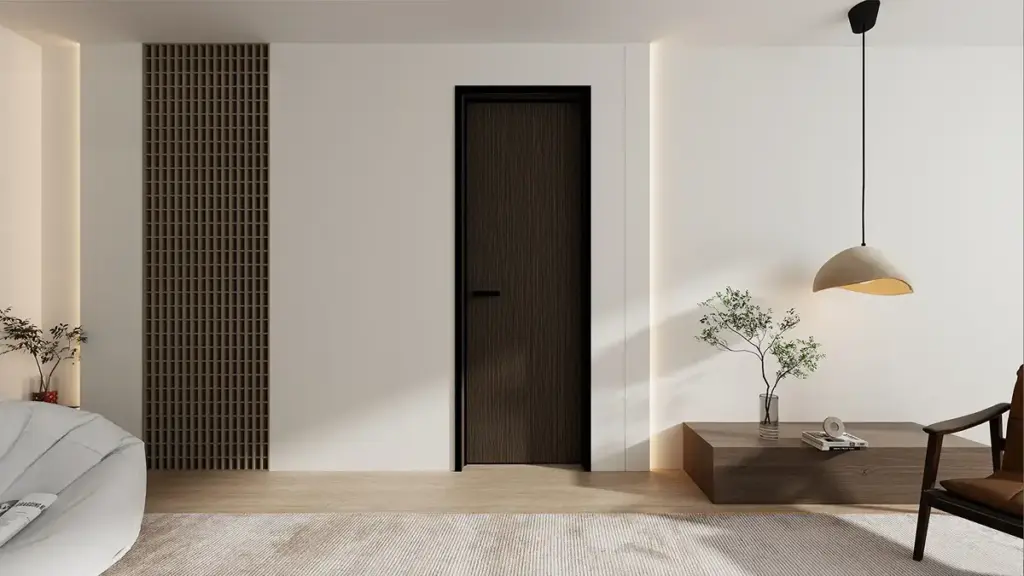
Freight bills by the container, so the sales form sets the landed cost of every door inside it.
A door travelling standing in its own frame takes more container than the same door stacked as a leaf. Our export packing rules make the constraint explicit: units travel upright with temporary cross-bracing, the full sill length sits on support, and laying units flat is prohibited. That rule stops frames and insulated glass distorting in transit, and it also decides your loading plan.
Upright and un-nestable is the freight story. This is where the slab door vs prehung choice stops being a carpentry question. Run the arithmetic on published dimensions rather than on anyone’s rule of thumb.
| Sales Form | Envelope, 36 × 80 in Door | Volume per Unit |
|---|---|---|
| Slab at 40 mm d'épaisseur | 0.914 × 2.032 × 0.040 m | 0.075 m³ |
| Assembled in a 4-9/16 in jamb | 0.914 × 2.032 × 0.116 m | 0.216 m³ |
| Ratio | 0.216 ÷ 0.075 | 2.9 times the volume |
Every input above sits on this site. Le 36 par 80 in size comes from our interior door size guide. Le 30 à 50 mm total thickness comes from our aluminum door thickness guide, et le 4-9/16 in jamb depth from the frame guide. Run the division at both ends of that thickness range and an assembled unit occupies between 2.3 et 3.9 times the space of the leaf.
That is a product envelope, not a crate. Edge protectors, stretch film, and the bracing gaps between stillages sit on top of it, so the working ratio moves further against the assembled unit. Anyone quoting a neat slab door vs prehung multiplier without a packing list is quoting a guess.
Height Decides Which Box You Book
US interior doors run 80 in high, avec 84 et 96 in appearing in taller new work. Convert those against the containers we publish figures for. UN 20 ft or 40 ft standard box measures 2,390 mm inside, and its door opening stands 2,280 mm high.
UN 96 in leaf is 2,438 mm. It will not stand in a standard box, and it clears a high-cube opening of 2,580 à 2,600 mm with room for bracing. Un 84 in leaf at 2,134 mm fits either. Tall doors force a high-cube before they force anything else.
Ask for Cubic Metres per Set
We do not publish a units-per-container figure, and you should treat any supplier who does as guessing on your behalf. The count follows your sizes, your hardware, and the crate protecting both. What you can require is the number behind the count: cubic metres per set, plus a loading diagram showing how the sets stand and where the braces sit.
The arithmetic after that is a division. A container priced the same and holding half as many sets doubles the freight carried inside every door. Notre export shipping and packaging guide lists the volumes to divide into: 76 à 86 m³ in a high-cube, 67 à 68 m³ in a 40 ft standard. It also names the packing standards behind them, ASTM D4169 and 49 Partie CFR 178.
How Aluminum Doors Change the Rules
Aluminum leaves rarely travel bare, because the frame is where the engineering sits.
Every slab door vs prehung article assumes a competent carpenter can build or fit a frame on site. On a timber opening that holds. On an aluminum opening it does not. The frame is an assembly of cut profiles with hardware set into the metal, and the party that cuts the profile is the sensible party to check it square.
Our production flow ends with leaf and frame assembled, hardware installed, and the whole door adjusted before packing. That is a factory sequence, not a shipping preference. It is why an assembled quote is the default on our aluminum wood door range.
Knock Down Is a Steel Term, Not an Aluminum Promise
Hollow metal work has a published word for the alternative. Le Steel Door Institute glossary defines knock down, abbreviated KD, as a frame product shipped disassembled. It names the hinge jamb, montant de frappe, and head as frame members, and a formed corner component that interlocks KD frames at the mitered head-to-jamb junction.
Nothing in that definition transfers to thermally broken aluminum joinery, which is why the question belongs on your purchase order rather than in a catalogue. Ask which form the price covers: assembled unit, loose leaf into a separate frame, or disassembled frame. Three suppliers will answer with three different products at one headline number.
Thermal Break Continuity
The Aluminum Extruders Council documents how the barrier is made. A rigid polyamide strip is mechanically crimped between two extrusions. A knurling wheel cuts teeth 0.15 à 0.30 mm long into the pocket, so they bite into the strip and carry shear. The alternative, pour and debridge, extrudes a channel, fills it with polymer, then removes the aluminum bridge.
Both methods build the barrier inside the profile, along its length. Neither hands you a guarantee about the corner, where two cut lengths meet and the strip ends. Ask how the break closes at that joint, and ask for the answer drawn on the shop drawing.
Systems With No Leaf-Only Form
Track-driven openings have no slab option. Glissement, pliable, and pocket orders carry frame, piste, rouleaux, guides, and sash as one package. The hardware sets the geometry, and the geometry sets the opening. A leaf without its track is inventory nobody can install.
Rated Openings Are Assemblies
A fire rating belongs to the assembly, not the leaf. Our cost guide states it directly: fire doors are tested assemblies, and leaf, cadre, charnières, plus près, et le matériel de verrouillage doit tous porter des listes compatibles. Substituting a slab into a rated frame breaks the listing whether the sizes match or not.
Where a rated opening appears in your schedule, the sales form question is settled before price. Buy the assembly the test report describes, and let the paperwork name every component in it.
When a Slab Door Is the Right Call
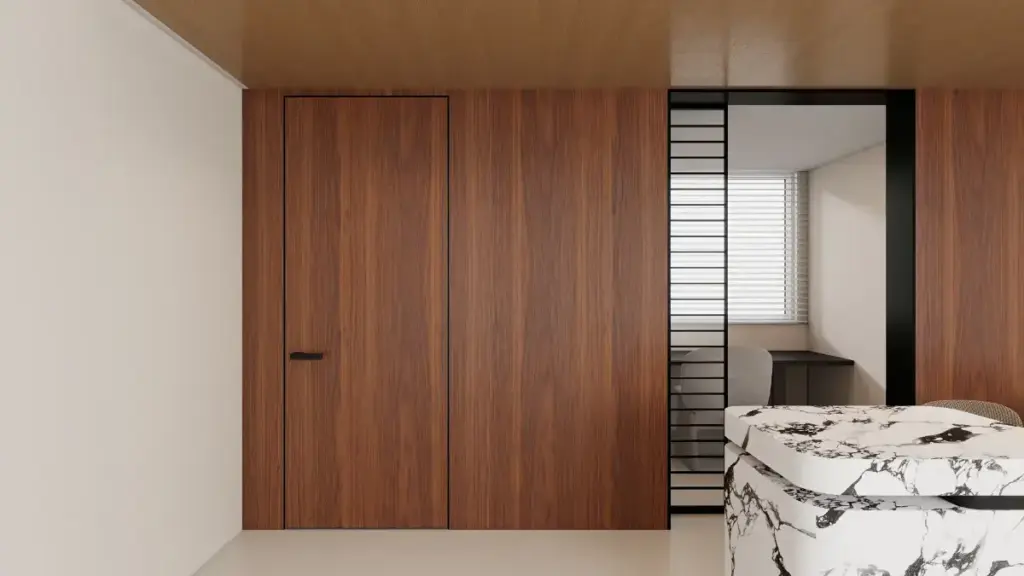
Order leaves when the frames already stand on site and you can prove they are true.
Retrofit work is the natural home for a slab order. The frame is the expensive part to remove, so buy the part that wears. Freight follows the same logic: at the envelope figures above, one container carries several times the count in leaves as it does in assembled units.
The Frame Check Before You Commit
Run this on a sample of openings, not on one lucky doorway, before confirming a slab order.
- Set a level on the hinge line of the existing jamb. A latch that only catches with a shove is the usual tell of a jamb out of plumb.
- Measure the thickness you will be matching. Timber interior leaves run 1-3/8 à 1-3/4 dans; aluminum leaves run 30 à 50 mm overall.
- Photograph the hinge positions and count the screws in each leaf before the old door comes off.
- Record the bore: diameter, backset, and hand. If the leaf ships unbored, write that on the order instead of assuming it.
- Confirm the opening is not part of a rated assembly, where a substituted leaf voids the listing.
- State the tolerance you expect back. Linear 1/16 dans (1.6 mm) is normal fabrication practice.
Put responsibility in writing too, because this is where a slab order becomes a claim. A wrong-hand unit built to a wrong sheet is the buyer’s freight. A unit that departs from the signed sheet is the factory’s. That sentence belongs on the purchase order before anyone cuts profile.
When a Prehung Unit Earns Its Freight
Assembled units pay for their extra cubic metres on new openings, and where nobody on site owns squaring.
New construction has no frame to inherit. Rough openings arrive from a framing crew already on to the next trade. A supplier who ships leaves into that job hands the alignment problem to whoever is next on site, and usually that is nobody.
The correct sequence is on our frame guide: plumb the hinge jamb first, mettre à niveau le montant de la tête, puis fixez le côté de la gâche, checking squareness as you go. A crew hanging six openings a week holds that discipline. A crew hanging six openings once in a project does not, and the difference shows up as callbacks.
Mixing Both Forms in One Order
Most container buyers land on a mix, and the split follows opening type rather than a published ratio. Sort your schedule into three columns: replacement leaves into standing frames, new openings with no frame yet, and track systems with no leaf-only form. The first takes slabs. The third never does. The second is where the freight decision is made.
Send that count with your enquiry. We quote both forms, and the columns set the stillage plan, so leaves and assembled units leave the plant on separate racks instead of one compromised stack.
Judged on unit price alone, slab door vs prehung looks like a small number on a large order. Judged on freight, on site skill, and on who owns a door that will not latch, it stops looking small. Decide by opening type, demand cubic metres per set, and put the frame check in writing.
Slab and Prehung Questions From Importers
What is a slab door vs a prehung door?
A slab is the door leaf on its own, with no frame, no hinges, and usually no lock bore. A prehung door is that leaf already hinged into a frame the factory assembled and squared, with sill and weatherstrip on exterior units. One question separates them: who fits the frame, and where.
Ce qui est moins cher, slab or prehung?
The leaf alone, at every point in the published ranges. Hollow-core slabs run $30 à $150 against $150 à $500 prehung, and solid-core $70 à $250 against $250 à $900. Labour does not close the gap. Setting either form costs $100 à $350 par porte.
Can I turn a slab door into a prehung door?
You can hang a slab into a frame you build or buy separately, and on timber work that is routine. What you take on is the machining: hinge mortises, the lock bore, the edge bevel, and squaring the assembly. An aluminum frame is cut-profile joinery, so that work belongs on the bench that cut it.
Do prehung doors come with hardware?
Hinges come fitted, and exterior units usually carry the sill and weatherstrip. Serrures, ferme-portes, and pulls ship separately or on request. On our line the production flow ends with hardware fitted and the whole door adjusted, so specify what must be mounted before packing.
How many slab doors fit in a container?
No honest answer comes off a table. UN 36 par 80 in leaf occupies about 0.075 m³ and the same door assembled about 0.216 m³, so the ratio runs near three to one. The absolute count follows your sizes and crates, which is why you ask for cubic metres per set and a loading diagram.
Are aluminum doors sold slab or prehung?
Usually assembled. The frame is cut-profile joinery with hardware set into the metal, so the factory that cuts it is the right place to check it square. Our production flow assembles leaf to frame, fits hardware, and adjusts the whole door before packing. Ask every supplier which form a quote covers.