콘텐츠로 건너 뜁니다

Ordering the units is the short part. To import aluminum windows and doors from China is mostly a paperwork exercise, and the paperwork finishes before anything is cut. It means buying factory-direct, taking title at the point your price term sets, and clearing units as the importer of record, the party that files the entry. Four documents decide the outcome: a schedule a factory can build from, drawings that match it, terms that survive a dispute, and a classification that holds at the port.
This guide treats the transaction as six gates. A gate is a handover where you either hold written proof or you stop the order. Two close before money moves and two after the units are finished, where the costly surprises sit.
Six Gates Decide an Import Order

Each gate ends with one document you hold, and a missing document is cheaper to notice at the desk than at the port.
A purchase order is not a gate. It is one signature on one price. The six gates follow the order the work happens in, each named by the document that closes it. Read them in sequence before you import aluminum windows and doors from China, because each gate assumes the last document exists.
What Each Gate Hands You
| Gate | Document you hold | Gate closes when |
|---|---|---|
| 1. Schedule | Window and door schedule, one line per mark | Every mark carries an opening size, 유리 빌드, 하드웨어 및 마감 |
| 2. Terms | Proforma invoice with the commercial terms written out | Price basis, lead-time start and inspection right are on paper |
| 3. Drawings | Shop drawings stamped approved, plus the approved sample | Each drawing line traces back to a schedule mark |
| 4. 생산 | Inspection report measured against the approved drawing | The balance moves after the report, not after a date |
| 5. Entry | Invoice, packing list, bill of lading and the agreed classification | The entry summary lists the tariff number you approved |
| 6. Receiving | Delivery receipt noted clean or damaged, with dated photos | Units are counted by mark, upright, and stored before installation |
OPUOMEN publishes its side of this chain as a five-stage cooperation process: Inquiry, 설계, 샘플 승인, 양산, 글로벌 배송. The first two stages sit before gate 3, and Global Delivery spans gates 5 그리고 6. The factory clock starts at drawing and sample confirmation, your clock at the schedule.
Write the Window and Door Schedule First
The schedule is the document a supplier quotes against and the one your inspector checks at the end, so write it before you ask for a price.
Give every unit a mark number and keep it on the label that reaches the site. A rendering starts arguments and a schedule settles them. Before you import aluminum windows and doors from China, decide what each line has to say. A quotation built on an incomplete schedule changes after the deposit.
Numbers a Schedule Line Must Carry
- Mark number, room or elevation, 수량, and which side of the wall the leaf opens to.
- Rough opening width and height in one unit system, with the tolerance you accept.
- Profile series and wall thickness stated as a number, not as a weight adjective.
- 유리 빌드: 단련된, insulating or Low-E (낮은 방사율), with the spacer width and coating named.
- Hardware type and brand, locking point count, and handle handedness per leaf.
- Finish system and color reference matched to a physical sample.
- Performance requirement where the destination code asks for air, water and wind resistance.
Schedule the windows against the 알루미늄 창문 range and the doors against the 알루미늄 목제 문 범위, then quote both from one document. A line that names a series cannot be value-engineered later without your signature.
What the Factory Publishes Back
Ask for the specification table in the units you scheduled in, and read the numbers, not the headings. OPUOMEN’s F16 casement page lists a 6063-T5 profile at a 3.0 mm wall thickness with a 116 mm 프레임 폭. The TS-6 sliding page lists the same alloy at 2.0 mm with a 135 mm width. One alloy, two figures, and only your schedule decides which one you are buying.
Thermal performance belongs to the same decision and changes the profile drawing, not the price line. Read how thermal break windows are built before you lock a series, then ask what changing the break costs after you approve a drawing.
Minimum Order Depends on the Line
Check the quantity floor against your schedule early. The F16 casement page and the TS-6 sliding page each state a minimum order of 2 제곱 미터, while the front-door page sets custom doors from 10 sets. A whole-house order clears both. A single replacement unit does not, and learning that late costs a renegotiation.
Vet the Factory and Fix the Terms
Vetting is document work, and commercial terms are worth more written down than discussed.
Ask for the business license and read the manufacturing scope against the plant address you are given, and ask which plant builds your units. opuo publishes its own answers on the About page: 설립된 2013, 에이 60,000 m² 공장, ISO 9001 achieved in 2018. The same checks, taken further, appear in this guide to finding a reliable windows and doors supplier.
Ask for the Certificate That Covers Your Series
A certificate photograph in a chat window says nothing about your order. The certificate scans OPUOMEN displays are series-specific, and one NFRC authorization names a single window series. Ask for the report that names the model you buy and the standard it was tested to. OPUOMEN’s public pages list NFRC, CSA and CE coverage, and the front-door page displays the certificate scans. Ask which scan covers your profile, and ask for the report number so the issuer can verify it.
Terms to Fix Before the Deposit
- Price basis under Incoterms: 본선 인도 (Free on Board) at a named load port, CIF (비용, Insurance and Freight) to your port, or DDP (Delivered Duty Paid) to the job.
- Who books the freight, and who is named as consignee on the bill of lading.
- Inspection right: who inspects, against which drawing, and what happens when a unit fails.
- Warranty scope in writing: what is covered, for how long, and what voids it.
- Replacement terms for units that arrive damaged, including who pays freight both ways.
- The start event for lead time: drawing approval or order signature.
Some of these are settled on a supplier’s public pages. OPUOMEN’s front-door page promises a reply within 24 hours and a quotation built from your drawing. The same page publishes a 10-year warranty on frame structure and finish, with spare parts support for the doors it supplies. Ask whether that figure covers your units, and get the answer in writing.
Approve Drawings, Samples, and Glass
The approved drawing becomes the standard your inspector measures against, which is why the stamp matters more than the signature on the order.
Shop drawings arrive as a PDF with dimensions on it. Read them against the schedule, mark by mark, and write the reconciliation down. Every number on a drawing should trace to a line you approved, and every schedule line should appear on a drawing. Where the two disagree, the drawing wins once approved.
Where a Specification Quietly Changes
Glass and small parts are the two places a build drifts. OPUOMEN’s manufacturing page lists tempered, insulating and Low-E glass as the options it works from. Ask for the glass build in the words you scheduled it, and check that the drawing repeats the spacer width, coating side and tempering rather than the category.
The parts list drifts the same way. The TS-6 sliding page offers a magnetic hidden mesh, while the F16 casement page specifies a nylon insulation strip coded PA66GF-25. Both are real items in one catalog, and a quotation can substitute either unless the drawing names it.
What the Sample Stage Proves
OPUOMEN’s published flow puts drawing, 색상, glass and hardware confirmation in the design stage, and gives sample approval its own stage before mass production starts. Use that stage to test the schedule rather than to admire a unit. A sample that exposes a bad decision in your schedule has done its job. The same problem found after loading costs a reorder and a drawing nobody approved.
Track Production Before the Balance
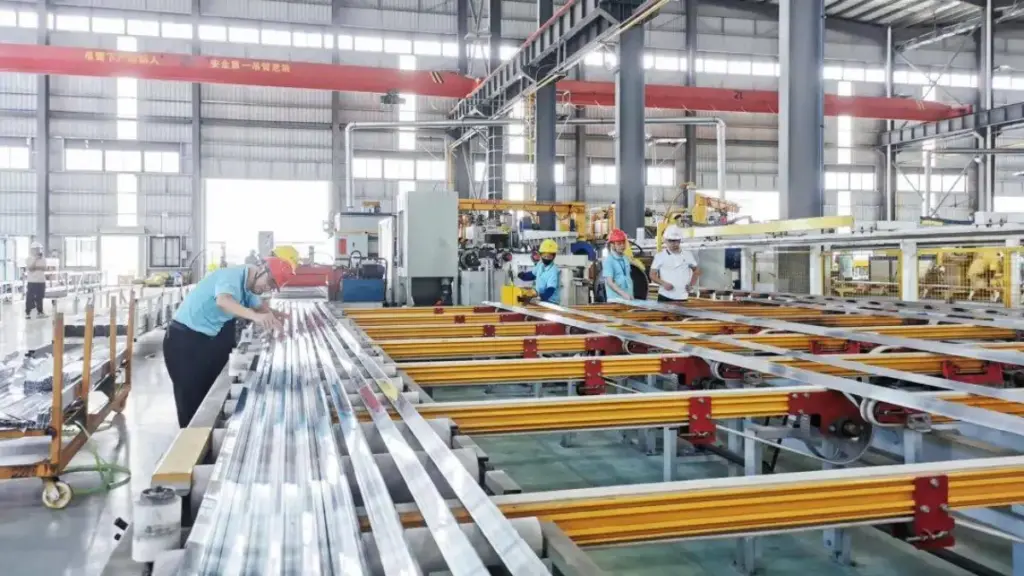
Release the balance against an inspection report measured on the approved drawing, not against a date on a calendar.
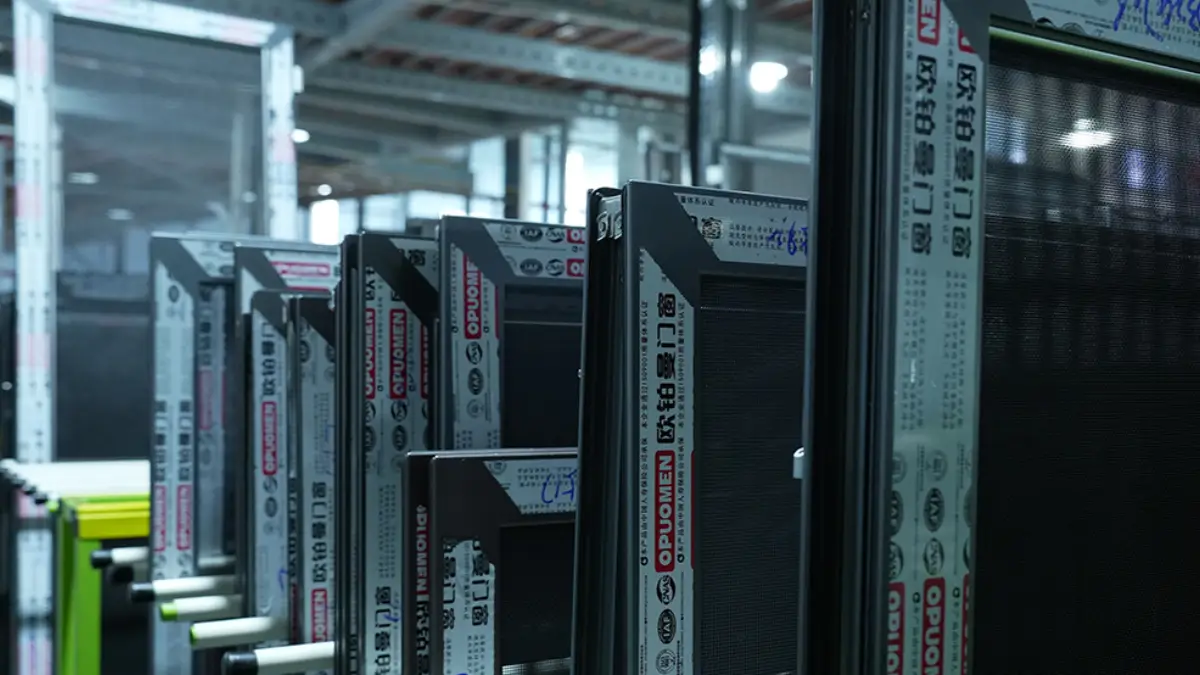
OPUOMEN publishes the sequence your units move through: design and drawing, material preparation, profile processing, 유리 처리, 집회, 품질 관리. That sequence is a counter-timeline: it says what evidence exists at each point. After profile processing the frame dimensions are fixed. Assembly and quality control are the last moments when a mistake is still the factory’s problem.
Evidence to Ask For by Stage
- Cut lengths and punched hole positions, photographed beside the approved drawing.
- Glass build read off the spacer bar, with the coating side confirmed.
- Hardware fitted on the correct hand, with the leaf operated on camera.
- Test evidence for any air, water or wind class the schedule sets.
- Final count against the schedule marks, with every label photographed.
Ask for it as one dated pack per shipment. A buyer who sees photographs mid-production can still change something. A buyer who sees them after the crates are closed is negotiating about damage already done.
The Lead Time Starts at a Signature
OPUOMEN states a typical lead time of 15 에게 25 days after drawing and sample confirmation. The clock runs from your approval, not from your payment, so freeze the schedule before you sign the drawing.
Clear Customs on the Right Entry
Classification is a buyer decision rather than a broker default, and on Chinese aluminum windows it sets four duty layers at once.
문, windows and their frames of aluminum classify under HTS (Harmonized Tariff Schedule) 7610.10.00, where the general rate is 5.7 percent ad valorem. Three further layers apply to Chinese origin, and chapter 99 writes each as an addition to the rate in the applicable subheading. That phrasing means they stack. When you import aluminum windows and doors from China, the classification you hand your broker sets the landed cost before the freight does.
| Layer | HTS heading | Rate as published |
|---|---|---|
| General rate | 7610.10.00 | 5.7% of entered value |
| Section 301 | 9903.88.15 | Applicable subheading plus 7.5% |
| Section 232 derivative aluminum | 9903.82.02 | Applicable subheading plus 50% |
| IEEPA (International Emergency Economic Powers Act) 층 | 9903.01.24 | Additional 10% on entries from 2025-11-10 |
| Total on entered value | Sum of the four lines | 73.2% at the rates published today |
Add the four figures, since each is a percentage of entered value. The current text is searchable at the USITC tariff lookup. 장 99 rates move, so check the line on the day your goods are entered.
Who Decides the Tariff Number
A broker classifies what you describe. Describe the same shipment as an aluminum structure and it lands in 7610.90.00. That line pairs with a 25 퍼센트 섹션 301 heading instead of the 7.5 percent heading that pairs with 7610.10.00. The difference is 17.5 points in one layer, created by a description, not by a product.
Send the classification you expect in writing, with the invoice wording you want on the entry summary, and have the broker confirm or correct it before the booking.
The Finished-Good Line in the Trade Case
The antidumping and countervailing duty orders on aluminum extrusions from China, 사례 A-570-967 및 C-570-968, date from 2011, and Commerce continued them after the 2022 sunset review. A window frame is an aluminum extrusion, so those orders reach your product category. What keeps a window out is the scope’s own exclusion language, worth reading in the notice itself.
The scope excludes finished merchandise containing aluminum extrusions as parts fully and permanently assembled and completed at the time of entry, and names finished windows with glass first. It also excludes goods entered unassembled in a finished goods kit, a packaged combination of parts holding everything needed to assemble the final good. The test is whether work remains: cutting or punching on site puts the shipment back inside the orders. A product is not a kit merely by including fasteners, so screws with a box of profiles do not earn the exclusion.
| How the shipment enters | Where it stands | Line in the scope that decides it |
|---|---|---|
| Assembled window, glazed at the factory | Outside the orders | Finished merchandise, assembled and completed at entry |
| Unassembled kit holding every part needed | Outside the orders | Finished goods kit, no further finishing or fabrication |
| Units that still need cutting or punching on site | Inside the orders | Cutting and punching are the fabrication steps named |
| Profiles plus a bag of screws | Inside the orders | Fasteners alone do not make a finished goods kit |
Ask your supplier in writing whether the shipment enters as assembled units or as kits, and put the answer in the same document as the price. Ask your broker, before booking, how a trade-case deposit would be assessed on your entry and who carries it.
The Document Set Your Broker Works From
- Commercial invoice stating the tariff number, the origin, and a description matching the classification you agreed.
- Packing list whose marks match the crate labels, so a count at the port is a count.
- Bill of lading naming the consignee who will file the entry.
- Certificate of origin for the shipment rather than a statement in an email.
- Test reports and product labels the destination market requires, matched to the series on the invoice.
Container choice, packing method and the certification sections for European markets are covered in OPUOMEN’s guide to global logistics for aluminum doors. Read it before you accept a packing proposal; the two documents must agree on how the units are crated.
Receive and Store Units on Site

Receiving is the one gate where you can still refuse a shipment, and the notes on the receipt decide who carries the damage.
The last gate of an order to import aluminum windows and doors from China is checked in the yard, not at the port. Count against the schedule marks rather than the invoice line total, because a line that reads twelve units can hold two marks. Open enough crates to see glass and hardware on every mark, and photograph the load before anything is carried.
Store the Way the Packing Was Designed
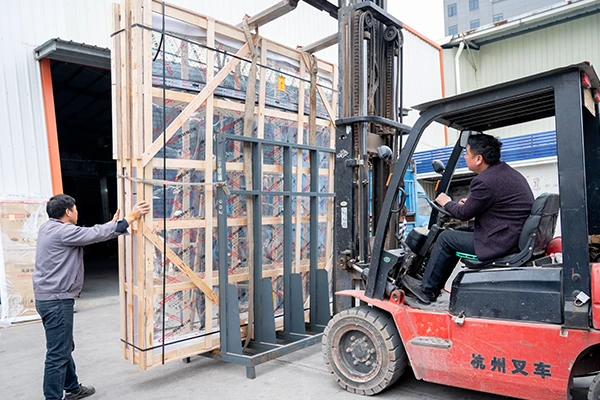
OPUOMEN’s logistics guide states the rule plainly: units travel and store upright with temporary cross-bracing, never laid flat. Frames need the full sill length supported so they do not bow, under ventilated covers and polyethylene film until installation. A yard that lays units flat for three weeks has undone that crate before the first fixing.
What to Write on the Delivery Receipt
- Mark numbers received and the count against each mark.
- Broken or shifted units named by mark rather than by crate number.
- Scratches and seal damage on the visible face of every unit checked.
- Whether the load was dry when the doors opened.
- The time the container was opened, which attaches a claim to the voyage rather than the factory.
Freight claims turn on what the receipt said at the moment of delivery, so the notes go on the paper while the driver waits. Damage recorded after the truck has gone is harder to attach to the leg that caused it. That is the difference between a credit note and a reorder you pay for.
자주 묻는 질문
How do I import aluminum windows and doors from China?
Work it as six gates. Write a schedule with one line per mark and fix the commercial terms in writing. Approve drawings and a sample, then inspect production against the approved drawing. Agree the classification with your broker before booking and inspect again on receipt. Each gate ends with a document you hold.
What is the tariff rate for imported aluminum doors and windows?
문, windows and their frames of aluminum classify under HTS 7610.10.00 에 5.7% general rate. For Chinese origin, chapter 99 추가하다 7.5% under heading 9903.88.15, 50% 아래에 9903.82.02 for derivative aluminum articles, 그리고 10% 아래에 9903.01.24. That totals 73.2% of entered value at the published rates.
Are Chinese aluminum windows subject to anti-dumping duty?
Only if the shipment falls inside the extrusion orders A-570-967 and C-570-968. Assembled, glazed windows are excluded as finished merchandise, and unassembled kits are excluded when they need no further cutting or punching. Units that still require fabrication on site stay inside the orders, so settle the entry form with your broker before booking.
What counts as a finished goods kit at customs?
A packaged combination of parts holding everything needed to assemble the final good, with no further fabrication such as cutting or punching. The scope adds that fasteners with a box of extrusions do not by themselves make a shipment a kit, so the test is whether work remains.
Can windows and doors be custom-made to my drawings?
예. OPUOMEN quotes from a drawing or a size list and supports OEM (Original Equipment Manufacturer) and ODM (Original Design Manufacturer) 일하다. You confirm drawings, 그림 물감, glass and hardware at the design and sample stage. Published window minimums start at 2 제곱 미터.
What documents do I need to clear aluminum windows through customs?
A commercial invoice stating the tariff number and origin, a packing list whose marks match the crate labels, the bill of lading naming the consignee, and a certificate of origin. Add the test reports and labels your market requires, and send the classification to your broker before the booking.