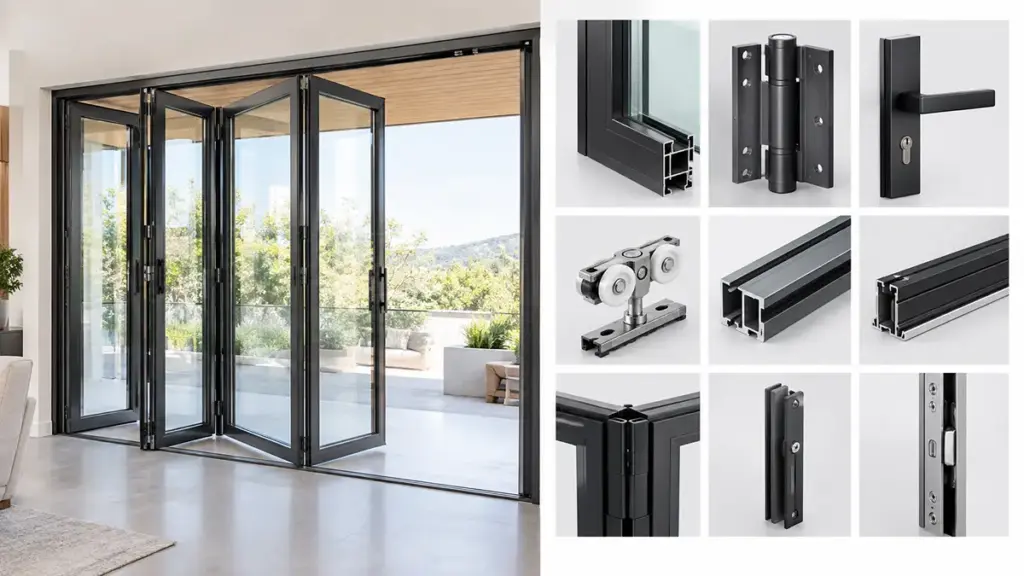
Aluminum and steel windows each offer distinct advantages depending on your project’s goals. This guide compares these materials across key factors like strength, thermal performance, installation requirements, and cost. Steel’s superior strength and energy efficiency contrast with aluminum’s affordability and ease of installation, helping you make an informed decision that suits both your design needs and budget. By the end, you’ll be equipped to choose the material that best aligns with your project’s vision and long-term goals.
What Are Steel Windows Known For?

Steel windows are known for their exceptional strength and slender profiles, offering superior rigidity, security, and design flexibility. Made from low-carbon structural steels (e.g., ASTM A36/A528), they allow for large openings with minimal deflection under wind loads. Steel windows typically feature narrow sightlines, providing a sleek, modern look while maintaining structural integrity.
These windows excel in security, tested to ASTM F588 standards for forced-entry resistance, with systems like W40 showing vertical load capacities of at least 600 N. They also meet advanced performance standards for thermal, acoustic, and fire resistance. Thermally broken systems achieve low U-factors (0.8 W/m²·K), while acoustic ratings can reach Rw up to 44 dB. Fire-rated versions comply with ASTM E152 and NFPA 80 for safety.
Durability is ensured with hot-dip galvanizing and polyester powder coating, providing long-lasting protection against corrosion and environmental wear.
How Do Aluminum Windows Compare in Cost and Performance?

Lower Initial Investment and Lifecycle Savings
Aluminum windows typically have a lower upfront cost compared to steel, due to simpler fabrication processes like mechanical crimping rather than the intensive welding required for steel. Aluminum offers a more budget-friendly option for high-performance projects that don’t require the extreme strength of steel.
Despite being positioned as a premium option compared to uPVC or wood, aluminum is still more cost-effective for most projects, with minimal maintenance costs over its 40–60 year service life. The reduced need for upkeep contributes to lower lifecycle costs.
Strong Thermal Efficiency and Structural Integrity
In terms of thermal performance, aluminum windows generally achieve U-values between 0.8–2.0 W/m²·K, offering solid energy efficiency, particularly for high-end designs. While aluminum alloys are strong (up to 690 MPa), steel’s superior material strength allows it to support ultra-slim sightlines and larger spans.
However, aluminum frames may require slightly thicker profiles to match steel’s structural performance, especially for larger glass panels. Steel excels in durability but requires more maintenance due to corrosion risks.
Which Offers Better Strength and Sightlines?
When it comes to strength and sightlines, steel windows outshine aluminum with their superior load-bearing capacity and ability to support slimmer profiles.
Steel’s Inherent Strength Advantage
Steel is approximately 3 times stronger than aluminum in window applications, providing significantly higher load capacity and structural integrity.
With the highest strength-to-weight ratio among common frame materials, steel maintains strength with minimal material.
While aluminum alloys have tensile strengths up to ≈690 MPa, steel’s overall structural performance excels at larger scales and for demanding applications.
Achieving Ultra-Narrow Sightlines and Large Panels
In contrast, aluminum, even with high-strength alloys, typically requires thicker profiles and additional reinforcements to achieve similar spans and stiffness, resulting in bulkier sightlines.
Due to steel’s superior strength, it can achieve much narrower sightlines—often the “slimmest” available in the industry—while still supporting large glass panels.
The 3x strength advantage enables steel frames to create lean profiles, maximizing visible glass and reducing the frame-to-glass ratio, which can also improve thermal efficiency.
Premium Aluminum Windows, Engineered for Global Success
How Do Aluminum and Steel Compare in Thermal Performance?

- Aluminum is significantly more thermally conductive (≈205 W/m·K) compared to steel (≈45–60 W/m·K), meaning raw aluminum is a poor insulator and transfers heat more efficiently.
- Steel’s lower thermal conductivity makes it a better choice for minimizing heat transfer, providing better insulation.
Aluminum windows offer strong thermal performance through the use of thermally broken systems, typically achieving U-values around 2.1 W/m²·K with double glazing. While slightly bulkier compared to steel, these systems maintain good insulation properties, though they may require additional reinforcement to meet certain energy efficiency standards. Manufacturers like Opumen provide advanced aluminum window solutions with thermal break technology, ensuring improved energy efficiency and enhanced insulation for high-performance projects.
On the other hand, steel, with its lower thermal conductivity, is naturally a better insulator. Modern thermally broken steel systems achieve U-factors as low as 0.57–0.8 W/m²·K, offering superior energy efficiency. The narrower profiles of steel frames allow for a higher glass-to-frame ratio, which enhances overall thermal performance by minimizing the frame’s impact on heat transfer.
What Are the Installation and Weight Differences?
Aluminum windows are significantly lighter than steel, making them easier to handle and simplifying on-site assembly. Their low density reduces labor intensity, potentially lowering installation costs compared to heavier materials like steel. The lightweight nature of aluminum allows for quicker, less expensive installation processes.
In contrast, steel windows are much heavier and require professional installation due to their weight and density. Steel’s robust construction provides superior strength, enabling large unsupported panes, but it also adds substantial dead load to the building. This requires precise fitting and sealing by skilled professionals to prevent distortion and ensure proper alignment.
Architects must also consider the increased weight of steel when calculating wind loads and ensuring seismic compliance, as it impacts the overall structural design of the building. Despite aluminum’s high tensile strength, steel remains the heavier option, influencing both installation and structural considerations.
Why Is Steel More Expensive Than Aluminum?
Steel windows are more expensive due to higher raw material costs, more complex manufacturing processes, and the need for anti-corrosion treatments. Steel’s inherent strength requires labor-intensive welded construction, unlike aluminum, which uses simpler crimping and slotting methods. Additionally, steel frames often require galvanization or stainless steel variants to prevent rust, adding to production costs.
Steel’s superior strength allows for thinner, more refined frames, making it ideal for high-end architectural designs. This ability to support larger, slimmer panes justifies the higher price, especially for luxury and commercial applications. A standard steel casement window can cost 4–10 times more than an aluminum counterpart, with installation costs ranging from £1,800 to £2,400 per meter.
With steel’s high cost, aluminum windows offer a more affordable alternative without compromising on strength or aesthetics. Manufacturers like Opuomen provide high-performance aluminum windows with advanced thermal break technology, making them an excellent choice for projects seeking durability, energy efficiency, and cost-effectiveness.
When Should You Choose Aluminum or Steel?
Choosing between aluminum and steel windows depends on a variety of factors, including budget, performance requirements, and design preferences. Below is a comparison to help you decide which material best suits your project.
| Feature | Steel Window Systems | Aluminum Window Systems |
|---|---|---|
| Strength & Max. Spans | Yield strength 235–275 MPa. Spans up to 3.2m H × 1.3m W without transom. Approx. 3x stronger than aluminum. Ideal for largest panels. | Tensile strength up to ≈690 MPa (alloys). Excellent for large commercial, but not absolute maximum spans of steel. |
| Typical Sightlines | Solid steel: ≈30 mm profile depth (welded). Frame sightline 53 mm; fixed light 36 mm; glazing bar 19–23 mm. | Frame sightline 58 mm; fixed light 33 mm; glazing bar 20–25 mm. |
| Thermal Performance (Uw-values) | High-end TB: ≈0.57 W/m²K (triple) to 1.2 W/m²K (double). Other solid: 1.7–2.9 W/m²K. Folded sheet: 1.3 W/m²K (triple) to 1.6 W/m²K (double). | Modern TB: ≈0.8–2.0 W/m²K. Advanced with aerogel: ≈0.6 W/m²K. Non-TB: 4.0–6.0 W/m²K. |
| Corrosion Resistance & Maintenance | Requires regular maintenance & protection (galvanizing, paint). Prone to rust if unprotected, especially in coastal/industrial zones. | High inherent corrosion resistance due to protective Al₂O₃ film. Minimal maintenance required in most environments. |
| Service Life | 50+ years with proper coatings and maintenance. | 40–60 years with appropriate specification. |
| Cost Ratio (vs. Aluminum) | Typically 4–5x the cost of comparable aluminum configurations. | Significantly more cost-effective, typically 1/4 to 1/5 the cost of steel. |
| Weight & Handling | Density ~7.8 g/cm³. Heavier, more complex transport and installation logistics. | Density ~2.7 g/cm³. Significantly lighter, simplifying transport, site handling, and installation. |
Final Thoughts
Ultimately, the choice between aluminum and steel windows comes down to the unique demands of your project. Steel offers exceptional strength and design flexibility, making it ideal for high-end, minimalist, and large-scale projects. On the other hand, aluminum provides a cost-effective solution with excellent thermal performance and durability, making it perfect for most residential and commercial applications.
At Opuomen, we specialize in high-performance aluminum windows that combine sleek aesthetics with energy efficiency, ensuring your project meets both functional and design goals. Ready to explore the benefits of aluminum windows? Contact us today to find the perfect solution for your next project!
Frequently Asked Questions
Understanding the Fundamental Choice: Aluminum vs. Steel Inquiries
Clients often inquire about the balance between initial investment and long-term operational costs, including maintenance. Questions frequently arise concerning aesthetic outcomes, specifically related to frame sightlines (e.g., slim profiles for maximal glass area) and design flexibility. A key area of inquiry is the suitability of each material for various architectural styles and project scales, from residential to large commercial applications.
Performance Metrics and Project Suitability Questions
Common questions revolve around structural integrity and durability, such as steel’s superior tensile strength (3x stronger than pure aluminum) for demanding applications. Thermal performance and energy efficiency are critical, leading to questions about U-values (thermally broken aluminum: 0.6-2.0 W/(m²K); steel: 1.5-2.5 W/(m²K)) and condensation prevention. Inquiries about lifespan and maintenance expectations are frequent, considering aluminum’s 40-60 year lifespan (minimal maintenance) versus steel’s 50+ years (requiring corrosion protection). Security compliance (e.g., PAS24 standards) and environmental adaptation (e.g., cold temperature performance of aluminum, corrosion resistance in humid areas) also form significant client questions.
Is aluminum easier to maintain than steel in coastal environments?
Yes. For coastal projects, powder-coated or anodized aluminum window frames are materially easier to maintain than carbon-steel windows, which require periodic rust-prevention, repainting, and coating inspection in marine exposure. Aluminum’s natural oxide layer plus factory powder coating typically limits maintenance to rinsing and light cleaning, whereas steel frames in salt air must be checked regularly for coating breakdown and corrosion, and recoated on a defined cycle. Aluminum coastal window frames typically have a 40–60‑year service life with minimal maintenance vs. steel requiring regular, proactive maintenance and protective treatments to achieve 50+ years in salt‑air environments.
What are the limitations on steel window customization compared to aluminum?
Steel windows enable greater customization for intricate shapes, larger panes, and slimmer profiles (e.g., 30mm profiles supporting panes up to 3.2m high by 1.3m wide without transoms) due to inherent strength. Aluminum is limited by thicker profiles, lower strength requiring additional supports, and less suitability for oversized or complex designs compared to solid steel profiles.
How does the thickness of the thermal break compare in high-end steel windows?
High-end thermally broken steel window systems typically use a polyamide or polyurethane thermal barrier around 3–5 mm (approximately 1/8″) thick. Some premium narrow-profile systems specify a thermal bridge thickness of exactly 1/8″ (3.2 mm) to maintain very slim sightlines (as low as 1‑5/16″ / 32 mm) while meeting energy code targets like IECC/ASHRAE 90.1.
Which system is better for integrating complex curtain wall designs?
The stick system is better for integrating complex curtain wall designs due to its superior on-site flexibility for custom shapes and modifications. This makes it ideal for high-end architectural projects despite generally having longer installation times compared to unitized systems.