Überspringen Sie zu Inhalten

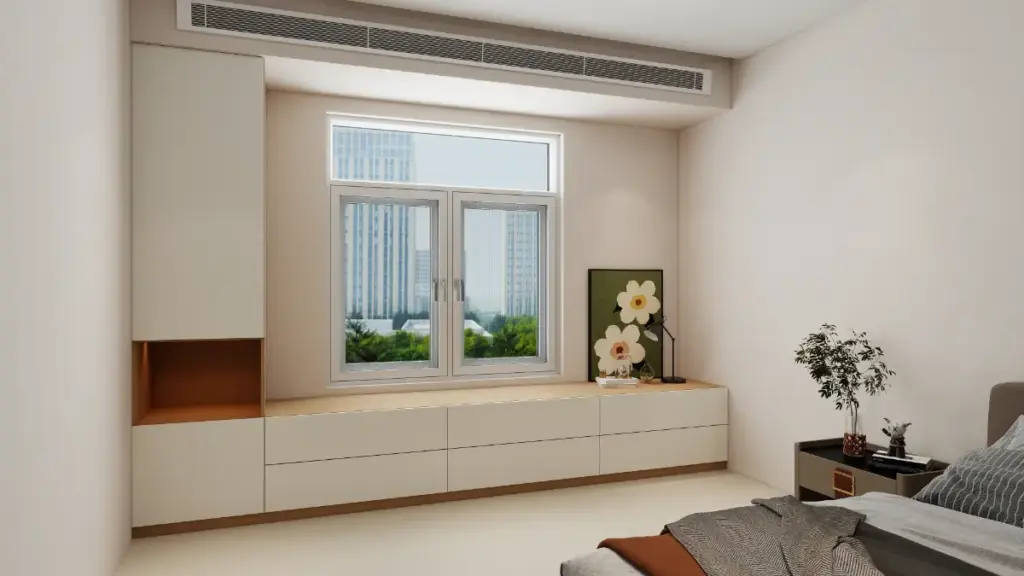
Hotel soundproof windows affect guest comfort, room quality and the overall hotel experience. While window specifications often include acoustic ratings, actual sound insulation also depends on glass configuration, window frame design, sealing and installation quality.
For hotel projects, buyers need to understand how acoustic ratings are measured and which glazing configurations suit different noise conditions. The article explains key acoustic ratings, glazing configurations and testing standards that project teams can review when evaluating aluminum windows for hotel buildings.
Set Acoustic Targets for the Room, Not Just the Window
The published rules for a noisy site measure the room, not the window.
A guest complaint arrives as a room condition, and the code answers the same way. Abschnitt 1207.11.2 of the 2008 City of Los Angeles Building Code limits interior noise from exterior sources to 45 dB in any habitable room.
The same clause names the metric: the day-night average sound level or the community noise equivalent level, and the day-night one is preferred. Its definition adds a 10 dB adjustment to hours between 10 p.m. Und 7 a.m., and the community metric adds 5 dB more for evening hours.
Those penalties explain why hotel soundproof windows are specified against a night figure. The same traffic at 2 p.m. und bei 11 p.m. does not count the same way.
The room has a second published number, the one a guest sleeps inside. Construction Canada reports guest rooms typically exhibiting ambient background levels of around 28 Zu 32 dBA. A quiet library sits at 30 dBA, and normal conversation runs 50 Zu 60 dBA.
A room whose floor is 30 dBA has little headroom before a 50 Zu 60 dBA conversation becomes the loudest thing in it. Where that conversation arrives is a door or a partition, and the code sets separate numbers for both.
Which Acoustic Rating Should Your Specification Use?

Four numbers describe one window, and only one of them is measured in a building.
STC is not a measurement of loudness. Der Acoustical Society of America defines sound transmission class as a single-number rating of airborne sound insulation, derived by fitting a reference curve to measured transmission loss values.
The frequency range is fixed by that definition. The values come from 16 contiguous one-third octave bands, with nominal midband frequencies of 125 Hz bis 4000 Hz inclusive. They are measured under ASTM E90 and turned into one number by ASTM E413.
The cited Los Angeles code uses STC requirements for specified interior assemblies, including walls, floor-ceiling assemblies and doors. This does not mean windows cannot receive an STC rating. It means the listed code requirements do not provide a specific window STC target for exterior noise.
A laboratory specimen is not your building. ASA names the field version apparent sound transmission class, or ASTC. It uses the same rating method on values measured under ASTM E336, and warns that field work is often subject to flanking transmission.
Where STC Falls Short for Exterior Noise
The Los Angeles code carries a caveat that belongs in every glazing review: STC ratings do not adequately characterize sound insulation when the intruding noise is predominantly low-pitched. It names amplified music and large mechanical equipment.
Unser Leitfaden zu acoustic glazing and frame design covers the physics of that gap.
Understanding the C and Ctr Corrections in Rw Ratings
The Chinese national standard handles the spectrum problem inside the rating. Clause 5.3.3 of GB/T 31433-2015 grades the airborne sound insulation of curtain walls and exterior windows using Rw+Ctr, the weighted sound reduction index with a spectrum adaptation term for traffic noise.
The same clause grades interior doors and windows on Rw+C, a pink-noise adaptation instead. One laboratory index, two adaptations. Bare Rw on a street-facing guest room has not answered your question.
What Affects a Window’s Sound Insulation Performance
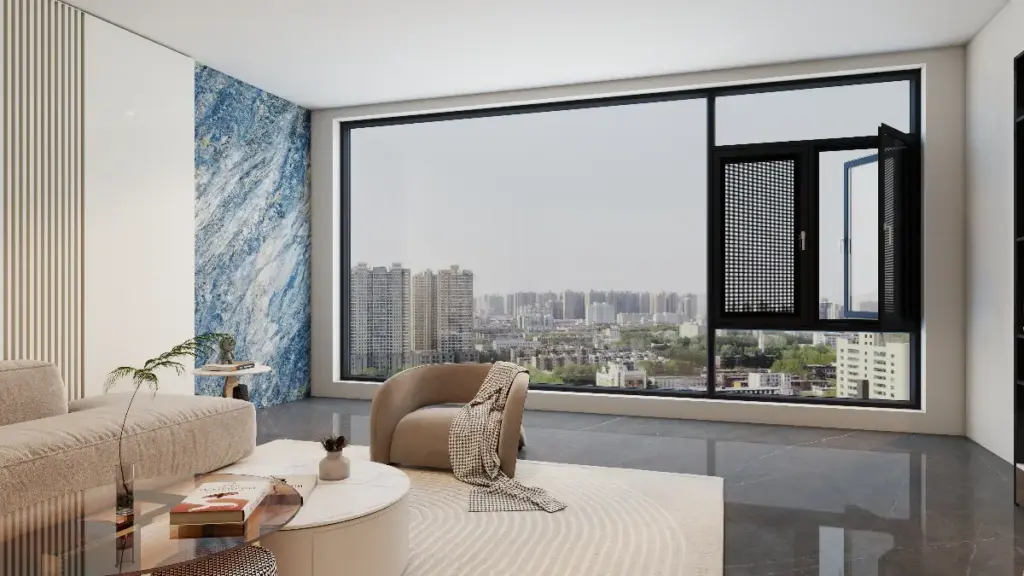
Air movement comes first, glass make-up second, and cost with both.
The rating label body puts the first lever before the glass. The National Fenestration Rating Council states that the most significant step which can be taken to reduce sound transmission is to minimize air infiltration. It adds that care should be taken to install windows properly, to minimize infiltration between the wall and the window frame.
Its guidance ties acoustics to airtightness directly: tight, insulated windows are dramatically quieter than leaky ones. Beyond infiltration control and double glazing, NFRC lists further steps and states that they are often custom and may add to product cost.
Four Glazing Options for Better Sound Insulation
The first is cavity depth. The page lists wide air or gas gaps between glazings of 5/8-inch or greater instead of the 1/2-inch or less. The second is the fill: replacing air with argon or krypton.
The third is asymmetry, a 1/4-inch exterior lite with an inner lite of different thickness, often laminated with 1/8-inch or 3/16-inch glass. The fourth is triple glazing with varying glass thicknesses, some greater than 1/8-inch.
Read those four as a question list, not a shopping list. Each lever is a line a factory can confirm or decline on a drawing, with a cost consequence you can price before ordering hotel soundproof windows.
How OPUOMEN’s Glass Build-Up Compares
Der acoustic sliding window page publishes its glass as 5+12A+5 double-layer insulated tempered glass.
The 12A cavity measures 12 mm, slightly below the 1/2-inch reference point. It does not match NFRC’s suggested wider-gap configuration of 5/8 inch or more, but cavity width alone cannot establish the window’s acoustic performance.
Both lites are 5 mm, so the build-up is symmetric, while the published lever asks for an inner lite of different thickness. None of this says the unit performs badly. It says the published build-up matches neither the wider-cavity lever nor the asymmetric-lite lever, while the page carries an acoustic word.
That gap between a common specification and an acoustic label is the finding a buyer can act on with any supplier. Ask which of the four levers the quoted build-up uses, in one sentence, before you order.
Matching Room Types to Noise and Targets
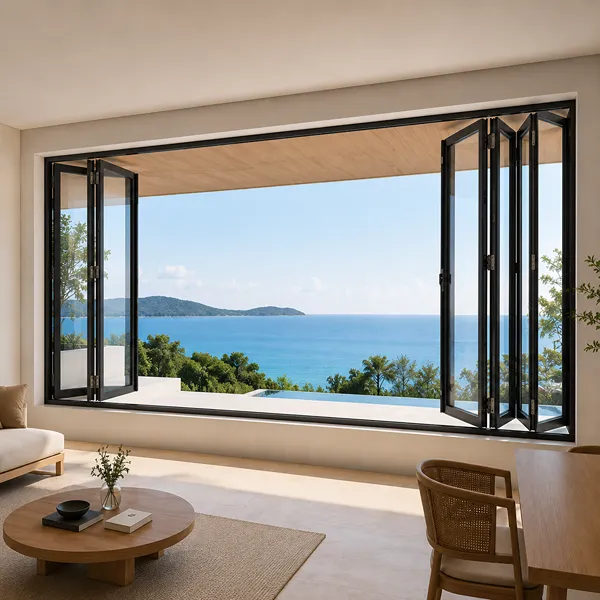
Each hotel area has a different published number, and none is a window rating.
The table maps hotel areas to the figures published for them. Each row names its source, and nothing in it is a recommended STC for a product.
| Hotel area | Noise the source names | Published figure | Method named |
|---|---|---|---|
| Street-facing guest room | Highways, city streets, railroads, rapid transit | 45 dB interior limit, habitable room | ASTM E1014 and E966 |
| Airport-adjacent guest room | Airport noise (1207.11.3) and other sources (1207.11.4) | Analysis required above 60 dB site level | Acoustical analysis by an experienced person |
| Guest room background | The level the guest sleeps inside | 28 Zu 32 dBA ambient | Measured room level, not a rating |
| Room-to-room partition | Speech and small household appliance noise | STC 50 laboratory, NIC 45 field | ASTM E90 with E413, or E336 |
| Corridor entrance door | Speech from corridors and adjacent guest rooms | STC 26 minimum with perimeter seal | Laboratory rating of the assembly |
| Plant and mechanical noise | Predominantly low-pitched intrusion | STC stated inadequate for it | Code names no replacement metric |
The STC 50 and NIC 45 pair governs separating assemblies between rooms, a discussion our acoustic door assemblies guide owns. Der 45 dB figure governs the whole room against everything outside it, which is where hotel soundproof windows actually live.
How Window Operation Affects Sound Insulation and Cost
Whether the window opens is a design decision, and the clause that permits it has a price attached. The acoustical analysis requirement adds a condition where the allowable interior level is met by requiring windows to be unopenable or closed. In that case the design must also specify a ventilation or air-conditioning system. It adds that the system must not compromise the room’s noise reduction.
Read those two sentences as one requirement. A fixed acoustic window can satisfy the level and then hand the room back to the air-conditioning system beside it, so the quiet path runs through the mechanical schedule.
Details That Affect the Tested Window Performance
Every failure mode named in the published rules sits outside the glass.
A rated assembly is a laboratory object, and the code expects the installed one to differ. Abschnitt 1207.13 allows field testing where inspection shows construction not in accordance with the approved design, or noise reduction compromised by sound leaks or flanking paths.
On a sliding unit the weak point has a shape. The sash has to travel along its track, so our soundproof sliding window guide describes overlapping sashes and brush seals, and the micro-gaps that follow for sound-carrying air. Der sliding window category lists the series built on that geometry.
Mass the frame has to carry
We read those levers as weight and depth on the frame. The published profile data for our acoustic slider is 6063-T5 aluminum with a 2.0 mm wall thickness and a 126 mm wall width.
That is the frame the make-up sits inside. Ask for the hardware line and sash weight alongside the glass build-up, not after it.
Where the infiltration argument lands
NFRC highlights the importance of the wall-to-frame joint in window installation. Unlike the sash, which is assembled in the factory, this joint is sealed on site as part of the rough-opening installation.
The specification should identify the sealing material, the contractor responsible for the work and the inspection procedure. Even a well-sealed sash can lose acoustic performance if the frame-to-wall joint is poorly installed.
Tell us the site level, the metric and the room layout, and we will match glass, Profile, hardware and opening systems to them. That is the service we publish as Performance Matching, and it is where an acoustic enquiry should start. Any figure we cannot support with a test report gets a written note, not a level.
Seitdem direkter Hersteller 2013 | 60,000 m² Pflanze | 200+ professionelles Personal
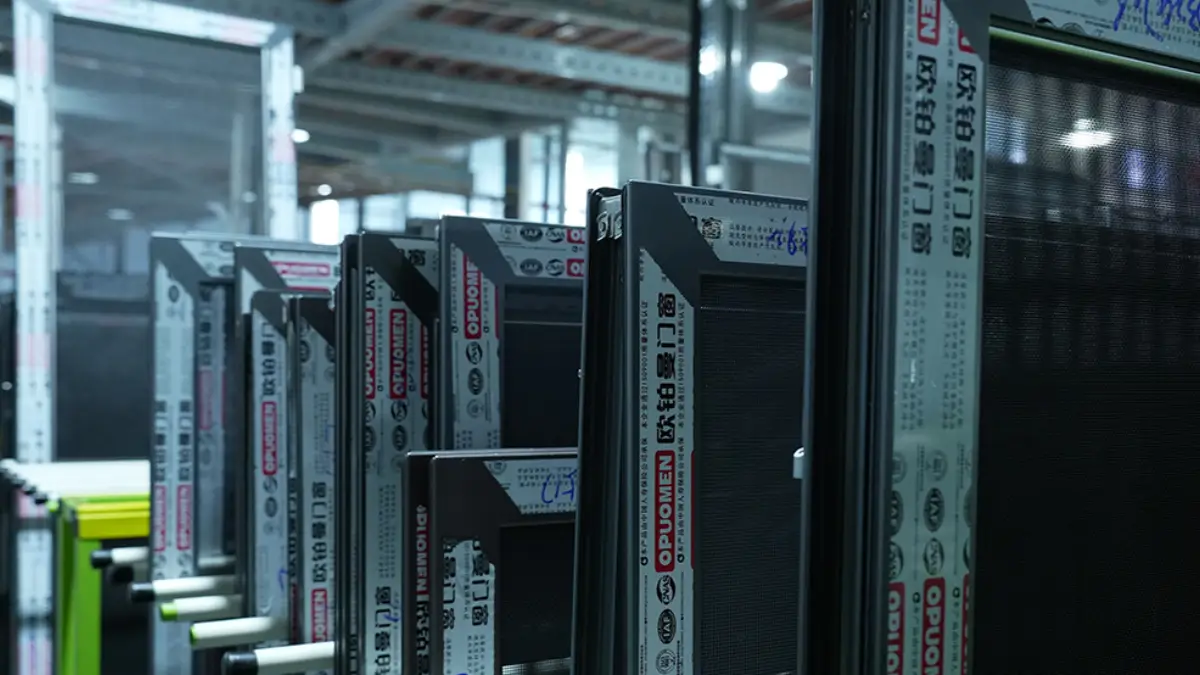
Understanding China’s Window Sound-Insulation Ratings
A level number is a grade reference, and the grade table is public.
Three of our own product pages carry a sound-insulation level in their feature list: an acoustic slider, a floor-to-ceiling casement, and a fixed double-glass casement. The slider page reads Good sound insulation effect at level 4, and the other two read Good sound insulation at level 4. None of the three publishes an STC, Rw, dB or decibel figure, and we claim no band for them here.
Numbered levels for window sound insulation have one published ladder: GB/T 31433-2015. It is a recommended national standard, administered by the technical committee for building curtain wall and door and window standardization. Here is its grade table.
| Grad | Exterior windows and doors | Curtain wall | Interior windows and doors |
|---|---|---|---|
| 1 | 20 to under 25 Rw+Ctr | 25 to under 30 Rw+Ctr | 20 to under 25 Rw+C |
| 2 | 25 to under 30 Rw+Ctr | 30 to under 35 Rw+Ctr | 25 to under 30 Rw+C |
| 3 | 30 to under 35 Rw+Ctr | 35 to under 40 Rw+Ctr | 30 to under 35 Rw+C |
| 4 | 35 to under 40 Rw+Ctr | 40 to under 45 Rw+Ctr | 35 to under 40 Rw+C |
| 5 | 40 to under 45 Rw+Ctr | 45 or more Rw+Ctr | 40 to under 45 Rw+C |
| 6 | 45 or more Rw+Ctr | Not defined | 45 or more Rw+C |
All three columns are in decibels, taken from Table 18 of GB/T 31433-2015. The exterior column is what a level claim on a window page should resolve to: Ebene 4 means Rw+Ctr at or above 35 dB and below 40 dB.
The same level means two different bands
Grad 4 Ist 35 Zu 40 dB for an exterior window and 40 Zu 45 dB for a curtain wall, five decibels apart on the same word. The curtain wall column stops at grade 5, so a level 6 claim on a curtain wall product has no band to point at.
The third column carries the same bands as the exterior column but a different adaptation term, since interior units are graded against pink noise. A grade quoted without its column cannot be checked.
Four questions a level claim should answer
Erste, which product class the level was assigned under, since the columns differ. Zweite, whether the figure behind it is Rw or Rw+Ctr, because the standard grades on the corrected value. Dritte, which test method produced the result. GB/T 31433-2015 provides the grading framework, while GB/T 8485 specifies the test method for airborne sound insulation of building windows and doors.
Vierte, whether the product is in scope at all. Clause 1 covers curtain wall and doors and windows for civil buildings, and excludes fire and escape windows, smoke-vent windows and radiation-shielded units. A level claim on those points at a product the table does not grade.
These questions apply to us as squarely as to any other supplier of hotel soundproof windows.
Verifying Acoustic Performance Before Handover
The published process puts proof before the permit and after the install, nicht auf dem Karton.
Before construction, the route is a study rather than a product choice. Sections 1207.11.3 Und 1207.11.4 require an acoustical analysis where the annual site level exceeds 60 dB, showing the design achieves the allowable interior level. Abschnitt 1207.11.2 sets the basis as worst-case existing or future levels, with future levels predicted at least 10 years out.
Evidence of compliance is submitted with the permit application, prepared under the supervision of a person experienced in acoustical engineering. No window supplier produces that document, and your glazing specification should trace back to it.
During construction, field testing is the check, and the methods are named. Outdoor sound levels follow ASTM E1014, and field measurement of airborne sound insulation from exterior sources follows ASTM E966. Read the normalization rule before you read a report.
Sound level differences measured in unoccupied units are normalized to a receiving-room reverberation time of one-half second, and values from occupied units are not normalized. An empty-room figure and a live-room figure are not two readings of one thing.
After handover, the code has a cost rule for disputes. Where a complaint requires a field test, the complainant posts a bond or funds in escrow for the testing cost, charged to them if the building proves compliant. A hotel operator living with a noise claim should know which side of that sentence it stands on.
Using Sound Masking to Improve Perceived Privacy
There is a published fix that never touches the window. Construction Canada describes an unmasked guest room sitting just below 30 dBA, with volume spikes of nearly 15 dBA from a conversation in the corridor. Set to 44 dBA, commercial masking cut those variations sharply.
The mechanism is arithmetic: masking raises the baseline, so the gap between it and any peak gets smaller. The same feature describes a room at 21 dBA unmasked and 45 dBA masked to the standard National Research Council masking spectrum.
That is no substitute for a quiet envelope, and no way to hide one. It belongs in the same conversation as hotel soundproof windows on a standing building.
Six lines for the specification
Write the requirement as a room, then make every figure on hotel soundproof windows answer to it. These six lines are the ones the published sources support.
- The interior level the room must hold, with the metric and night penalty named.
- The measured or predicted site level, who took it, and whether worst-case was used.
- Every number on the sheet stated as test standard plus rating standard.
- The adaptation term on every Rw: traffic for a street-facing room, pink noise for an interior one.
- The rough-opening closure detail, its material, and the party that signs it off.
- The field test trigger and its normalization rule, agreed before handover.
Häufig gestellte Fragen
What is an STC rating on a window?
A contour fit, not a loudness reading. STC is derived by fitting a reference curve to transmission loss values measured under ASTM E90. Those values cover 16 one-third octave bands from 125 Hz bis 4000 Hz, and ASTM E413 calculates the rating. It is a laboratory rating for speech-range sound.
What STC rating do hotel guest rooms need?
The cited code sets no window STC for a guest room. The Los Angeles building code instead limits interior noise from exterior sources to 45 dB in any habitable room, measured as the day-night level. Work backwards from that figure and let the analysis choose the glazing.
Is a higher STC always better for a hotel window?
NEIN. The Los Angeles code states that STC ratings do not adequately characterize assemblies when intruding noise is predominantly low-pitched, as from amplified music or large mechanical equipment. A leaky frame-to-wall joint sits ahead of the rating, since infiltration control is NFRC’s most significant step.
How do I read a Chinese sound-insulation level claim?
Match the level to the right column of Table 18 in GB/T 31433-2015. For an exterior window, grade 4 is Rw+Ctr 35 to under 40 dB. A curtain wall grade 4 Ist 40 Zu 45 dB, so ask which product class the grade was assigned under.
Should hotel acoustic windows open?
Decide that before you choose the glazing. The Los Angeles code states that if allowable interior levels are met by requiring windows to be unopenable or closed, the design must also specify ventilation or air conditioning. That system must not compromise the room’s noise reduction.
How do hotels make an existing room quieter?
Sometimes by raising the background rather than lowering the intrusion. Construction Canada reports a guest room sitting just below 30 dBA and showing spikes of nearly 15 dBA caused by a conversation in the corridor. Commercial masking set to 44 dBA significantly reduced those variations.