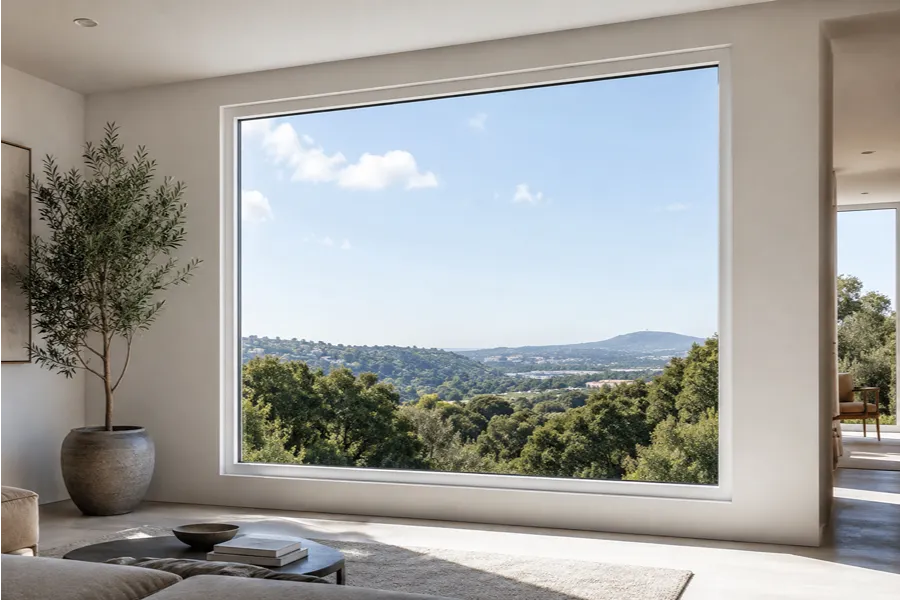
A picture window is one large fixed lite of glass in a frame that opens nowhere. Picture windows sell on a single promise: an unbroken view, with no meeting rail and no hardware in the middle of it.
The limit arrives fast. Sheet size, spessore del vetro, weight and wind load cap the largest lite you can ship and hang. Our published spec stops one fixed insulated unit at 40 piede quadrato (3.7 sq m) of glass and 225 libbre (102 kg).
This guide works outward from that line: the sizes that trade, what a large lite does to the price per square foot, and where an operable wins.
What a Picture Window Actually Is
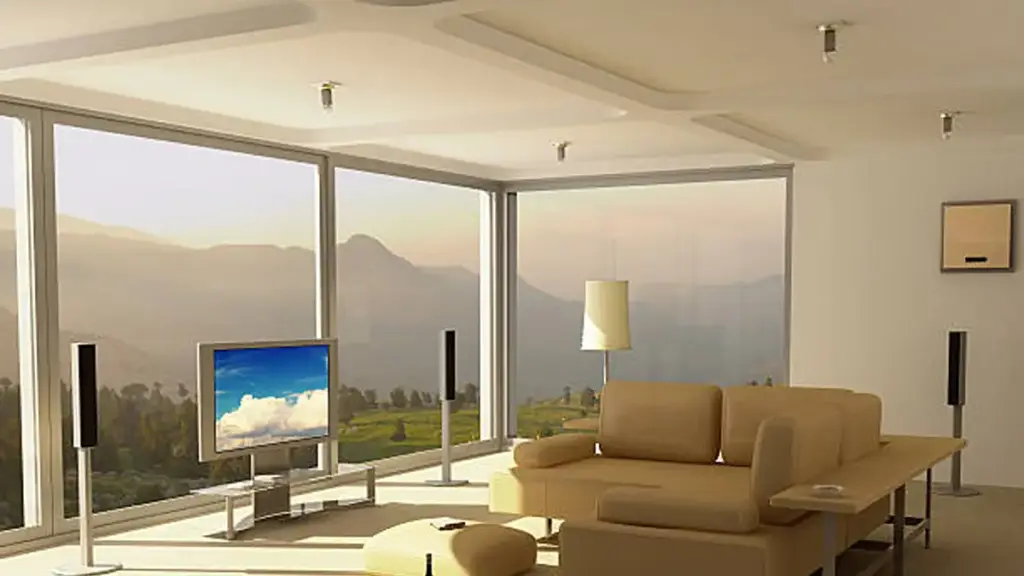
A picture window is a fixed window, and the name describes only its size and its job.
Technically, a picture window is a non-operating unit: an exterior frame, a sealed insulating glass unit (Per me) and glazing beads. There is no sash, hinge, operator, handle or weep path sized for an open leaf.
Trade language adds the label. UN 24 X 36 fixed unit over a bathroom sink is just a fixed window. UN 72 X 60 on a view wall is the same product, and the market calls it a picture window.
Three consequences come with a unit that has no moving part.
- No ventilation. The unit moves zero air, in either direction.
- No escape route. A bedroom cannot use a fixed lite as its emergency opening.
- No access to the outside face. What cannot be reached from inside needs a ladder or a lift.
In exchange the fixed lite gives you the sightline: one pane, one frame, no vertical member, no hardware shadow. On a view wall that is the whole product.
Picture vs Fixed vs Panoramic vs Bay Windows
Four words, three real differences: whether it opens, whether it projects, and how many panes sit in the wall.
Purchase orders use these four terms loosely, and the labels are not interchangeable. Sort them by what the wall has to do.
| Tipo | Opens? | Typical configuration | Used for |
|---|---|---|---|
| Fixed window | NO | Many shapes and sizes; can be combined with operable windows | Natural light, fixed glazing, minore manutenzione |
| Picture window | NO | Usually one large fixed glazed unit | Framing outdoor views, brightening living spaces |
| Panoramic window | Usually no, a seconda del sistema | One wide unit or a series of large glazed panels | Expansive views, villa elevations, floor-to-ceiling glazing |
| Bay window | Side windows may open | Usually three windows arranged at angles, projecting beyond the exterior wall | Creating an interior nook, adding depth, expanding views |
The bay is the outlier. It projects from the wall on angled units at 30° or 45°, adds floor area, and normally puts a fixed center lite between two operables. That center lite is a picture window in everything but frame angle. Our breakdown of the types of bay windows covers the geometry.
Panoramic is the name our factory line uses, and buyers mean the same thing when they ask for picture windows: the largest pane the wall will take. IL panoramic window series covers fixed lites, floor-to-ceiling panels and fixed-and-operable runs.
Standard Picture Window Sizes and Limits
Catalog widths run 24 A 96 In, E 6 piedi 8 in by 6 piedi 0 in is about the largest single lite our published caps allow.
How the Four-Digit Size Code Works
North American window sizes are written as four digits. The first two give width in feet and inches, and the last two give height the same way. COSÌ 6040 reads as 6 piedi 0 in wide by 4 piedi 0 in high.
| Codice | Imperial size | Millimeters | Glass area | Single fixed lite? |
|---|---|---|---|---|
| 3020 | 3 piedi 0 in by 2 piedi 0 In (36 X 24) | 914 X 610 | 6.0 piede quadrato | SÌ |
| 5030 | 5 piedi 0 in by 3 piedi 0 In (60 X 36) | 1,524 X 914 | 12.5 piede quadrato | SÌ |
| 6040 | 6 piedi 0 in by 4 piedi 0 In (72 X 48) | 1,829 X 1,219 | 24.0 piede quadrato | SÌ |
| 8060 | 8 piedi 0 in by 6 piedi 0 In (96 X 72) | 2,438 X 1,829 | 48.0 piede quadrato | NO, past our 40 sq ft cap |
Widths run 24 A 96 In, altezze 12 A 96 In. The volume sizes are 24 X 36, 36 X 36, 48 X 48, 60 X 48 E 72 X 60, and each stays inside our fixed-lite caps. UN 96 X 96 unit is 64 piede quadrato, so it arrives as a mullioned run.
Why 1200 mm Is Not 48 Inches
Metric-market factories quote bands of 1,200, 1,500, 1,800, 2,100 E 2,400 mm. These are not the inch nominals wearing a different label, and the gap is enough to ruin a rough opening.
- 1,200 mm = 47.2 In, not 48 In
- 1,500 mm = 59.1 In, not 60 In
- 1,800 mm = 70.9 In, not 72 In
- 2,100 mm = 82.7 In, not 84 In
Each step leaves close to an inch of unused opening. Draw and measure in one system, and check the unit dimension rather than the nominal.
What Really Caps a Single Lite
Four limits stack, and the first one to bind decides the span.
Sheet size. Standard float stock comes off the line at 96 X 130 In, Di 2,440 X 3,300 mm. Vitro’s guide to oversized glass lists full-size sheets at 100 X 144 in and oversized formats to 130 X 240 In. The sheet decides what can be cut, whatever the drawing says.
Peso. Glass weight is the limit buyers ignore. Float glass runs 2.5 kg per sq m for each mm of thickness, quindi un 5 mm lite is near 2.6 lb per sq ft. The published figures sit in the table below.
| Glass build | Weight per sq ft | Max lite area we publish |
|---|---|---|
| 5 + 5 mm double | 5.1 libbre | 40 piede quadrato |
| Three 5 mm lites | 7.8 libbre | 35 piede quadrato |
| 10 + 10 mm double | 10.2 libbre | On request |
Deflection and wind load. Nothing caps a lite by area alone. ASTM E1300 matches glass thickness to a design load. Published tables built from it size annealed 5.7 mm dual glass at 35 sq ft under a DP50 load, E 48 sq ft at DP40. Those tables answer breakage odds; shipping and hanging are a separate limit. Vitro recommends staying under ¾ in (19 mm) of center-of-glass deflection. Tempered glass breaks safer but bends just as far.
Our published unit limits. IL aluminum window frame specs guide carries those weights and areas. It also caps a finished unit near 240 libbre, with the glass itself under 225 lb and the frame at roughly 1 lb per sq ft. Both published caps sit inside that E1300 band, so weight binds before wind pressure does. Ask for the test report, not just a grade. A rating under AAMA/WDMA/CSA 101 covers only the sizes actually tested.
Take the example buyers send most: UN 2,400 X 1,800 mm pane. That is 46.5 piede quadrato, and at 5.1 lb per sq ft the glass alone weighs about 237 libbre (108 kg). The order breaks both caps at once. It becomes two lites behind a mullion, or one thicker lite with a lift plan. Either path costs more than the fixed-lite story suggests.
Frame Thermal Break and Mullion Options
At picture window sizes, stiffness and heat flow pick the frame. The series number is a shop label.
What the Series Names Really Mean
Chinese extruders sell aluminum as 60, 70 E 80 serie. The number is the frame face width in millimeters, quindi un 60 series shows about 60 mm on the wall. It is a factory label with no standing in a US standard and no word about load or insulation.
Spec the frame by three measured numbers instead: profondità del telaio, sightline width and wall thickness. Our line runs 50 A 75 mm deep, con 22 A 55 mm sightlines and 1.2 A 2.0 mm walls. UN 60 series at 1.2 mm suits a 3020 unit, e un 6040 lite wants an 80 series at 1.8 A 2.0 mm. Impact-rated profiles run 2.0 A 2.5 mm, the wall a US engineer expects on load-bearing exterior aluminum.
Finish is the fourth number worth writing down. Anodizing runs 8 A 15 μm and powder coating 60 A 100 μm. AMAMA 2603 is the basic coating grade, 2605 the coastal grade held to 10 years of South Florida weathering. Nome 2605 on a beachfront order.
Thermal Break at Large Glass Areas
Bare aluminum bridges the inside and outside of a wall. A thermal break inserts a polyamide strip, 12 A 34 mm in our profiles, between the two halves. Without it a large fixed frame runs cold and collects condensation on humid mornings.
Our thermally broken systems publish a whole-window Uw of 0.86 A 1.0, which reads as U-factor 0.15 A 0.17 on a US label. The wider catalog spans 0.8 A 2.0. As the pane grows, glass takes a larger share of the heat flow, so the glazing package decides energy performance more than the frame does.
Mullion or One Heavy Lite
UN 12 ft wall can be bought two ways: one 144 in pane, or three 48 in lites joined by mullions. Do the weight math first. Each 48 X 72 lite in 5 + 5 mm glass is 24 piede quadrato, Di 122 libbre (55 kg) of glass. Three ship flat on standard pallets and hang with two people. One 144 X 72 pane is 72 piede quadrato, roughly 367 libbre (167 kg), past both caps. It needs an oversized sheet, thicker glass and a mechanical lift.
Mullions put a vertical line across the view, so quote both before drawings issue. Where the sightline must stay clean, buyers keep one large fixed center panel and push the mullions beside the operables.
Picture Window Cost per Square Foot
A fixed lite costs less per square foot than an operable one, until the oversize surcharges arrive.
Why a Fixed Lite Costs Less
An operable unit carries a sash profile, hinges or a slider carriage, a multipoint lock, a handle, a stay and extra weatherstrip. A fixed unit drops all of it.
In our production, bulk catalog units run about $100 A $400 FOB per window, and custom frames $300 A $4,000 con 6 A 8 week leads. Both are China FOB numbers, not US installed prices.
Our published panoramic bands show the slope. UN 36 X 36 compact unit is 9 sq ft at $600 A $800, roughly $67 A $89 per piede quadrato. UN 72 X 60 panel is 30 sq ft at $1,300 A $2,000, O $43 A $67 per piede quadrato.
Where the Saving Disappears
The per-square-foot advantage erodes in a known order, and each line below is a separate quote item.
| Cost driver | What it changes | When it lands |
|---|---|---|
| Thicker glass | 8 mm o 10 mm lite, more weight | Past the stock span |
| Tempering or lamination | Second processing line, longer lead | Safety or impact duty |
| Heavier frame wall | 1.8 A 2.0 mm wall: our specs guide prices this at 20 A 30 percent more frame material | Wide spans, coastal wind |
| Rigging and crew | Suction lift, crane, extra labor | Past a two-person lift |
| Structural work | Larger header, engineered opening | Enlarge the wall |
One surcharge can erase a fixed-lite saving. Two or three, and a fixed unit quotes above the operable it replaced. That is why the claim that picture windows run 20 A 30 percent cheaper is a slogan, not a number. Same width and height, fixed against operable: fixed wins. Compare a 40 sq ft pane with a mullioned run and the answer flips.
Oversize picture windows change the risk profile too. Our warranty runs five years, and a broken 40 sq ft pane means a full unit replacement and a second trip to the opening.
Retail Numbers to Plan Against
On the US install market, EcoWatch picture window pricing puts typical installed cost at $350 A $850, with an average near $600. Its size table runs from about $550 per un 36 X 48 in unit to about $1,500 per un 96 X 96 in unit. Permits add $50 A $200 where one is pulled.
Run those endpoints per square foot: 12 sq ft at $550 is near $46, E 64 sq ft at $1,500 is near $23. The big pane is cheaper per square foot and three times the money.
Ventilazione, Cleaning and Heat Gain Tradeoffs
A picture window buys the view by giving up air, cleaning access and part of the solar budget.
The Ventilation Gap
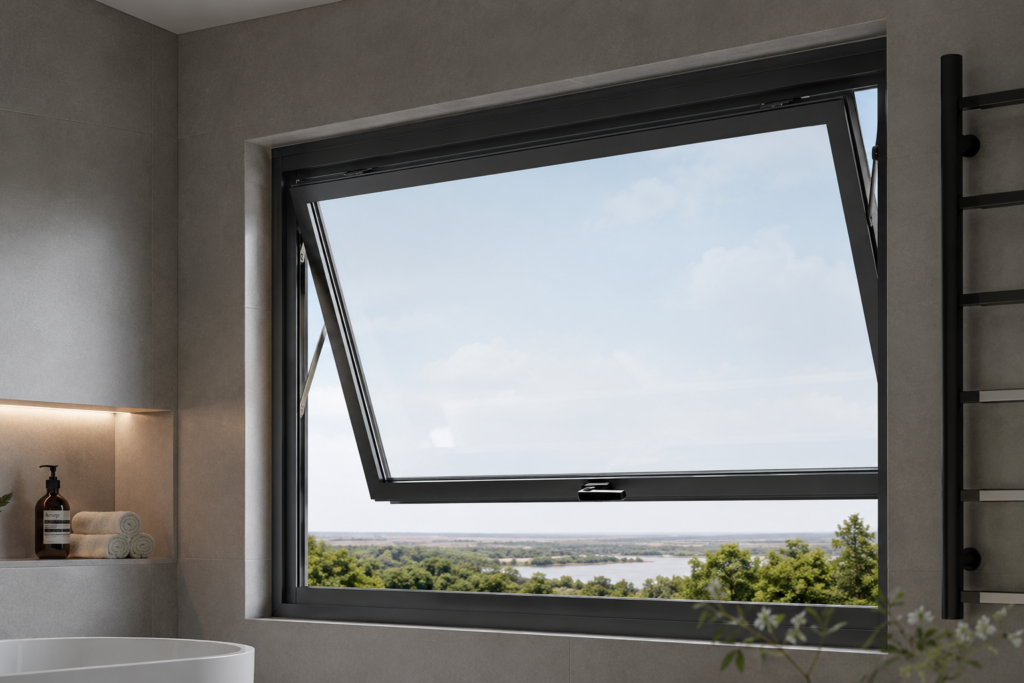
A fixed lite adds no air movement, so a single-exposure wall usually gets a flanking operable on each side of the picture center. Our awning sashes run 400 A 3,050 mm tall, and an operable sash is capped at 67 kg or 2.75 sq m.
Egress is the harder constraint. Under the IRC a bedroom escape opening needs 5.7 sq ft of net clear opening, almeno 24 in wide and 20 in high. The sill has to sit 44 in or lower. A fixed pane meets none of that, so the room needs a separate operable.
Who Cleans the Outside
Operable sashes let you wash the outboard face from inside; a fixed lite does not. Someone has to reach it from outside for the life of the building, and a second-floor lite over a two-height room means a lift or a crew every year.
On a multi-unit or HOA job, facade access is a specification item before the glass is ordered. A lite no one can reach gets swapped for a smaller operable at the first review.
Glare Fading and Solar Gain
A low-emissivity coating with argon fill slows heat loss, and the Uw range above is what those packages deliver. Solar gain is a separate coating problem, measured as SHGC.
A clear double IGU passes most of the sun that enters it; a solar-control coating cuts it, and that is the difference between a comfortable room and a collector. Our comparison of double vs triple pane windows covers where each package pays.
Here is how that reads in our two main markets. Sotto il 2021 CEICC, Texas Climate Zone 2 allows U-0.40 with SHGC at or below 0.25, and Zone 3 tightens the U-factor to 0.30. Confirm the county zone and code edition before submitting paperwork. California runs Title 24 Parte 6, whose 2025 standards cap fenestration at 40 percent of gross exterior wall area. Above that line the project needs the performance path and NFRC certified ratings.
Which Positions Need Safety Glass
The usual claim is that a large or high picture window must be tempered. The code tests neither alone: IRC R308.4.3 needs safety glazing when four conditions are true at once:
- The exposed area of one pane is larger than 9 piede quadrato.
- The bottom edge of the glazing sits less than 18 in above the floor.
- The top edge sits more than 36 in above the floor.
- A walking surface is within 36 in of the glazing, measured horizontally.
A picture window on a normal sill can stay annealed. Four positions change that. Two are about proximity: glass within 24 in of a door jamb, and glass beside a tub or shower. Two are about orientation: glass at floor level that reads as a doorway, and sloped glazing more than 15° off vertical. The last needs a laminated inner lite.
A low sill brings its own rule. IRC R312 requires a guard where a walking surface sits more than 30 in above the floor below. R312.2 adds fall protection where the clear opening starts under 24 in above the interior floor and more than 72 in above the surface beneath. Either one puts a barrier in front of the view.
Impact regions are a separate specification. Hurricane-rated assemblies are tested and labeled to a different standard. A rated fixed lite usually quotes below a rated operable of the same size, because there is no operating hardware to certify. See hurricane impact window ratings for the classes.
Where Picture Windows Earn Their Place

Specify one where the view is the product and the wall is not expected to do a second job.
Residential View Walls
The strongest case is a room whose job is the view: a great-room end wall, a stair landing, a hall return. The pane lights a space with no ventilation duty, and the builder sells the elevation on it.
High-end elevations in California and Texas put picture windows over the counter wall and above a fixed seat. West and south exposures need a solar-control coating rather than plain low-E, and a kitchen wall that also needs air keeps one operable in the run.
Commercial and Multi-Unit Work
On commercial jobs a fixed lite is the low-maintenance option: no hardware to service, no operator to fail, no weatherstrip to replace. Lobbies, clubhouse walls, restaurant fronts and model units are the usual fits.
MOQ is part of the case. Minimum order on our standard line is 2 sq m, which clears a single feature unit. The motorized panoramic series starts at 6 sq m, a floor that matters on mixed runs.
Specify Something Else When
- The room depends on one wall for air: put an awning or casement at the center.
- The pane must serve as a bedroom escape opening, which a fixed lite cannot do.
- Site access is poor, where a mullioned run ships and hangs without a crane.
- The wall faces west with no overhang, and high SHGC glass turns the room into a collector.
- The span needs more than about 35 sq ft at a DP50 design load, or more than our published 40 piede quadrato: split the run or go thicker.
Frequently Asked Questions About Picture Windows
What is the maximum size of a picture window?
About 40 piede quadrato (3.7 sq m) of glass per fixed insulated unit, and about 225 libbre (102 kg) of glass. Standard float sheets are 96 X 130 In, so a wider pane needs oversized stock in 8 O 10 mm. Past either cap, split the run behind a mullion.
Is a picture window more energy efficient than an operable window?
Usually, and the reason is hardware. A fixed unit has no sash seals to age and no opening path for air, and our published air leakage limit is 0.375 cfm a 25 mph. The glazing package then sets the result, so compare like against like.
Can a picture window be used in a bedroom?
Yes for light, no for escape. A bedroom emergency opening needs 5.7 sq ft of net clear opening, almeno 24 in wide and 20 in high. The sill has to sit 44 in or lower. A fixed pane cannot open, so the room needs a separate operable that meets those numbers.
How do you clean the outside of a picture window?
From outside the building, because there is no sash to open and reach through. Price the access method before the glass is ordered: ground-floor units are simple, and two-height lites need a lift or a crew on a recurring schedule.
Is a picture window cheaper than a casement of the same size?
At the same size, yes, because a fixed unit carries no sash profile, cerniere, lock or handle. Our bulk catalog units run $100 A $400 FOB per window. Past the stock span, vetro più spesso, tempering and rigging close the gap or reverse it.
Does a large picture window always need tempered glass?
NO. Size alone does not trigger the requirement. IRC R308.4.3 needs four positional conditions together, including a bottom edge under 18 in above the floor. Sloped glazing more than 15° off vertical is a separate rule, and impact regions add a tested assembly.