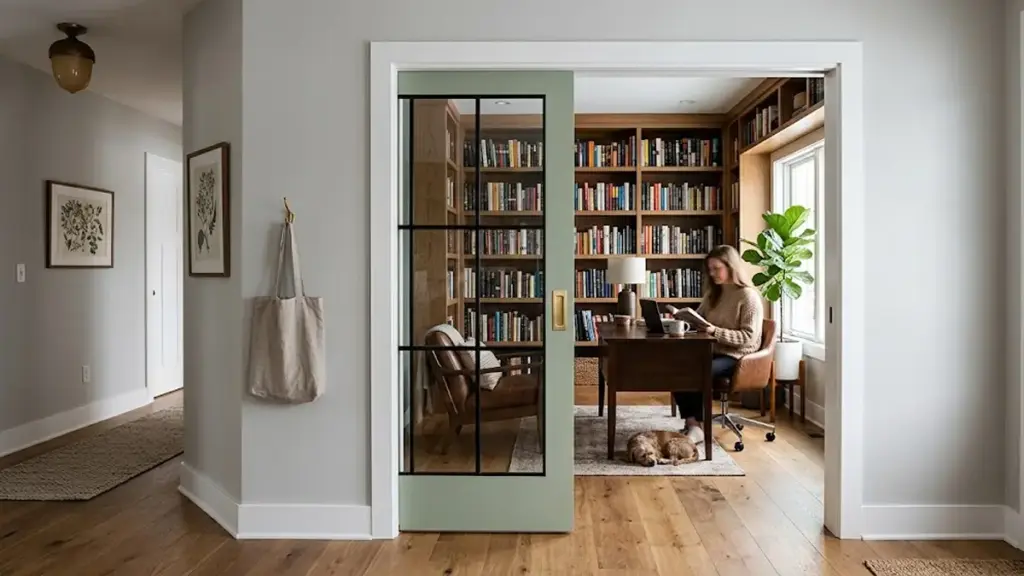
Specifying pocket door hardware means balancing load ratings against track tolerances to avoid structural binding inside finished walls. Undersized roller assemblies or mismatched track profiles lead to permanent sag, repeated homeowner callbacks, and warranty claims that land on the installer rather than the component supplier.
This guide benchmarks residential and commercial systems across published load classes from 60 に 400 pounds, covering wheel-bearing mechanics, alignment tolerances, and the specification sequence that helps you select components that resist deflection under high-frequency cycles.
Anatomy of a Pocket Door System
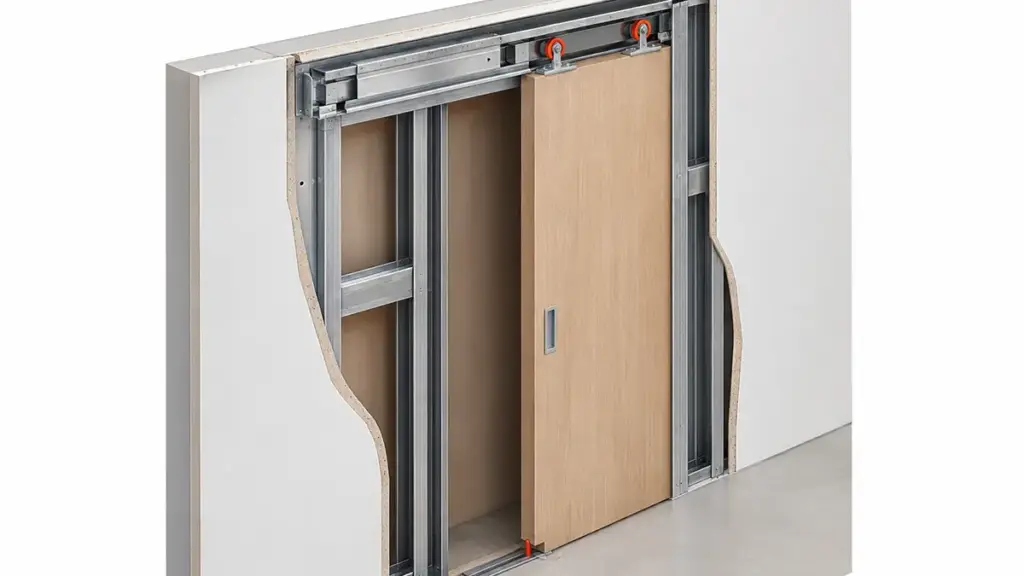
A pocket door requires precise structural framing and matched suspension hardware to prevent wall deflection and keep the slab running freely inside the wall cavity.
The structural skeleton isolates the sliding slab from the surrounding partition while carrying its entire dead weight, and framing errors cannot be corrected after the drywall goes up.
Structural Framing and Cavity Dimensions
- Rough Opening Width: Twice the door-panel width plus the pocket-frame assembly thickness; frame suppliers publish rough-opening tables per model.
- Split Studs: Steel-reinforced split studs provide the vertical stiffness needed to resist wall deflection and keep the slab clear of the interior framing.
- ヘッダーのサポート: The header transfers the suspended door load to the surrounding wall framing and must be installed level; a sloped header lets the door drift on its own.
- Cavity Clearance: Keep the pocket cavity clear of electrical wiring, 配管, ductwork, and fasteners that obstruct the door path.
Mechanical Hardware and Suspended Track Operations
Smooth operation depends on the overhead track and bottom stabilization components working together to minimize friction.
- Roller Carriages: Nylon or polymer wheels run inside the track profile and connect to the door through adjustable mounting brackets.
- Floor Guides: Guides mounted at the pocket entrance control lateral movement by engaging a continuous groove cut in the door bottom.
- Hanger Adjustments: Threaded hanger bolts on the roller carriages allow installers to level the door, balance the load, and correct uneven reveals at the jamb.
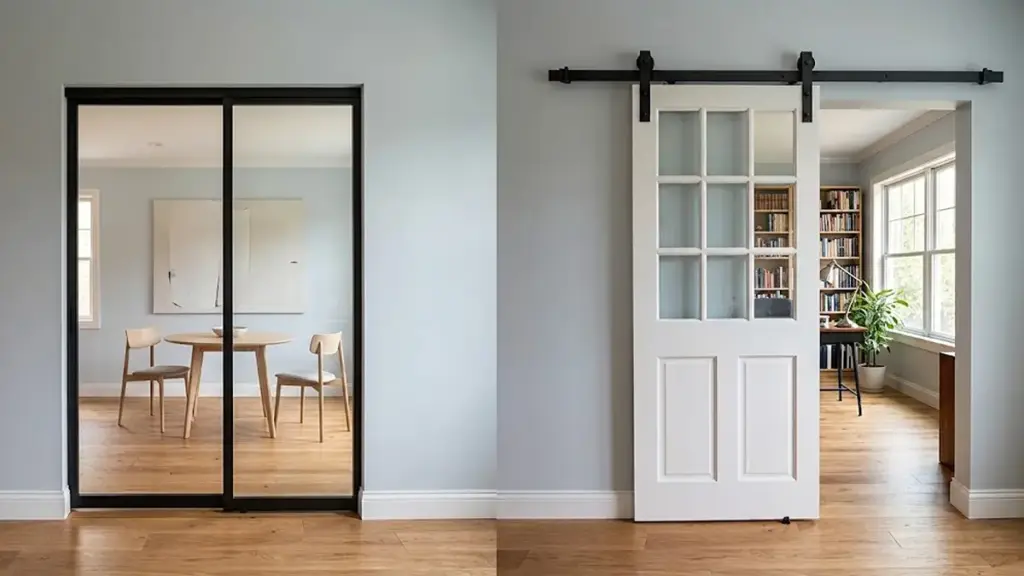
ポケットドア conceal the slab inside the wall. For openings where the panel stays on the room side, 私たちの comparison of sliding and folding door systems covers the mechanical differences. For hinged aluminum door components, 私たちの aluminum door hardware selection guide covers handles, ロック, そして終わります; this article stays with pocket-door suspension hardware.
Top Track and Mounting Rail
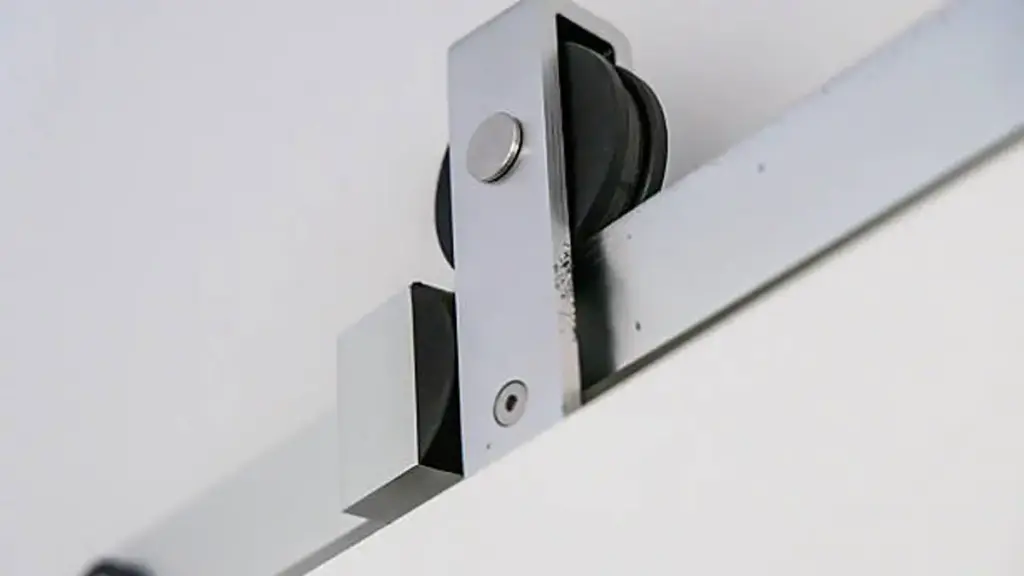
Track selection and mounting alignment determine whether a pocket door runs smoothly or binds inside the wall cavity.
Track Materials and Weight Capacities
Specify the profile by door weight, operating frequency, および環境暴露.
- Extruded Aluminum: 6063-T6 profiles are the industry default, typically carrying published safe working loads of 125 に 150 pounds per door.
- Heavy-Duty Steel: Steel rails carry industrial or thick wood doors and lift system limits to 200 pounds and above.
- ステンレス鋼: 304-grade tracks resist rust in high-humidity areas such as bathrooms, pool houses, and commercial kitchens.
- Mounting Substrates: Installers anchor tracks to solid timber, engineered plywood rails, or metal framing to limit structural sag under load.
Overall capacity depends on the weakest component in the assembly. High-rated roller carriages cannot compensate for an undersized timber header or a flexing mounting rail.
Mounting Configurations and Alignment Specifications
Mounting choice depends on ceiling heights, wall depths, and trim requirements. 鉛直, レベル, and square track alignment prevents the door from drifting on its own or binding against the split studs.
- Direct Header Mount: Fastens the track straight to the rough overhead opening, saving vertical space in low-clearance residential doorways.
- Mounting Rail Installation: Attaches the track to a dedicated plywood substrate that distributes fastener loads across a wider structural area.
- Recessed Mounting: Sets the track into a routed header channel to hide hardware and minimize the gap above the panel.
- Access Clearances: Leave roughly a 3/4-inch offset from the finished opening to the track so keyhole mounting slots remain reachable during adjustments.
- Fastening Standards: Pre-drilling pilot holes (commonly 3/32-inch for #8 x 1-inch screws) prevents thin aluminum profiles from warping; follow the supplier’s fastening schedule.
Small leveling errors compound over time. A track sloped by a fraction of an inch lets the door roll open spontaneously, wears hanger bearings prematurely, and misaligns the latch on the receiving jamb.
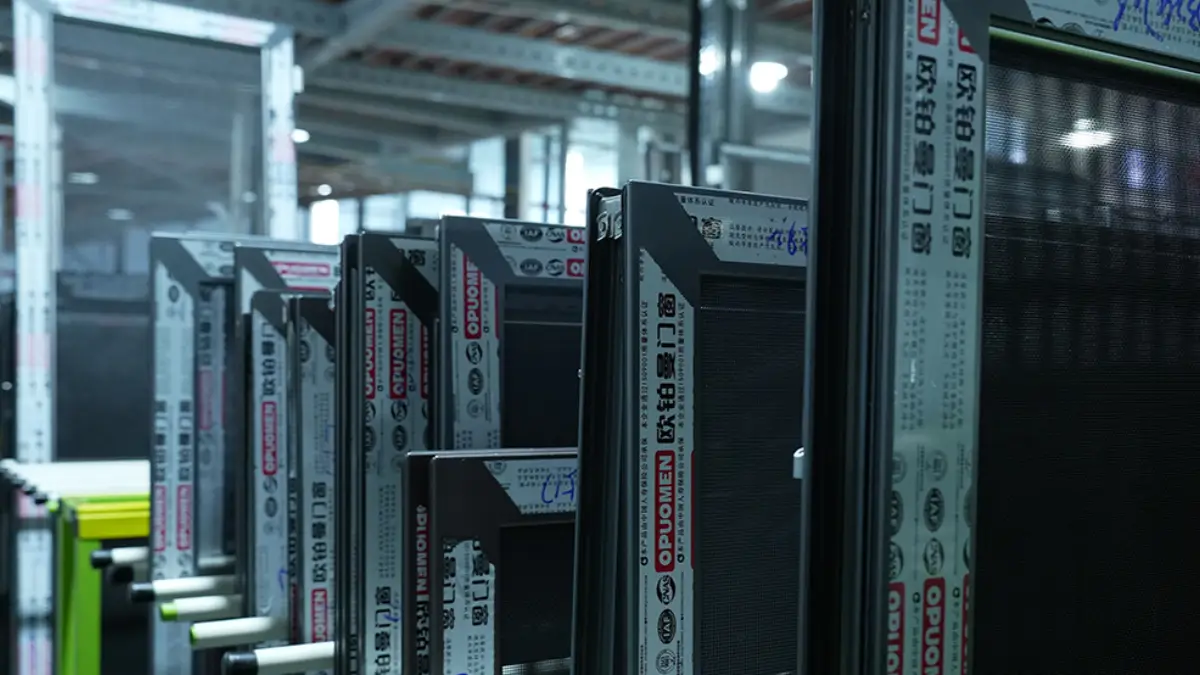
Hangers, ローラー, and Weight Rating
Pocket door longevity depends on matching track and roller configurations to the complete operating weight, from light-duty 60-pound setups to heavy-duty 400-pound commercial hardware.
| System Class | Weight Capacity | ベアリングの種類 | 最優秀アプリケーション |
|---|---|---|---|
| Light-Duty | 60 ポンド (~27 kg) | Plain-Bearing / Bushing | Hollow-core interior doors |
| Standard Residential | 150 – 200 ポンド (~68-91 kg) | Bushing / Basic Ball-Bearing | Standard solid-core or heavy residential panels |
| 耐久性の高い | 200 – 250 ポンド (~91-113 kg) | Ball-Bearing (Upgraded) | Dense solid-core doors, large custom panels |
| Commercial/Specialized | 250 – 400 ポンド (~113-181 kg) | Precision Ball-Bearing | Heavy sliding panels, commercial partitions |
Roller and Hanger Components and Mechanical Configurations
Suspension hardware carries the panel’s entire static load; the right mechanical configuration limits track wear and holds rolling resistance low over years of cycling.
- Hanger Plate and Bolt Construction: Rigid steel plates support heavy door panels, while lightweight aluminum alternatives resist corrosion.
- Wheel Configuration and Materials: Assemblies feature two, 三つ, or four wheels. Nylon and polymer wheels reduce operating noise, but solid metal wheels support higher weight classes and transmit more vibration through the track.
- Axle Bearing Types and Performance: Ball-bearing wheels reduce rolling resistance compared with plain-bearing or bushing systems. Many suppliers re-rate an otherwise identical hardware set from 150 に 250 pounds on the ball-bearing option; confirm against the published data sheet.
- Height Adjustment Mechanics: Standard rollers use locking nuts or retaining clips to secure height adjustments. Keeping the door plumb preserves floor clearance and prevents the panel face from scraping the pocket frame.
Weight Rating Categories and Load Calculation Methods
Accurate load calculations are essential; underestimating total system mass causes structural sag, track deformation, and premature bearing failure.
- Total System Mass Calculation: Designers sum the door slab, ガラスインサート, mirrors, ロックセット, pulls, plus applied trim or cladding. As a working baseline, solid-core wood slabs run roughly 40-60 kg, aluminum-frame glass slabs 60-100 kg, and MDF slabs 20-30 kg; weigh the actual panel before specifying.
- Per-Door versus Per-Hanger Ratings: System capacity represents the weight supported by the complete assembly (typically a pair of hangers), not the standalone rating of an isolated roller.
- Soft-Close Mechanism Load Bands: Dampers are sold in discrete weight bands (例えば 22-44, 88-132, または 132-187 pounds). Match the calculated slab mass to the published band; a mismatched damper closes incompletely or wears early.
- Track and Structural Header Alignment: The track must match the exact wheel profile, and the header must support both static door weight and dynamic stop-and-start forces without sagging.
Bottom Guide and Door Alignment
Proper bottom guide selection and precise sequential alignment prevent pocket doors from dragging, rattling, or scraping split studs during operation.
Guide Selection and Bottom Groove Specifications
Guide choice follows the specified floor finish and whether exposed hardware is acceptable; field failures trace more often to poor guide selection or incorrect bottom preparation than to the overhead track.
- Floor-Mounted Guides: Anchor to the subfloor or finished floor, offering maximum stability for heavy doors but requiring drilling into the flooring.
- Jamb-Mounted Guides: Mount to the split jambs at the pocket entrance. This keeps the floor clear of fasteners, which suits tile or hydronic radiant heating systems.
- Concealed Routing Dimensions: A precise channel is cut along the door’s bottom edge. Common published specifications are a groove 20 mm wide by 6 mm deep, or a deeper mortise 1/2 inch wide by 7/8 inch deep, depending on the manufacturer.
- 横方向の隙間: Plan for about 1/16 inch of side-to-side clearance on each side of the guide. Tight gaps cause friction, while wider gaps allow the door to wobble and rattle.
Verify system compatibility before cutting; a guide/groove mismatch is difficult to correct once the wall cavity is sealed.
Step-by-Step Installation and Alignment Sequence
Aligning a pocket door requires a strict order of operations. The bottom guide cannot repair mistakes left by the top track installation.
- ステップ 1: Hang and level the door. Suspend the slab from the overhead rollers. Adjust the top hanger bolts to make the door plumb and level, ensuring floor clearance before touching the bottom guide.
- ステップ 2: Track the natural centerline. Let the door hang freely to find its plumb line; slide it back and forth, marking the floor along this natural travel path instead of guessing a theoretical center.
- ステップ 3: Position and anchor the guide. Insert the guide into the bottom groove at the pocket entrance. Secure it temporarily, test full travel to confirm the door does not bind, then tighten the fasteners.
If the door rubs near the pocket entrance, the guide is likely offset or the split jambs are bowed. Loosen the slotted guide screws slightly, slide the door to center the hardware naturally, and retighten. The bottom guide should never be used to force a crooked door plumb.
Soft-Close and Bumper Options
Matching door weight to damper ratings prevents hardware failure and keeps deceleration smooth and predictable.
Soft-Close Configurations and Technical Weight Limits
Soft-close mechanisms convert manual force into controlled motion: the system slows the slab, captures it via a trigger hook, and draws it silently into position, eliminating the slamming common with basic hardware.
- Dual-Direction Systems: Provide controlled deceleration at both the fully open and fully closed positions, protecting the pocket interior and the strike jamb.
- Weight Capacity Thresholds: Published damper ratings span roughly from 60 kg class units to 200 lb class units; the correct figure is model-specific and comes from the supplier data sheet.
- Compatibility Checks: Verify the track profile, door slab thickness, frame clearance, and pocket-frame rigidity before committing to a kit.
Selecting the correct weight band matters. An under-rated damper on a heavy solid-core door bottoms out early, and the seals fail sooner than the rest of the hardware set.
Passive Bumper Placement and System Installation Guide
Passive bumpers lack hydraulic speed control; they act as physical limits against wood-on-wood contact and are simple, 費用対効果の高い, and easy to replace.
- Bumper Configurations: Frame jamb, adhesive-backed, and screw-mounted rubber stops prevent direct impacts at the travel limits.
- Active versus Passive: Active systems use hydraulic or spring-loaded dampers to slow the door, while passive bumpers only reduce noise and vibration upon contact.
- Durability Standards: Specify hardware graded to recognized cycle standards such as EN 1527, which sets 100,000 cycles for commercial duty and 20,000 cycles as the residential minimum. High-cycle components also reduce finger-pinch exposure in high-traffic applications.
Calibrate the trigger precisely; a misaligned trigger fails to catch the door cleanly, causing the hanger to jump or binding the track assembly.
Pocket Frame Kit (Steel vs Aluminum)
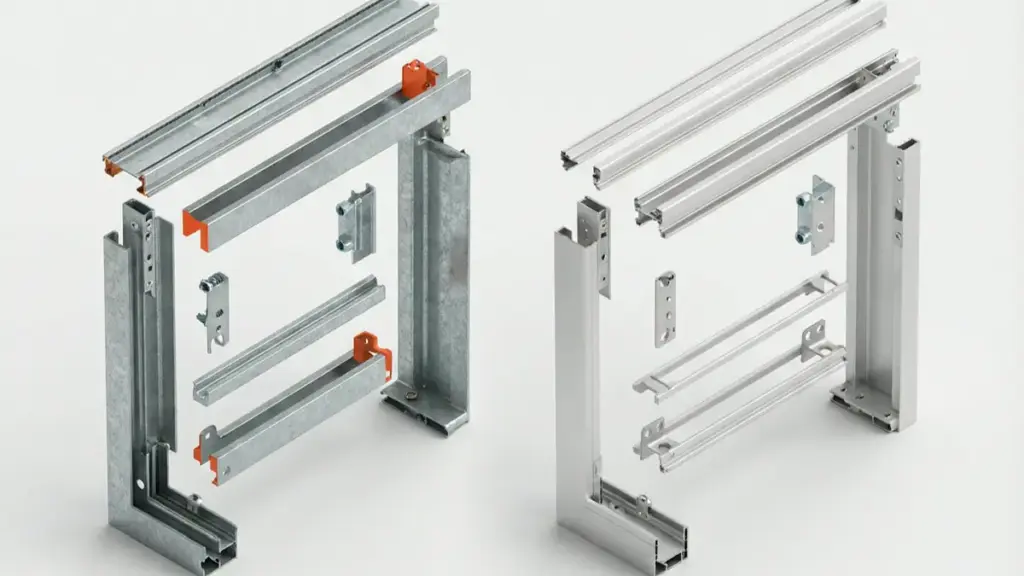
Steel-dominant frames resist wall bowing under heavy door loads, while aluminum tracks deliver smooth, lightweight rolling and corrosion resistance in humid environments.
Material Performance and Structural Capacity
Selecting the right alloy and thickness keeps the wall rigid and prevents the pocket from closing in over time.
- Steel Split Studs: Heavy-duty galvanized steel, commonly 16-gauge or 18-gauge, offers the structural stiffness needed to limit wall bowing under heavy door loads.
- Aluminum Tracks: Extruded 6063-T6 aluminum tracks provide consistent channel geometry and smooth rolling surfaces for hanger rollers without adding excess overhead weight.
This combination places high-modulus steel where structural loading is greatest and smooth aluminum where wheel travel occurs.
Durability and Installation Environments
Moisture exposure and physical impact dictate which framing type holds its alignment.
- 耐食性: Aluminum components resist atmospheric corrosion in high-humidity spaces such as bathrooms, but installers must isolate dissimilar metals to prevent galvanic corrosion from raw steel fasteners.
- Impact and Handling: Steel-dominant systems provide the impact resistance needed for high-traffic commercial spaces and heavy solid-core doors, while lightweight aluminum configurations ease residential retrofits.
Matching the framing style to moisture exposure and structural traffic helps the pocket hold alignment for the life of the installation.
Hardware Brand Map and Service Network
The pocket-door hardware market remains highly fragmented: no single supplier holds a dominant share, which makes localized specification and exact-match component sourcing critical for long-term systems.
Global Brand Landscapes and System Categories
Groups such as ASSA ABLOY, Häfele, Eclisse, Scrigno, and Hettich hold limited share of pocket-door systems specifically, leaving the field to regional specialists and custom manufacturers.
- Regional Specialists: Johnson Hardware is widely specified in North American residential work, while Cavity Sliders focuses on commercial-grade, high-cycle architectural hardware.
- Residential versus Commercial Systems: Residential projects typically use standard steel-reinforced split studs, whereas commercial builds specify flush-wall profiles and heavy-duty aluminum tracks.
- Structural Formats: Offerings split between complete cassette frame kits that form the entire wall pocket and standalone track-and-hardware kits for site-built timber frames.
Selecting between a pre-fabricated cassette and a modular track kit changes your structural requirements. Cassette systems protect the pocket cavity from accidental drywall screw penetration, while track-only kits rely on the framing carpenter to deliver a straight stud cavity.
Distribution Channels and Lifetime Maintenance Support
Procurement pathways depend on project type: off-the-shelf residential kits flow through retail home centers, while premium architectural builds require direct manufacturer specification and commercial distributor channels.
- Multi-Tier Support: Long-term performance relies on manufacturer technical support, authorized field representatives, and experienced finish carpenters.
- Replacement Components: ローラー, ハンガー, and floor guides must match the original track geometry to prevent binding or premature wheel failure.
- Warranty Terms: Frame warranty terms vary widely by brand, product line, and region. Obtain them in writing before specifying.
Because track systems are sealed inside finished drywall, choosing components with a clear replacement pathway is essential; standardizing on a documented brand keeps future parts orders possible without opening the wall.
For importers and contractors, hardware selection becomes an ordering sequence from quotation to container load without tolerance surprises.
| Stage | What to Lock Down | Why It Matters |
|---|---|---|
| 1. Inquiry and Sampling | Slab construction, measured total mass, hardware series and load rating | Rating mismatches surface at quotation, not after the drywall closes |
| 2. サンプルの承認 | Rolling feel, bearing noise, 仕上げる, and groove fit against the approved unit | The approved sample becomes the physical benchmark for mass inspection |
| 3. Specification Freeze | Track profile, hanger rating, bottom-groove dimensions, soft-close band, ラベリング, 梱包 – confirmed in writing | Sealed cavities punish late changes; every dimension must stop moving |
| 4. Pre-Shipment Verification | Production lot checked against the frozen spec and approved sample, with AQL sampling on bearings and finish | Catches bearing and finish defects before the container is loaded |
| 5. Delivery and Spares | Spare rollers, ハンガー, and guides ordered at an agreed percentage of unit count | In-wall repairs cannot wait on a new purchase order |
よくある質問
What hardware do I need for a pocket door?
A complete pocket door setup requires a pocket-door frame or track system, door hangers with rollers, bottom guides, recessed door pulls, and a passage or privacy lock. For a new installation, a frame kit provides the track, ヘッダ, split studs, and brackets to build the wall cavity.
How much weight can a pocket door hold?
Weight capacity depends on the hardware system specified. Standard systems commonly carry published ratings of 80 に 150 pounds, which accommodates most residential doors. Heavy-duty residential and commercial systems reach 200 pounds and above, and specialized frames are rated for solid-core doors up to 400 pounds.
Do pocket doors need a bottom guide?
はい, pocket doors require a bottom guide or stabilizer. While the top track carries the door’s weight, the bottom guide keeps the panel centered. Without a guide, the door swings side to side, scrapes the finished jambs, damages paint or wood, and rattles during operation.
Can I add soft-close to an existing pocket door?
はい, you can retrofit soft-close hardware on an existing door if the current track is compatible. You must temporarily remove the door to swap a standard hanger for the soft-close damper component, then secure the actuator trigger inside the track.
What size pocket door hardware do I need?
Size the hardware from the door slab’s width, 身長, 厚さ, そして体重. For a standard single door, plan a track length of twice the door width. The framing rough opening generally requires a width of twice the door width plus 1 インチ, and a height of the door height plus 4.5 に 5 インチ.
Choosing cheap pocket door hardware risks trapping low-quality rollers behind finished drywall, leading to costly wall demolition and ruined project margins. Standardizing on heavy-duty steel frames and precision ball-bearing rollers helps avoid these callback risks, keeps operation smooth, and protects your reputation on high-frequency installations.
Skip the guesswork: request a hardware sample kit to inspect finish and bearing tolerances before your next project, そして contact our commercial team for the B2B catalog and volume pricing.