Treating a window r value as a simple additive metric across a fenestration assembly leads to severe thermal bypass and building envelope failure.
This analysis benchmarks whole-window assembly performance against NFRC testing standards. We evaluate center-of-glass metrics, frame thermal conductivity, and area-weighted conversions to help you secure an accurate, code-compliant specification.
What R-Value Measures on a Window
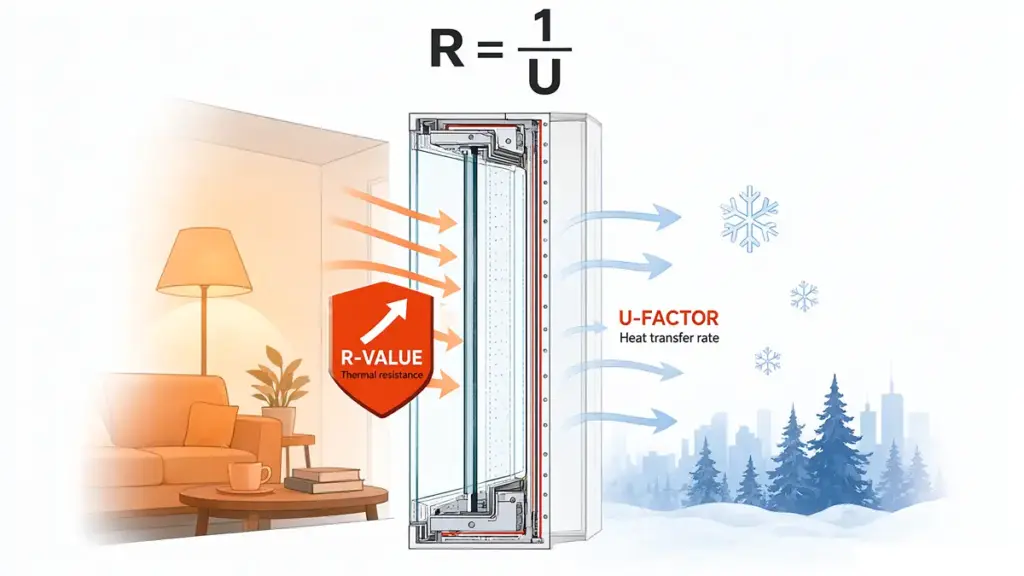
R-value measures a window’s thermal resistance, representing how effectively the unit prevents heat transfer. To evaluate actual performance, we convert this value to its practical reciprocal, Uファクター.
Thermal Resistance and the Inverse Relationship with U-Factor
We calculate a window’s insulating capability by looking at two metrics that operate as mathematical reciprocals: R-value and U-factor. While R-value quantifies how effectively a material resists heat flow, U-factor measures the rate at which heat escapes through the entire assembly.
The formula is straightforward: R equals 1 divided by U. 例えば, a window with a U-factor of 0.25 yields an effective R-value of 4.0. Both metrics describe conductive heat transfer, but they approach the physics from opposite directions.
But a single rating does not tell the whole story. Spec sheets often highlight center-of-glass ratings because the glass center insulates better than the edges. The whole-window rating always delivers a lower effective thermal resistance because it factors in the highly conductive frame and spacer components.
Key Structural Components Influencing Overall Window Insulation
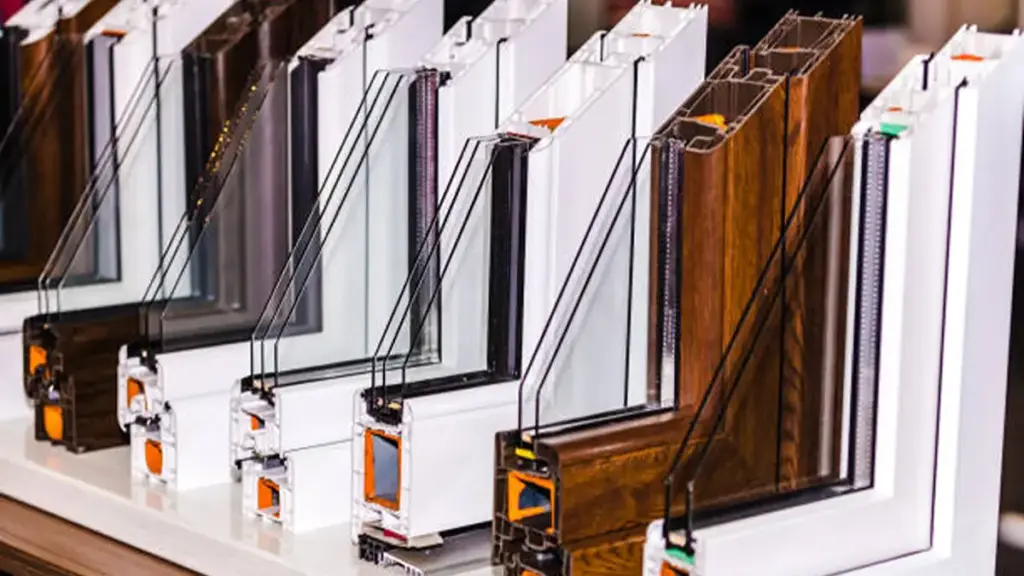
To build a highly insulating window, manufacturers must optimize multiple components to limit thermal bridging. The glass package, フレーム, and the edge seals all work in parallel to dictate the final assembly performance.
We evaluate these essential structural components:
- Multi-Pane Glazing: Double or triple layers of glass create sealed insulating cavities that restrict direct heat movement.
- 不活性ガスの充填: Dense gases like argon or krypton replace standard air inside the glazing cavities to suppress convective heat transfer.
- Low-E コーティング: Microscopically thin metallic layers on the glass surfaces block long-wave infrared radiation, keeping heat on the side where it belongs.
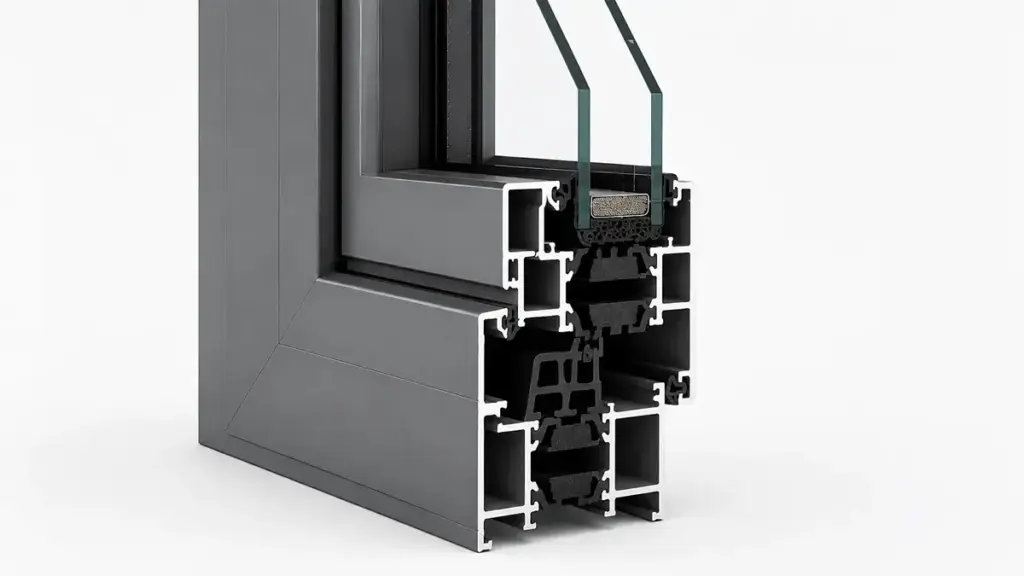
- Insulating Frames: Low-conductivity materials such as vinyl, グラスファイバー, and wood prevent heat from bypassing the glass, unlike highly conductive raw aluminum sashes.
- Warm-Edge Spacers: Structural components that separate the glass panes using low-conductivity designs to eliminate thermal bridging at the perimeter.
R-Value vs U-Value Conversion
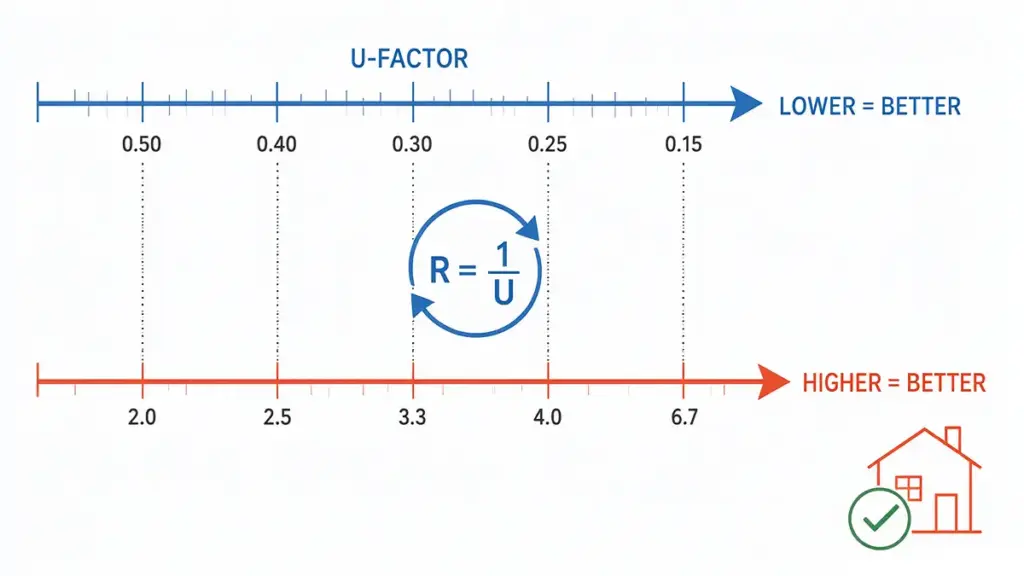
U-factor measures heat-transfer rate while R-value measures thermal resistance; they are mathematical reciprocals where lower U-factors and higher R-values indicate superior window insulation performance.
Mathematical Formulas and Unit Conversions
To calculate thermal resistance from thermal transmittance, divide 1 by the U-factor. This simple reciprocal calculation defines the relationship between the two metrics: R equals 1 divided by U, and U equals 1 divided by R. A lower U-factor translates directly to a higher R-value, indicating that the material resists heat transfer more effectively. For the U-factor side of this equation, see our companion guide on U-factor windows explained.
When working across international specifications, conversion factors must account for the difference between U.S. customary units and the metric SI system. Apply these precise multipliers to convert window ratings:
- Metric U-Value (SI): Multiply the U.S. U-factor by 5.678 to determine the rating in W/(m²・K).
- 私たち. U-ファクター: Multiply the SI U-value by 0.1761 to calculate Btu/(h·ft²·°F).
- Metric R-Value (SI): Multiply the U.S. R-value by 0.1761 to find m²·K/W.
- 私たち. R-Value: Multiply the SI R-value by 5.678 to find h·ft²·°F/Btu.
Source Premium Aluminum Windows Direct

Why Cavity R Is Not Whole-Window R
Cavity R-value only measures isolated gas space. Real-world performance drops because highly conductive frames, edge spacers, and installation interfaces create massive thermal bridges across the entire assembly.
| Metric Type | What It Measures | Typical Range |
|---|---|---|
| Cavity R-Value | Resistance credited to the gas-filled cavity between panes. A single air or argon cavity contributes only about R-1 to R-2; the R-3 to R-8 figures quoted in marketing belong to the stacked glazing package, not one cavity. | R-1 to R-2 per cavity |
| Center-of-Glass (COG) | Thermal performance at the center of the glazing, ignoring frame and edge spacer effects. | U-0.10 to U-0.25 (R-10 to R-4) |
| Whole-Window Assembly | Area-weighted heat transfer of the complete physical product, ガラスを含む, フレーム, そしてシール. | U-0.15 to U-0.50 (R-6.7 to R-2) |
The Mathematical Disconnect Between Center-Glass and Assembly Performance
Spec sheets frequently highlight high R-values from center-glass or isolated cavity measurements. This tactic hides the structural reality of the system. A window operates as a thermal circuit where heat flows in parallel paths, meaning energy automatically escapes through the easiest path of thermal escape. Because heat flows through these parallel paths rather than a series of layers, you cannot add individual component R-values together; engineers instead use area-weighted calculations that divide the summed component U-factors multiplied by their respective areas by the total window area.
- Frame conductivity: Highly conductive frame materials like uninsulated aluminum bypass the thermal resistance of the center-of-glass gas cavity.
- Edge-of-glass bridging: Spacers and edge sealant geometries create a highly localized thermal bridge around the entire perimeter of the insulated glass unit.
- Area-weighted degradation: Mathematical models factor in these highly conductive edge and frame areas, reducing overall assembly efficiency far below center-glass values.
This disconnect means an advanced triple-pane cavity performs poorly when paired with a conductive frame. The frame and edge zones cover a massive percentage of the product area on smaller or highly divided windows, which heavily dictates the final efficiency rating.
Standardized Testing Protocols and External Installation Realities
Laboratory performance data rarely matches field conditions. Standardized certifications establish baseline comparisons under controlled environments, but they omit the physical installation variables that compromise building envelopes.
- NFRC certifications: National Fenestration Rating Council standards require testing the entire physical product, forcing commercial specifications to use whole-window U-factors instead of isolated glass R-values.
- Rough opening interfaces: In-field variables like empty shim spaces, poor thermal cavity packing, and discontinuous perimeter air barriers degrade real-world performance.
- Condensation vulnerabilities: Localized surface temperature drops occur at structural boundaries near the frame, creating condensation and mold risks regardless of your internal cavity gas concentration.
When writing specifications, rely strictly on whole-product certified ratings. Ensuring proper field-applied perimeter air sealing, using warm-edge spacers, and choosing thermally broken frame profiles protects the building far better than chasing abstract cavity ratings on a spec sheet.
Typical R-Value by Window Build
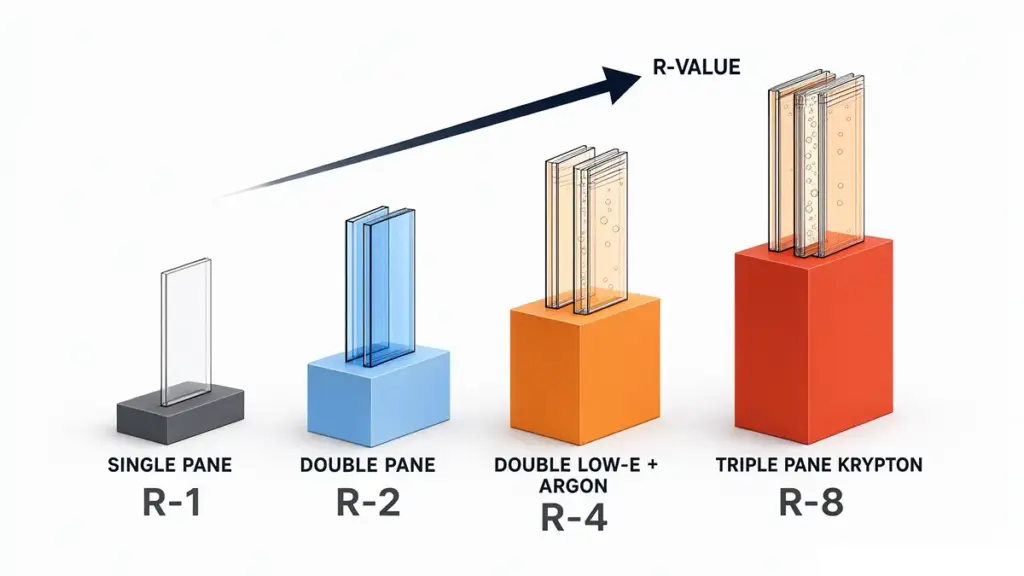
Window thermal performance depends on the entire assembly. While basic glass ratings hover around R-1, high-performance triple-pane configurations can push past R-8.
Performance Characteristics Across Glass Configurations
Standard glass packages establish the baseline for building energy calculations. Raw glass acts as a poor insulator, meaning performance gains rely entirely on engineered cavities and surface treatments.
- Single-Pane Clear: Delivers a baseline rating of R-1.0 to R-1.2. Direct contact allows rapid conductive and radiative heat transfer.
- Double-Pane Clear: Elevates performance to R-1.8 or R-2.2 by trapping a single insulating layer of air.
- Double-Pane with Low-E and Argon: Reaches R-3.0 to R-4.0, a U-factor range of roughly 0.25 に 0.33, as microscopic metallic coatings block infrared radiation while dense argon gas suppresses convection.
- Triple-Pane with Dual Low-E and Krypton: Climbs to R-6.0 to R-8.0. This configuration uses two narrow cavities filled with high-cost krypton gas for peak resistance.
Selecting the right glass configuration requires matching the thermal resistance to regional climate demands. In cold regions, the jump from R-2 to R-5 dramatically reduces heating loads and eliminates cold drafts near the glass.
Impact of Frames, Spacers, and Testing Methods on Whole-Window Ratings
Glass accounts for only a portion of real-world energy loss. The entire assembly, including the frame and perimeter seals, dictates actual thermal resistance.
- フレーム素材: ビニール, 木材, and fiberglass provide low conductivity. Uninsulated aluminum requires a thermal break to prevent heavy thermal bridging (browse our aluminum window catalog for configurable profile options).
- Edge Spacers: Traditional aluminum spacers conduct heat rapidly. Warm-edge composite spacers reduce perimeter heat loss and lower interior condensation risks.
- Whole-Window vs. COG: Center-of-glass (COG) ratings ignore frame losses. Whole-window U-factor conversions offer the only reliable performance comparison.
- 設置品質: Gaps in the rough opening, missing perimeter foam, or flawed flashing can destroy the performance of a high-R window. We covered field detailing in our guide to energy-efficient window installation.
When specifying windows for code compliance or energy performance, always evaluate certified National Fenestration Rating Council (NFRC) whole-product values. Relying on glass-only claims leads to under-performing building envelopes.
Which Code Uses R vs Which Uses U
Building energy codes mandate minimum R-values for opaque walls and ceilings, while strictly enforcing maximum whole-assembly U-factors for windows, ドア, and other fenestration systems.
Code Requirements for Opaque Insulation and Fenestration Assemblies
The International Energy Conservation Code (IECC) and the International Residential Code (IRC) draw a sharp line between structural insulation and windows. Opaque building-envelope components like walls, roofs, and foundations must meet minimum R-value limits. Windows, glazed doors, and skylights must comply with maximum U-factor limits.
Energy codes are adopted state by state, so confirm which edition the project’s jurisdiction enforces. The two fastest-growing U.S. luxury villa markets illustrate how different that answer can be:
- テキサス州 (2021 IECC baseline, state-amended): Houston, Austin, and San Antonio sit in Climate Zone 2—maximum U-factor of 0.40 with a maximum SHGC of 0.25. Dallas–Fort Worth (Zone 3) tightens to U-0.30 and SHGC 0.25, while El Paso and the Panhandle (Zone 4) hold U-0.30 with SHGC 0.40.
- カリフォルニア (タイトル 24, Part 6—no IECC at all): The 2025 edition, in force since January 1, 2026, caps prescriptive vertical fenestration at roughly U-0.30 to U-0.40 depending on the state’s 16 climate zones, with SHGC limits near 0.25 for south- and west-facing glazing.
- Glass-heavy villa designs: California villas routinely exceed prescriptive fenestration limits and comply through the whole-building performance path—another reason certified NFRC whole-window ratings, not marketing R-values, carry the negotiation in every energy-model trade-off.
Commercial projects under ASHRAE Standard 90.1 discard individual component R-values. Enforcement agencies evaluate whole-assembly U-factors across vertical glazing, 店頭, and skylights to capture complete thermal behavior.
ENERGY STAR specifications establish voluntary benchmarks to guide consumers. These performance targets rely on U-factor limits to verify efficiency, but local building codes remain the only legally binding mandates.
Compliance Pathways and Selection Metrics in Modern Building Codes
Prescriptive code tables treat listed thermal metrics as regulatory boundaries. You must treat any listed insulation R-value as an absolute minimum requirement. 逆に, you must treat any listed fenestration U-factor as a maximum allowable limit.
Building inspectors reject center-of-glass ratings during code verification. Codes require the whole-window U-factor because it accounts for thermal bridging across the frame, edge spacers, サッシ, and glass perimeter. Highly insulating glass package performance drops significantly once mounted in a conductive frame.
Modern codes provide performance compliance pathways that allow design trade-offs. You can use area-weighted average calculations for fenestration, but you cannot use a converted, approximate R-value to bypass a certified, tested U-factor rating.
Architects often calculate equivalent R-values using reciprocal calculations to compare window performance to walls. While this reciprocal math helps communicate thermal efficiency, enforcement officers only recognize certified NFRC testing metrics on the submittal sheets.
Reading a Spec Sheet Without Getting Fooled
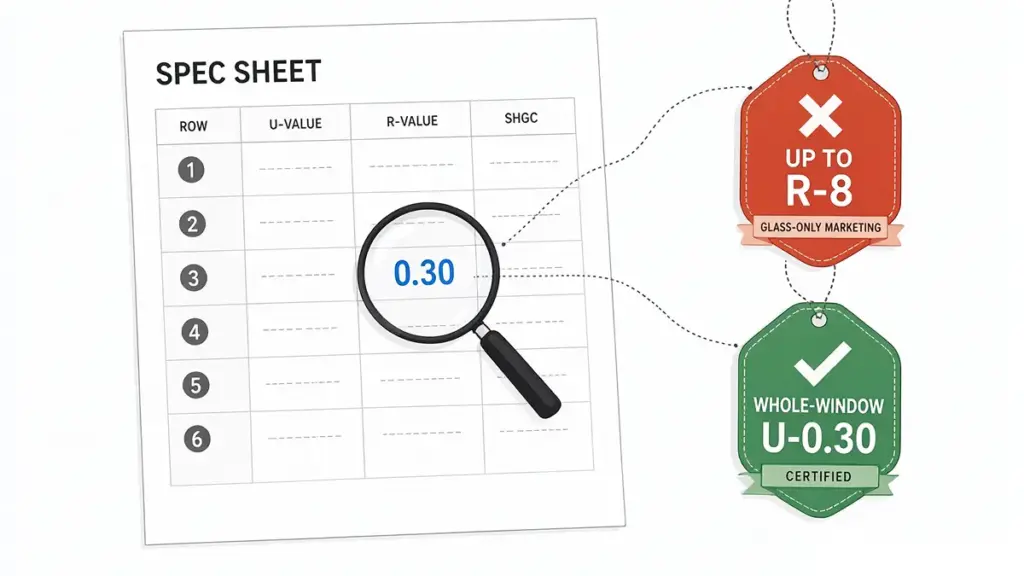
Spec sheets often highlight glass-only metrics to inflate performance. True thermal efficiency requires looking at certified, whole-window NFRC ratings that include the frame and spacers.
Separating Whole-Window Performance from Glass-Only Marketing
As established earlier, フレーム, スペーサー, and sash act as parallel heat-flow paths that drag assembly performance below the center-of-glass laboratory figure. On a spec sheet, that means the COG number is never the number the installed window will post.
Spec sheets frequently use “まで” language to highlight the absolute best-case scenario. This peak performance usually belongs to a premium, triple-pane, krypton-filled fixed window of a specific large size. If you purchase an operable double-hung or sliding model with standard double-pane glass, your actual U-factor will be significantly worse. Always demand the exact rating for your chosen configuration and operating type.
Verifying Certified Ratings Beyond the Headline Numbers
Do not rely on self-reported manufacturer calculations. Standardized ratings require a National Fenestration Rating Council (NFRC) label. The NFRC tests the complete window assembly under uniform laboratory conditions. This certification ensures you compare products on a level playing field, reflecting real-world performance instead of idealized estimates.
A low U-factor only measures conductive heat transfer. To evaluate actual energy performance, look at the full NFRC label:
- エア漏れ (AL): Measures draftiness through sashes and operating joints; look for a rating of 0.3 cfm/ft² or lower.
- 太陽熱ゲイン係数 (SHGC): Controls the fraction of solar radiation entering the building, depending on your climate zone.
- Visible Transmittance (VT): Defines the amount of daylight passing through the glass, which can be restricted by heavy low-E coatings.
Prioritizing U-factor while ignoring these metrics leads to drafty spaces or overheated rooms. 例えば, selecting a low-U-factor window with high solar heat gain in a cooling-dominated climate will drive up your air conditioning costs.
よくある質問
What R-value should a residential window be?
Aim for R-3 to R-5 for most replacement windows, which equals a whole-window U-factor of 0.33 に 0.20. 寒冷地では, select windows closer to R-4.5 or higher (U-factor 0.22 それ以下) to meet current energy standards. For hot climates, prioritize solar heat gain control with an SHGC of 0.23 or lower instead of chasing a high R-value.
Why are window R-values so much lower than wall R-values?
Opaque walls hold thick, continuous insulation like fiberglass or foam to easily reach R-13 to R-25. Windows have limited physical space, meaning they rely on thin air or inert-gas cavities. Glass and metal frames also conduct heat rapidly, creating parallel thermal bridges where energy quickly escapes.
How do you convert a window’s U-factor to R-value?
Divide 1 by the U-factor (R = 1/U). 例えば, a window with a certified whole-window U-factor of 0.25 has an approximate R-value of 4. Use the whole-window U-factor rather than the glass-only rating, as frames and spacers significantly lower the overall insulation performance.
Do triple-pane windows reach R-10?
Triple-pane windows can approach R-10 at the center of the glass, but the complete installed assembly rarely reaches this level. Most high-performance residential triple-pane windows deliver a practical whole-window rating of R-5 to R-8. To hit these higher numbers, windows require low-emissivity coatings, krypton gas fills, ウォームエッジスペーサー, and insulated fiberglass or vinyl frames.
Does the window frame material change the R-value?
はい, frame materials directly impact the thermal resistance of the entire window. グラスファイバー, 木材, and vinyl frames insulate much better than standard aluminum or steel frames. If you choose metal frames, ensure they contain a thermal break—an insulating barrier that interrupts the conductive metal path—to prevent rapid heat loss.
最終的な考え
While uncertified frames or glass-only ratings offer lower upfront costs, specifying products to the whole-window NFRC U-factor standard is the only way to safeguard your reputation against structural thermal bridging, 不合格な検査, and expensive draft callbacks. Relying on deceptive center-of-glass marketing risks complete envelope failure. Secure your project’s thermal performance by demanding certified assembly metrics from the start.
Don’t guess on thermal efficiency—verify it. We recommend reviewing our NFRC-certified product catalog to match your climate’s exact performance requirements. 弊社の技術チームにお問い合わせください to discuss your project specifications and request custom engineering calculations.