For architects, developers, and contractors specifying aluminum-clad wood (alu-clad) doors and windows on luxury residential and commercial projects, wood core stability is often the hidden factor that determines long-term success.
Even the highest-grade aluminum cladding and advanced thermal breaks cannot compensate for a wood core that moves, cracks, or absorbs moisture after installation.
At Opuomen, we have refined a proprietary 3-Step Kiln-Drying Process specifically engineered for aluminum-wood hybrid systems. This process consistently brings core moisture content down to 6-8% with superior uniformity, dramatically reducing post-installation movement, condensation risks, and costly warranty claims in demanding North American and European climates.
Why Kiln-Drying Matters More in Aluminum-Clad Systems
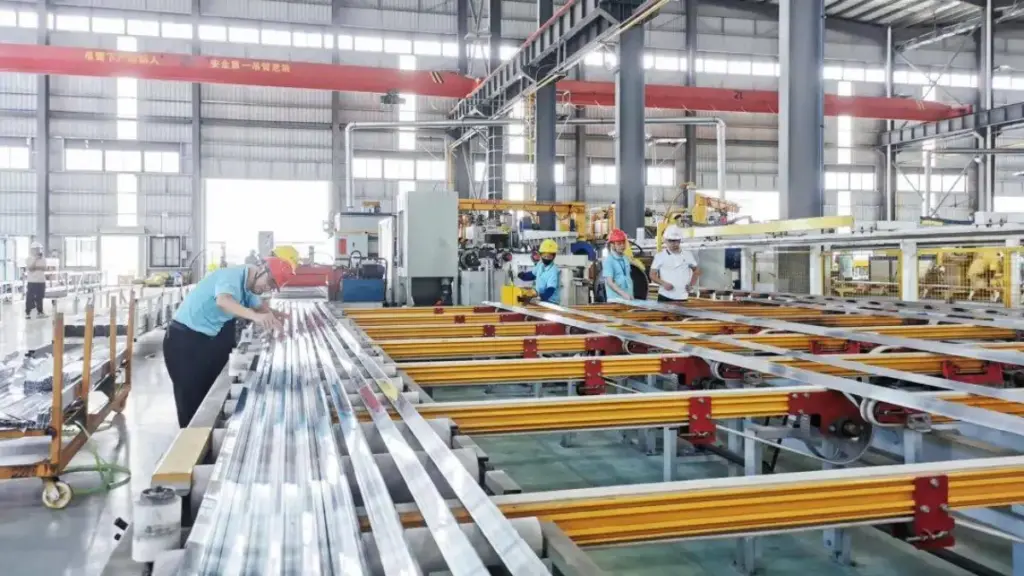
Unlike traditional solid wood windows that can freely exchange moisture with the air on both sides, aluminum-clad systems partially encapsulate the wood core. This creates restricted vapor diffusion paths, making the initial moisture content and drying uniformity critical.
Excess residual moisture leads to:
- Differential shrinkage after cladding
- Stress at the aluminum-wood interface
- Seal compression loss and air leakage
- Potential core rot in humid or coastal environments
Conversely, overly aggressive drying creates internal stresses, brittleness, and surface checking. The solution is a controlled, multi-phase scientific approach rather than conventional single-stage kiln drying or air seasoning.
The 3-Step Kiln-Drying Process
Step 1: Pre-Treatment & Controlled Ramp-Up
This initial phase focuses on gentle moisture equalization and free water removal while preventing surface hardening.
Freshly selected timber (typically high-quality pine, oak, or African mahogany) is first conditioned to balance internal and external moisture gradients. Temperature is slowly ramped from ambient to approximately 40-50°C under high relative humidity (75-85%). Precise airflow control ensures uniform heat distribution across large door panels and oversized sections.
This stage typically lasts 48-72 hours depending on timber species and thickness. The slow ramp prevents case-hardening — where the outer layers dry too quickly and trap moisture inside — a common cause of honeycombing and warping in alu-clad cores.
Step 2: Main Drying Phase
The core moisture removal stage uses a tightly controlled temperature-humidity schedule to extract bound water efficiently while managing drying stresses.
Temperatures are gradually increased to 60-75°C with carefully modulated humidity drops. Intermittent ventilation and stress-relief cycles allow the wood fibers to relax, minimizing cupping, twisting, and internal checks. Real-time moisture probes and weight monitoring track core moisture gradients, ensuring the drying rate never exceeds the species-specific safe limit.
This phase is the longest (typically 10-18 days for thick sections) and is where most conventional drying processes fail. Our programmable kilns maintain tolerances within ±2% relative humidity and ±1°C, delivering exceptional uniformity even in large-format pivot doors or floor-to-ceiling units.
Step 3: Conditioning & Equilibrium Phase
The final and most critical stage for aluminum-wood compatibility.
Once target moisture content is approached, the kiln shifts to a conditioning mode. Temperature is reduced slowly while humidity is adjusted to allow the entire wood section to reach equilibrium at 6-8% moisture content (customized according to destination climate — lower for cold-dry regions, slightly higher for temperate zones).
This phase eliminates residual drying stresses and stabilizes the wood at a level that closely matches the long-term equilibrium moisture content it will experience once encased in aluminum. Final cooling is gradual to prevent condensation inside the kiln. Each batch undergoes multiple-point moisture metering, dimensional stability checks, and visual stress inspection before release.
Proven Performance Advantages
Projects using our 3-Step kiln-dried cores typically show:
- 70%+ reduction in post-installation dimensional movement compared to standard kiln-dried timber
- Significantly lower risk of joint opening or seal failure
- Improved long-term thermal performance through maintained airtightness
- Extended system lifespan, often exceeding 40-50 years with minimal maintenance
These results are particularly valuable in high-humidity coastal areas (e.g., Florida, Pacific Northwest, UK, Scandinavia) and extreme temperature swing regions where wood movement can otherwise compromise even the best thermal-break aluminum cladding.
Quality Control & Verification
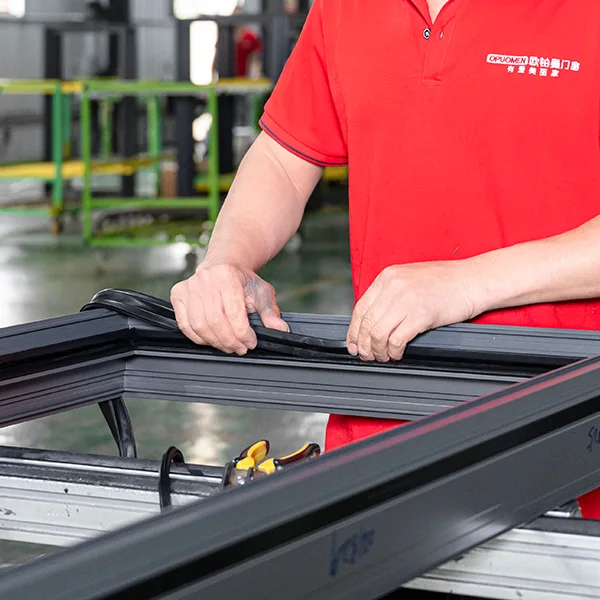
Every production batch is traceable. We record kiln schedules, species, initial moisture, and final readings. B2B partners can request:
- Moisture content certification
- Drying curve reports
- Independent lab test data
- Physical sample sections showing uniformity
This transparency helps architects and developers confidently specify “3-Step Kiln-Dried Wood Core” in project documentation, supporting CE marking, Passive House compliance, and stringent North American energy codes.
Real-World Impact on Luxury Projects
On recent high-end villa developments, proper wood core drying has eliminated common field issues such as interior condensation around door frames, visible frame distortion in large glass walls, and early seal degradation. Developers report fewer callbacks, faster handover, and stronger client satisfaction — all of which protect profit margins on premium properties.
Stability Is Engineered, Not Assumed
In aluminum-wood hybrid systems, the beauty and performance of the final product begin deep inside the wood core. The “3-Step” Kiln-Drying Process represents the professional standard for projects where reliability cannot be compromised.
When specifying custom aluminum-clad wood doors and windows, we strongly recommend requiring detailed kiln-drying protocols rather than accepting generic “kiln-dried” claims. The difference appears in performance years after installation.
At Opuomen, our ISO-certified factory combines advanced 3-Step kiln drying with precision aluminum cladding, high-performance thermal breaks, and rigorous quality systems to deliver alu-clad solutions engineered for global climates.
Ready to strengthen your next project with truly stable aluminum-wood systems?
Contact our technical team today to request detailed drying process documentation, wood species samples, or a project-specific quotation. Let us help you engineer lasting stability from the inside out.