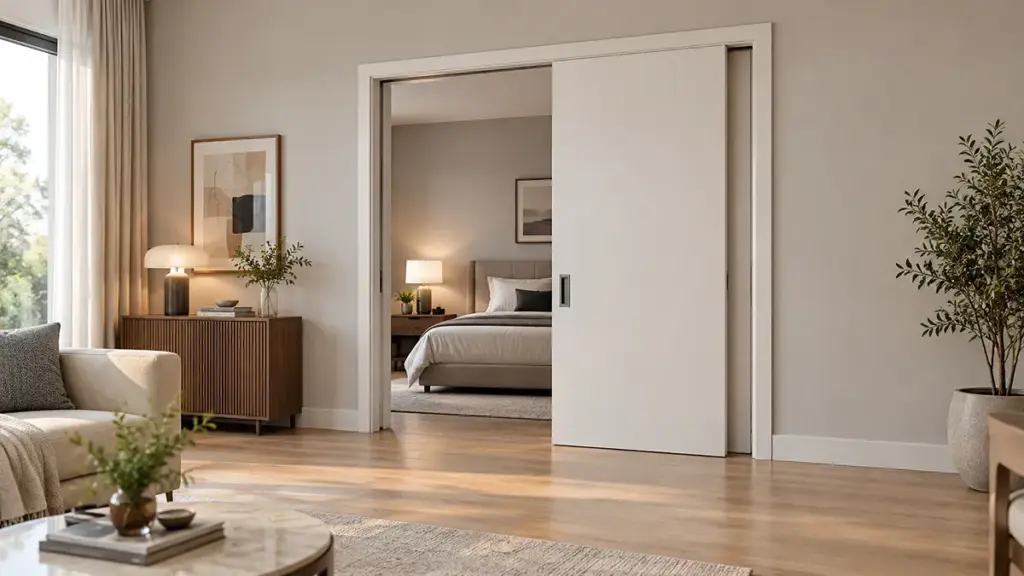
Aluminum sliding doors sourcing without precise specifications risks project failures, बजट की अधिकता, and persistent performance issues.
This guide analyzes frame material, glazing performance, and operational mechanisms across various aluminum sliding door types. We examine critical factors like U-values, structural strength for large panels (जैसे, panel widths up to 1.5-2.0 मीटर की दूरी पर), and hardware quality to ensure long-term system performance.
What are Aluminum Sliding Doors
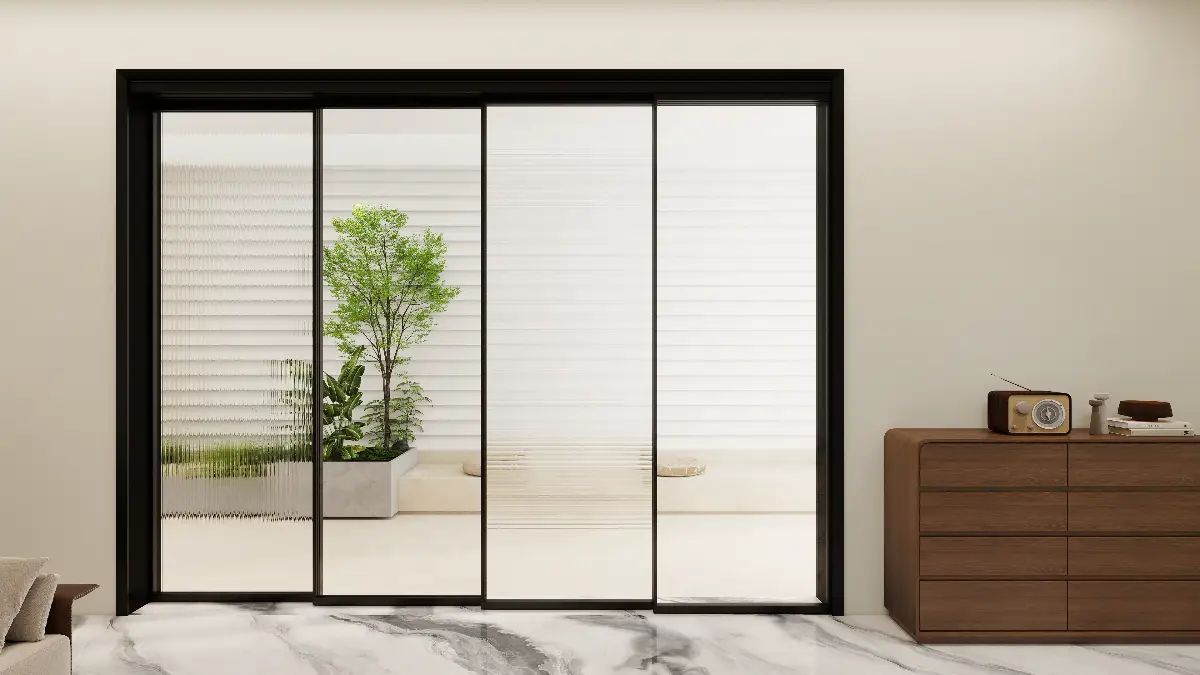
Aluminum sliding doors use framed glass panels moving horizontally on tracks. They create wide openings, connect spaces, and maximize light and views with strong, slim aluminum frames.
एल्यूमीनियम स्लाइडिंग दरवाजे are door systems that operate by moving one or more panels horizontally along a track instead of swinging inward or outward. This operating method allows the doors to provide wide access openings while minimizing the space required for daily operation. नतीजतन, they have become a preferred solution for contemporary residential, मेहमाननवाज़ी, and commercial architecture where efficient layouts and clean visual lines are priorities.
Unlike conventional hinged doors, aluminum sliding doors create a stronger visual connection between interior and exterior spaces. Large glazed panels allow abundant natural daylight to enter buildings while providing unobstructed views of gardens, छतों, बालकनियों, आंगनों, or surrounding landscapes. These characteristics make sliding systems particularly suitable for projects that emphasize openness and modern architectural design.
Main Types of Aluminum Sliding Doors
Aluminum sliding doors come in various designs, from standard and slimline to multi-panel and specialized performance systems, each suited for different opening mechanisms and architectural needs.
Standard Aluminum Sliding Doors
Standard sliding doors feature one or more movable panels sliding horizontally on tracks, parallel to fixed panels. People often use these for balconies, छतों, आंगन, and garden access, prioritizing large glass areas and easy operation.
These doors typically offer around a 75% opening of the total span. They work with 2-track or 3-track systems, allowing multiple panels to slide and stack to one side for wider openings. They fit medium to large openings in homes and light commercial spaces.
Aluminum frames give these doors high structural strength, supporting large glass areas without thick frames. Modern systems include thermal breaks and insulated profiles to improve energy performance. They resist high wind loads and operate durably for external facades and exposed sites.
Slimline Aluminum Sliding Doors
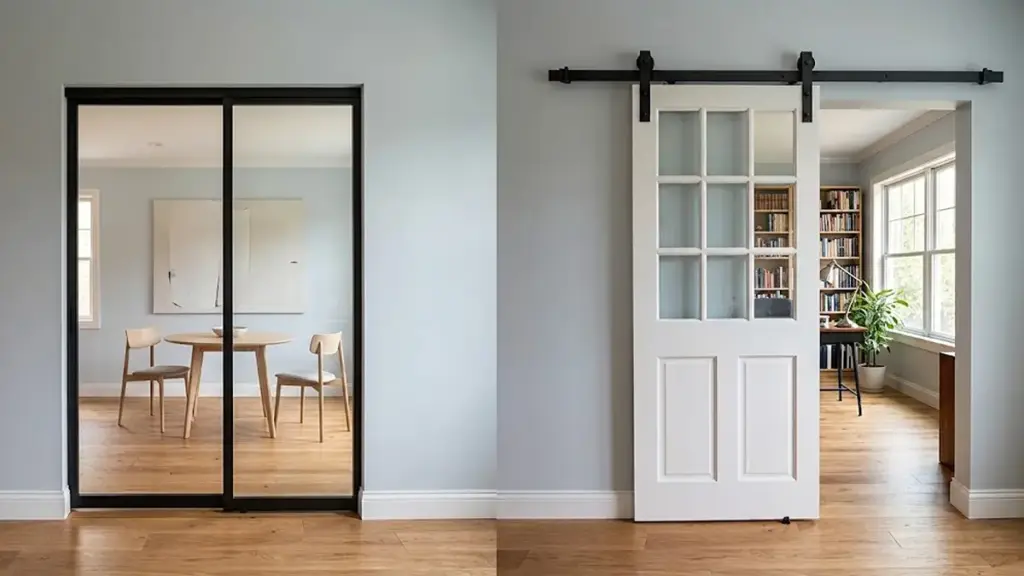
Slimline slider doors use ultra-slim aluminum profiles. This maximizes glass area and minimizes visible frame. Designers often specify them for modern interiors, उच्च स्तरीय आवासीय परियोजनाएँ, open kitchen partitions, and contemporary facade designs.
These doors reduce sightlines, creating a more seamless indoor–outdoor visual connection. They operate like standard sliding doors but focus on minimalist aesthetics. They frequently use large panels to create unobstructed views and strong architectural statements.
Slimline doors support large glass assemblies, sometimes several meters high. Premium panoramic sliders combine slim frames with high thermal performance, enabling large glass areas without significant heat loss. These doors suit design-led projects where visual impact and daylight are key priorities.
Large-Panel Aluminum Sliding Doors
इन sliding door systems are engineered specifically for large, भारी कांच के पैनल. उच्च स्तरीय आवासीय, मेहमाननवाज़ी, and commercial buildings frequently use them. They create expansive openings and dramatic glass facades.
Panels can reach heights up to about 4 meters and widths typically range from 1.8 को 3.3 मीटर की दूरी पर, सिस्टम पर निर्भर करता है. Track and roller assemblies are designed for smooth operation despite the high panel weight. People often use them for feature openings between interior spaces and patios, conservatories, या छतों.
Large-panel doors offer high wind load resistance for exposed facades. They are engineered for rigidity and dimensional stability, ensuring long-term function under heavy loads. Builders frequently combine them with low-threshold designs to provide barrier-free access while maintaining weather performance.
Multi-Track and Multi-Panel Aluminum Sliding Doors
These systems have multiple sliding panels running on two or more parallel tracks. This allows several panels to move independently and stack behind one another. Companies use them to enlarge opening sizes beyond what two-panel sliders offer.
Configurations with 3-tracks or more support 3, 4, or more sliding panels. This enables wider span coverage and increases the opening percentage. Panels can stack on one side or split stack (some left, some right) to tailor space usage and circulation.
Aluminum profiles and tracks are engineered for high load capacity. This supports multiple heavy glazed panels without compromising operational ease. These doors suit wide facade openings in living rooms, hotel lobbies, and commercial fronts needing modular opening flexibility.
Slide-and-Fold (Bi-Fold Style Sliding) एल्यूमीनियम दरवाजे
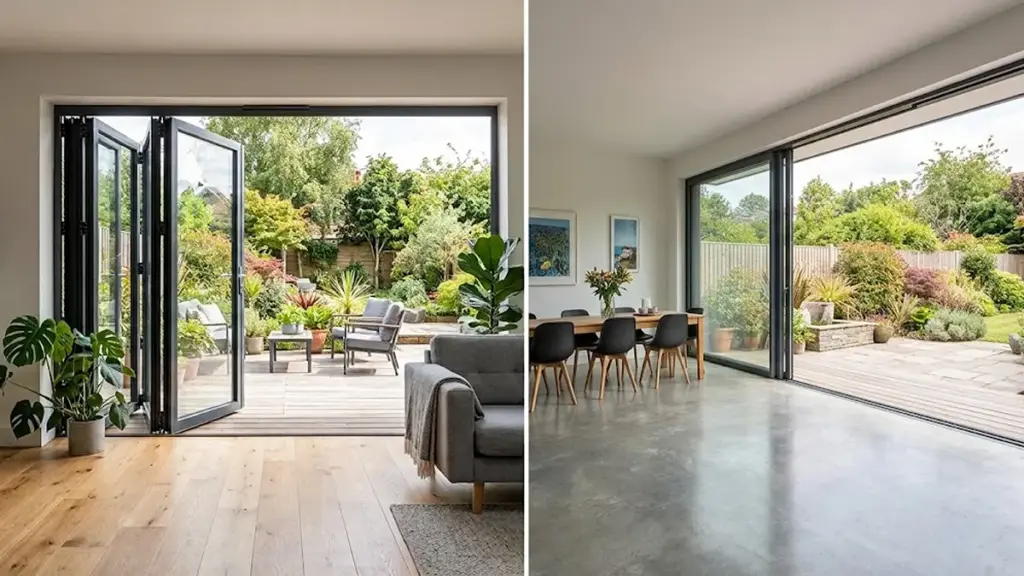
Aluminum slide-and-fold doors combine a sliding motion with a folding mechanism. Panels link by hinges and slide along a track, folding and stacking to one or both sides. This creates an almost full-width opening.
They create very wide clear openings, often approaching nearly 100% of the structural width. This differs from standard sliders, which typically offer about 75% उद्घाटन. Flexible configurations allow adjusting openings from partially to fully open, ideal for entertaining spaces, garden rooms, कैफे, और रेस्तरां.
Aluminum frames support multiple hinged panels without excessive deformation. This is crucial for smooth folding and alignment. Builders often specify these when a design needs both wide openings and compact panel stacking to the side, freeing up floor and wall space.
Collapsible / Sliding-Stack Aluminum Doors
Collapsible aluminum doors have multiple framed segments that slide and stack or collapse to the side. This creates a larger opening than a single-panel slider. They are used in commercial shopfronts, garages, and large indoor–outdoor interfaces needing flexible access.
Panels articulate and stack compactly, clearing the opening for vehicle access or high foot traffic. This design combines basic sliding guidance on tracks with collapsible, segmented frames.
Aluminum construction provides enough strength for repeated folding and stacking operations. They suit situations where space-saving and wide-access functionality are critical, with less emphasis on panoramic views than standard sliders.
Reliable B2B Systems: गुणवत्ता, प्रदर्शन, प्रभावी लागत
Aluminum Sliding Doors vs Other Door Types
Aluminum sliding doors offer unique advantages in strength, सौंदर्यशास्र, and maintenance compared to other door types, making them a strategic choice for specific project needs.
Aluminum Sliding Doors vs. विनाइल स्लाइडिंग दरवाजे
- संरचनात्मक ताकत: Aluminum offers greater structural strength than vinyl. This allows for larger panel sizes, पतले फ्रेम, and more glass area. Aluminum handles high wind loads and tall openings better. Vinyl needs thicker frames and often internal reinforcement for larger spans, reducing visible glass.
- फ़्रेम प्रोफ़ाइल: Aluminum frames generally measure around 1 इंच मोटी, while vinyl panels are closer to 1.5 इंच. This makes vinyl frames bulkier and can reduce sightlines.
- ऊष्मीय प्रदर्शन: Vinyl inherently insulates well. Aluminum needs thermal breaks and high-performance glazing to match vinyl’s energy efficiency. Lower-end aluminum systems without thermal breaks are less efficient.
- सहनशीलता: Aluminum resists warping, खुर, और यूवी गिरावट. Its finishes are long-lasting. Vinyl can chalk, fade, or become brittle over time, and large panels might sag in hot climates.
- लागत: Aluminum is more expensive than vinyl but provides greater durability, सौंदर्यपरक अपील, and structural integrity for larger openings. Vinyl suits cost-sensitive projects.
Aluminum Sliding Doors vs. फ्रेंच दरवाजे (टिका हुआ)
- अंतरिक्ष: Aluminum sliding doors do not need swing clearance. This makes them ideal for tight spaces like small patios or balconies. French doors require significant clear floor space for their swing path.
- सौंदर्यशास्र: Aluminum sliding doors align with modern, contemporary designs, emphasizing large glass areas and minimal frames. French doors offer a traditional, classic look, often with divided lites.
- लागत & रखरखाव: Aluminum sliding doors are generally less expensive to own and maintain over their lifetime than French doors. फ्रेंच दरवाजे, especially wood or high-end fiberglass, cost more upfront and require more maintenance.
Aluminum Sliding Doors vs. Fiberglass Sliding Doors
- संरचनात्मक ताकत: Aluminum is the go-to for very large, भारी, or multi-panel systems because of its superior strength. Fiberglass frames are strong and stable, but often have size limitations in common residential offerings.
- ऊष्मीय प्रदर्शन: Fiberglass typically offers better inherent thermal insulation than aluminum without needing complex thermal breaks. Aluminum can match this performance with thermal breaks and high-performance glazing, but at a higher cost.
- लागत: Fiberglass is generally more expensive than aluminum. Aluminum sits in the mid-range: more than vinyl, less than fiberglass and many wood systems.
- मामलों का प्रयोग करें: Fiberglass suits projects prioritizing energy performance and low maintenance with a higher budget. Aluminum excels when maximum opening size, पतले फ्रेम, and modern aesthetics are primary drivers.
Aluminum Sliding Doors vs. Wood Doors
- उपस्थिति: Wood offers a warm, प्राकृतिक, and customizable look, favored in traditional or luxury projects. Aluminum provides a clean, न्यूनतम लुक. Some aluminum systems mimic wood tones externally.
- प्रदर्शन & रखरखाव: Wood needs regular painting, धुंधला हो जाना, or sealing to prevent warping, सड़ांध, or termite damage. It is also more susceptible to moisture and UV. Aluminum does not rot, ताना, or attract termites; it is largely maintenance-light. Aluminum is better for humid or high-exposure conditions.
- लागत: Wood doors are often at the top of the cost spectrum, for both purchase and maintenance. Aluminum sliding doors cost less than wood and offer more predictable long-term performance in harsh environments.
Key Performance Specs Buyers should Check
When buying aluminum sliding doors, focus on frame material, ग्लास प्रकार, ऊष्मीय प्रदर्शन, and robust hardware for long-term durability and efficiency. Verify certifications and installation plans.
Dimensions and Panel Layouts
Standard aluminum sliding doors come in typical heights. In North America, this often means 80 इंच (के बारे में 2032 मिमी) for standard ceilings, या 96 इंच (के बारे में 2438 मिमी) for higher ceilings. Across the UK and metric markets, typical heights sit between 2000-2500 मिमी. Overall widths vary quite a bit, से 60 को 192 इंच (1524 को 4877 मिमी) for complete sliding systems. Common openings usually fall between 5-12 feet wide.
For standard residential use, common catalog sizes for aluminum sliding patio doors include 60 एक्स 80 इंच, 72 एक्स 80 इंच, और 96 एक्स 80 इंच. These are often marketed as 5 फुट, 6 फुट, या 8 ft wide, respectively. Larger patio door product lines offer 8 ft widths and beyond. For specialized multi-slide or tall aluminum systems, single panels can reach up to 8 ft wide and 12 फीट लंबा (के बारे में 2438 एक्स 3658 मिमी).
Aluminum sliding doors are available in frames with two, तीन, or four (और अधिक) पैनलों. Each panel has its own width and weight limits:
- 2-panel systems: These are common for widths of 60, 72, या 96 इंच (1524, 1829, 2438 मिमी). Metric designs typically range from 1500-2400 mm for two panels. We usually recommend a panel width of 1.5-2.0 meters for good operation and to control deflection.
- 3-panel systems: You often find these in widths of 108-144 इंच (2743-3658 मिमी). For UK/metric designs, this covers 3000-4500 mm openings. In basic residential patio doors, only one panel is typically operable, with two fixed panels.
- 4-panel systems: These are for larger openings, with typical widths of 144 या 192 इंच (3658 या 4877 मिमी). You see them in widths from 5000 mm and up for “wall of glass” डिजाइन. Standard setups often have two sliding and two fixed panels within one frame.
Operational Mechanisms
Aluminum sliding doors operate with linear motion along a bottom track, guided at the top. The opening scheme depends on the panel count and configuration. Basic options include:
- Single-slider (2-पैनल): One panel slides horizontally to overlap the adjacent fixed panel. You can specify it for left-hand or right-hand operation (X-O versus O-X). The clear opening width is about one panel width minus the frame overlap, आम तौर पर 40-50% of the total frame width.
- Single active leaf in multi-panel frame (3-पैनल): One operable X panel slides over one of the fixed O panels. The clear opening width is about one panel width, framed by two fixed panels for a balanced look.
- Two-way center opening (4-पैनल): Two central sliding panels (X-X) meet in the center when closed. Each panel slides outward to overlap the outer fixed panels (O-X-X-O). The clear opening can reach about 50-60% of the overall width, depending on the interlock and frame design.
काँच, Hardware and Color Options for Different Projects
Choosing glass, हार्डवेयर, and colors for aluminum sliding doors means balancing project needs—energy, सुरक्षा, सौंदर्यशास्र, and function—across residential, व्यावसायिक, and interior uses.
Key Considerations for Glass, हार्डवेयर, and Color Selection
Glass choices range from basic insulated and tempered units to advanced Low-E, ध्वनिक, and impact-rated options. This helps prioritize energy, सुरक्षा, और आराम.
Hardware includes smooth-glide track systems, heavy-duty rollers, and robust locking mechanisms. There are also specialized options like lift-and-slide or soft-close for better functionality.
Color and finish selections involve durable anodized or powder-coated aluminum. These are available in standard and custom palettes to match architectural aesthetics and environmental conditions.
Tailoring Options to Specific Project Requirements
Residential projects often need energy-efficient glass, smooth-glide hardware, and frame colors that match the home’s design for comfort and looks.
Commercial and institutional projects prioritize large, durable glass panels, heavy-duty hardware for frequent use, and weather-resistant finishes. These finishes usually match branding or facade needs.
Interior sliders focus on tempered or acoustic glass for privacy, soft-close hardware for quiet use, and neutral frame colors to fit indoor environments.
Good selection means aligning glass performance, हार्डवेयर स्थायित्व, and finish choice with project needs. Think about energy efficiency, ध्वनिक नियंत्रण, or accessibility.
Typical Price Factors for Aluminum Sliding Doors
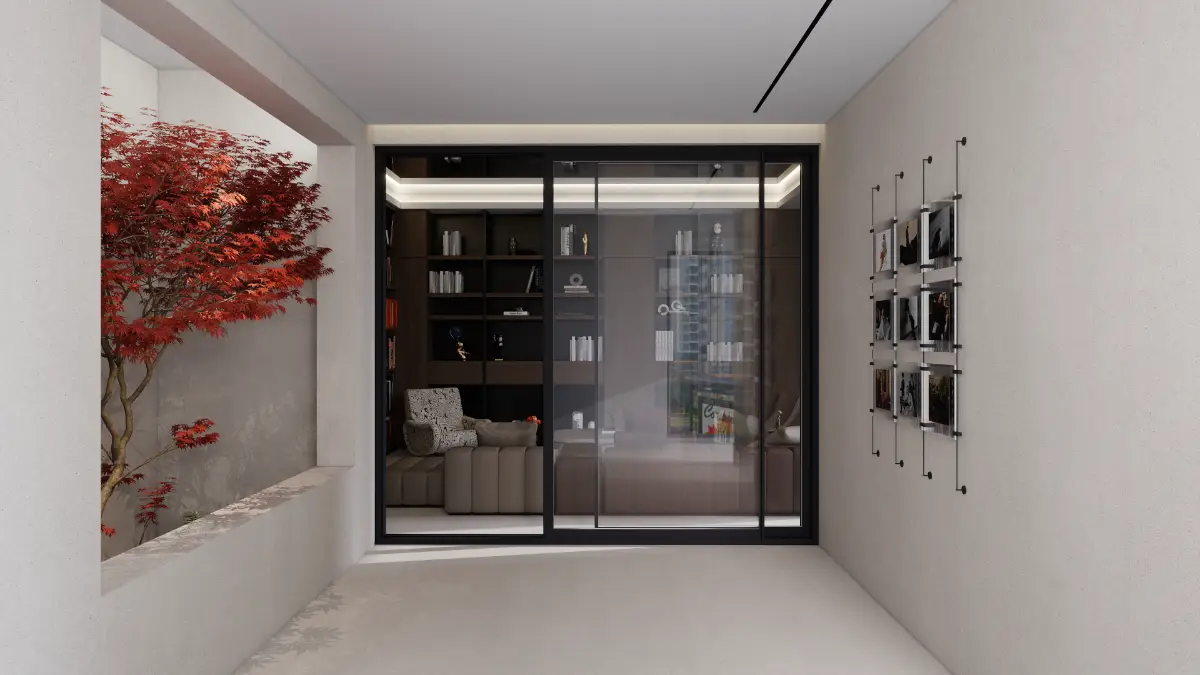
The cost of aluminum sliding doors varies from project to project because pricing is influenced by numerous technical and manufacturing factors rather than a single specification.
Door Dimensions
Overall door size remains one of the primary factors affecting cost.
Larger openings require more aluminum material, बड़े ग्लास पैनल, and stronger supporting components. As the dimensions increase, manufacturing complexity also rises, particularly for premium residential and commercial projects featuring expansive panoramic openings.
स्वनिर्धारित oversized aluminum sliding doors therefore generally involve different production considerations than standard residential configurations.
Profile Design and System Complexity
Different sliding systems incorporate different structural designs.
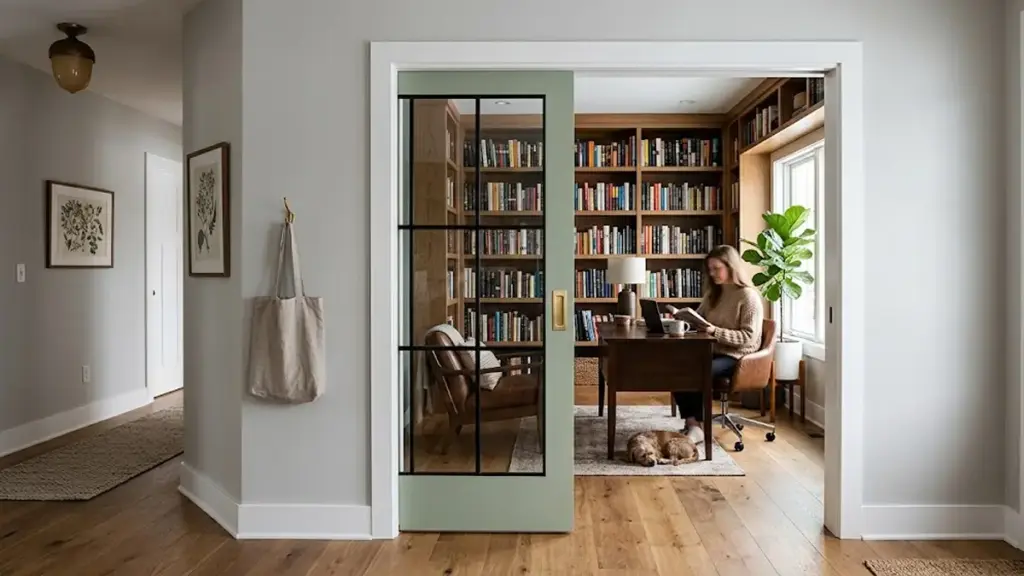
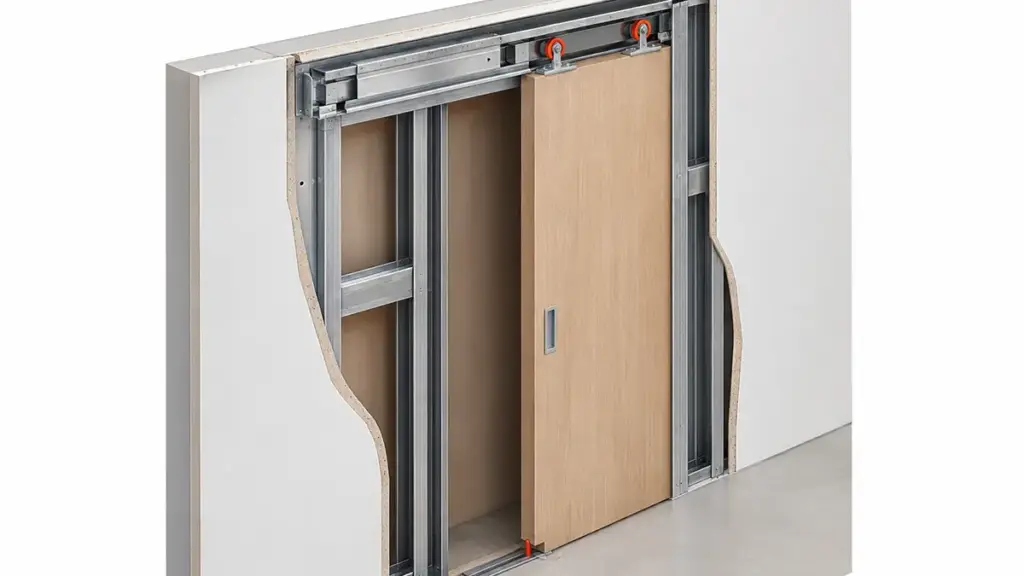
Basic two-panel configurations are generally simpler to manufacture than multi-panel, उठाना और खिसकाना, or pocket sliding systems. अधिक advanced aluminum sliding door design often requires additional engineering, precision manufacturing, and specialized hardware, all of which influence production costs.
Projects requiring customized structural solutions or unique architectural details may also involve more complex fabrication processes.
ग्लास विशिष्टताएँ
Glass selection significantly influences the overall cost of a sliding door system.
Factors such as glazing type, पैनल आयाम, and project-specific performance requirements all contribute to final pricing. Larger glass panels typically require greater handling precision during manufacturing and transportation.
Because glazing represents a substantial portion of the finished product, architects usually evaluate glass specifications alongside structural and aesthetic considerations during the design phase.
Hardware Selection
The quality and configuration of hardware also affect overall pricing.
Sliding mechanisms, लॉकिंग सिस्टम, रोलर्स, and handles should be selected according to the intended application and expected frequency of use. Premium hardware designed for demanding residential or commercial environments often contributes to smoother operation and longer service life.
Rather than viewing hardware as a secondary component, professional buyers typically consider it an essential part of the complete aluminum sliding door system.
How Distributors and Contractors Choose the Right Supplier
Selecting the right supplier is often just as important as selecting the right product. वितरकों के लिए, ठेकेदारों, आर्किटेक्ट्स, and developers, a dependable manufacturing partner contributes to smoother project execution, more consistent product quality, and stronger long-term business relationships.
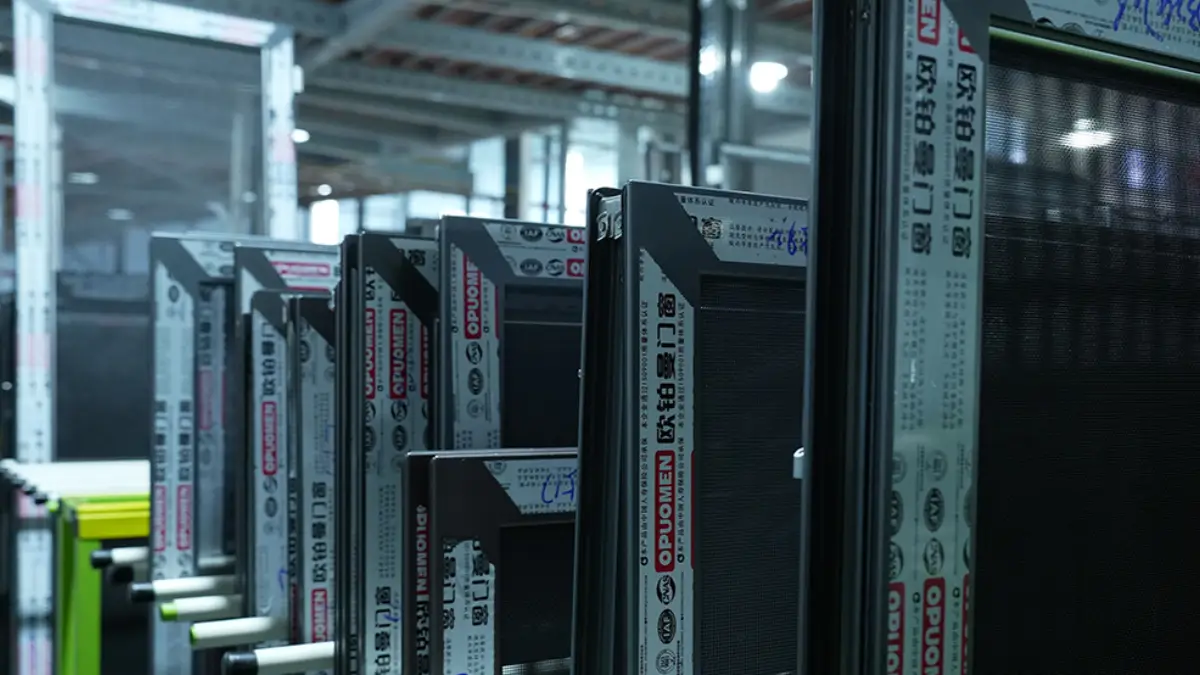
Manufacturing capability is one of the most important considerations. A factory with advanced production equipment, experienced technical teams, and stable manufacturing processes is better positioned to deliver consistent quality across projects of different sizes.
Customization capability is equally important. Since many commercial and residential developments require project-specific dimensions and configurations, suppliers should be able to manufacture products according to architectural drawings while maintaining consistent production standards.
Quality control also plays a critical role throughout the manufacturing process. Consistent fabrication, careful inspection, and attention to detail help ensure that every aluminum sliding door delivered to the project performs as expected after installation.
Technical communication is another important factor. Effective collaboration between architects, ठेकेदारों, वितरक, and manufacturers allows potential issues to be addressed early in the design process, reducing unnecessary revisions during production.
अंतिम विचार
Choosing quality aluminum sliding doors protects your investment and reputation. Generic options offer lower upfront costs, but only robust, thermally broken systems with certified hardware prevent costly performance failures. This approach guarantees long-term client satisfaction and project integrity.
Through precision manufacturing, लचीला अनुकूलन, and a commitment to quality, ओपूओ supports global partners in delivering elegant, टिकाऊ, and high-performance sliding door solutions tailored to architectural demands. Request our detailed catalog or contact our team directly for expert guidance on customization and sample orders. We are ready to align our certified aluminum door systems with your precise project requirements.