Deciding on tilt and turn vs casement windows sourcing often comes down to balancing hardware cost premiums against the risk of field failures. For projects moving toward European performance standards, underestimating the structural load tolerances of these mechanical systems leads to misaligned sashes and warranty claims.
This analysis benchmarks inward dual-action mechanisms against outward-projecting casements. We evaluate perimeter compression seals, ASTM E283 air leakage rates, and European OEM hardware supply chains from Roto and Siegenia to help you protect project margins and envelope performance.
What Inclinar e girar Actually Does
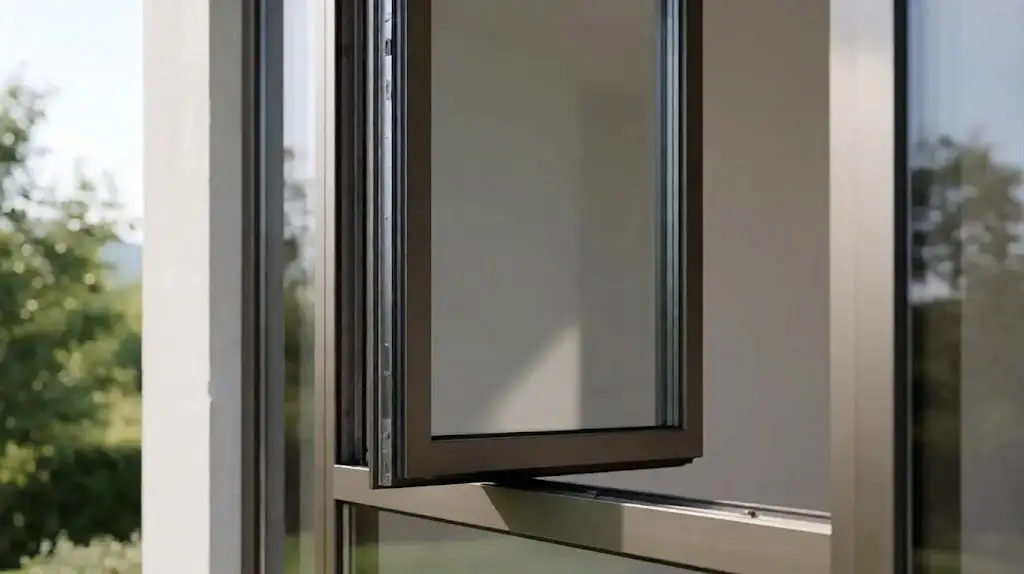
Tilt-and-turn windows isolate background ventilation and full maintenance access into two distinct mechanical modes, replacing conventional outward-opening sashes with a high-compression, sistema de bloqueio multiponto.
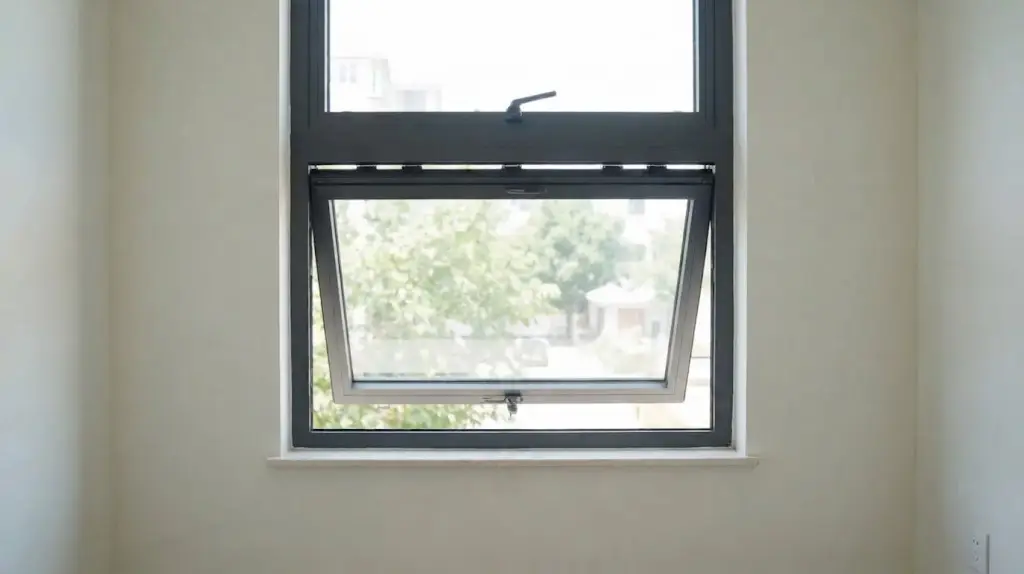
A tilt-and-turn system replaces the single outward swing of standard windows with a dual-action mechanism controlled by one handle. The hardware coordinates three distinct states through a central gearbox and perimeter drive rods:
- Tilt Mode for Secure Ventilation: The top edge of the sash leans inward 4 para 6 inches while the lower corners stay anchored. This creates a secure opening for continuous background airflow, directing fresh air toward the ceiling to prevent drafts on occupants.
- Turn Mode for Full Access: Rotating the handle releases all side locking points, and the entire sash swings inward on reinforced side hinges for rapid air exchange, saída de emergência, and interior glass cleaning.
- Locked Mode for Compression Seal: A central gearbox drives locking cams, corner transmissions, and stays that compress the sash evenly against continuous EPDM or silicone gaskets around the full perimeter.
For a deeper look at how these systems are engineered for aluminum frames, veja nosso guide to aluminum tilt-and-turn windows. In certified assemblies, this perimeter seal achieves air leakage rates as low as 0.10 cfm/ft² — a level that significantly outperforms basic sliding configurations.
Casement Mechanism Recap
Casement windows rely on crank arms and hinges to project outward, using compression seals to block air and water infiltration when locked.
A standard janela de batente swings on fixed vertical hinges along the frame side. The operating cycle follows a defined mechanical sequence: unlock the latch to release the sash, turn the crank to extend the linkage arm and push the window open, then reverse to close until the sash meets the frame and the weather seals compress. Internal crank operators convert rotational handle force into lateral arm movement, while friction slides provide controlled resistance to hold the sash at set angles.
Key failure points include worn gears (the crank spins without moving the sash), stripped splines where the handle socket loses grip on the operator shaft, sash sag from heavy glazing that causes the sash to scrape the frame, and misaligned strike plates that prevent a tight seal. These issues worsen in coastal or high-pollution environments where hardware exposure accelerates corrosion.
Locking style directly dictates seal performance. A single-point lock concentrates force in one area, allowing corners to flex under wind load. Multipoint locking casement systems distribute force along the entire perimeter, pulling the sash flat to compress weather seals tightly and block air leaks that would otherwise drive energy losses and occupant complaints. Routine maintenance requires biannual debris removal from tracks and weep holes, periodic gear lubrication with white lithium grease, and fastener audits on all hinges, keepers, and operators to catch loosening before it causes sash misalignment.
Ventilation Modes Compared
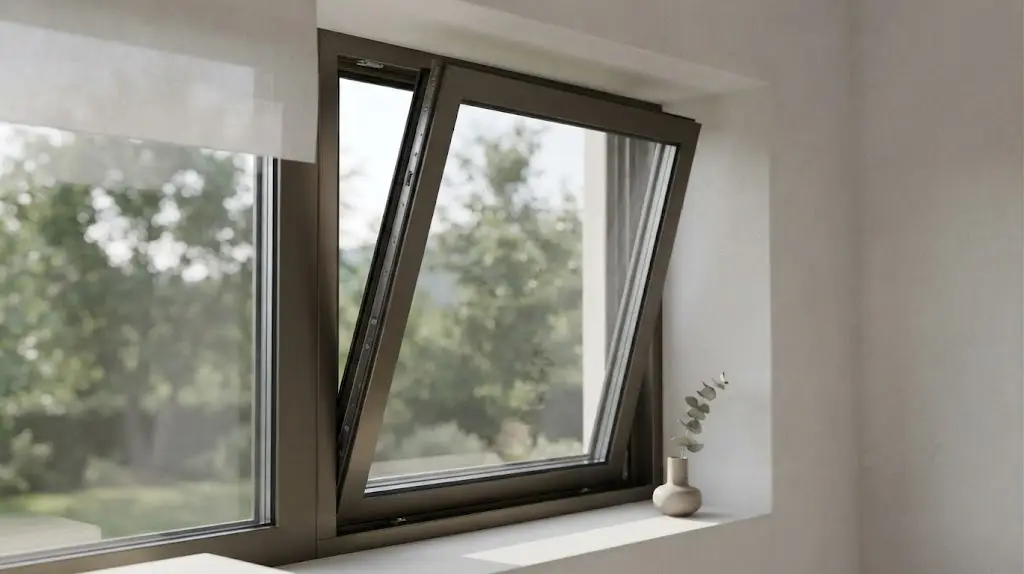
Tilt-and-turn windows isolate controlled background airing from high-volume purge ventilation, whereas standard casements rely on a single outward swing.
Tilt mode directs incoming air toward the ceiling through a 4-to-6-inch gap at the head of the frame, allowing natural circulation without dumping cold drafts onto occupants. This indirect path suits continuous background ventilation in residential and hotel spaces, particularly during cooler months when direct airflow would cause discomfort. Turn mode swings the sash fully inward up to 90 graus, offering maximum net free area for immediate extraction of heat and indoor pollutants. Outward casement sashes project into the external boundary layer, catching passing breezes and redirecting them indoors — an advantage in warm climates where cross-ventilation is the primary cooling strategy.
The physical differences in opening mechanics dictate distinct airflow profiles. Tilt mode concentrates intake at the highest point of the room; turn mode provides full-depth purge ventilation; and outward casement projection acts as a wind-catcher that can channel air even when breeze speeds are low.
- Rain Shedding: Tilt mode deflects light rain due to the downward sash angle, but wind-driven storms can bypass the high-level gap.
- Security in Partial Open: A tilted sash maintains multi-point engagement with frame keeps, resisting basic prying. An unsecured casement offers an easy leverage point unless fitted with restrictors.
- Integração de tela: Inward-swinging sashes push insect screens to the exterior face, requiring roller, pleated, or sliding screen systems that clear the frame depth.
Cleaning and Maintenance Access
Inward-opening tilt-and-turn windows simplify high-rise maintenance by enabling safe indoor cleaning, while outward casements require strict reach clearance and frequent track care.
Inward turn mode swings the sash like an interior door, exposing the outer glass pane for safe cleaning from inside the room. This eliminates scaffolding, cherry pickers, and exterior rigging on multi-level buildings, directly reducing insurance liabilities and facility maintenance costs. For buildings above four stories, this access advantage alone often justifies the hardware cost premium over outward-opening alternatives. A compensação: multi-point compression seals need regular debris removal from the lower frame pocket. Dust buildup in the track can jam the locking cams, forcing premature sash realignment and potentially voiding the hardware warranty if neglected.
Outward casements preserve interior floor space — no sash swings into the room — but complicate routine cleaning. Safe reach-through for exterior glass cleaning requires the sash to open to a full 90-degree angle, creating adequate space for arms and squeegees. Safety restrictor hinges, which are mandatory on many commercial projects to prevent accidental sash fall, often block this full opening, making indoor-access cleaning impossible and forcing building owners to hire exterior service crews for every maintenance cycle. Exposed hinge channels and operator tracks collect windblown grit continuously; when gears bind from accumulated dirt, operators naturally apply more force to the crank, which strips the internal teeth and turns a routine cleaning task into a hardware replacement job.
Weather Seal and Compression Gasketing
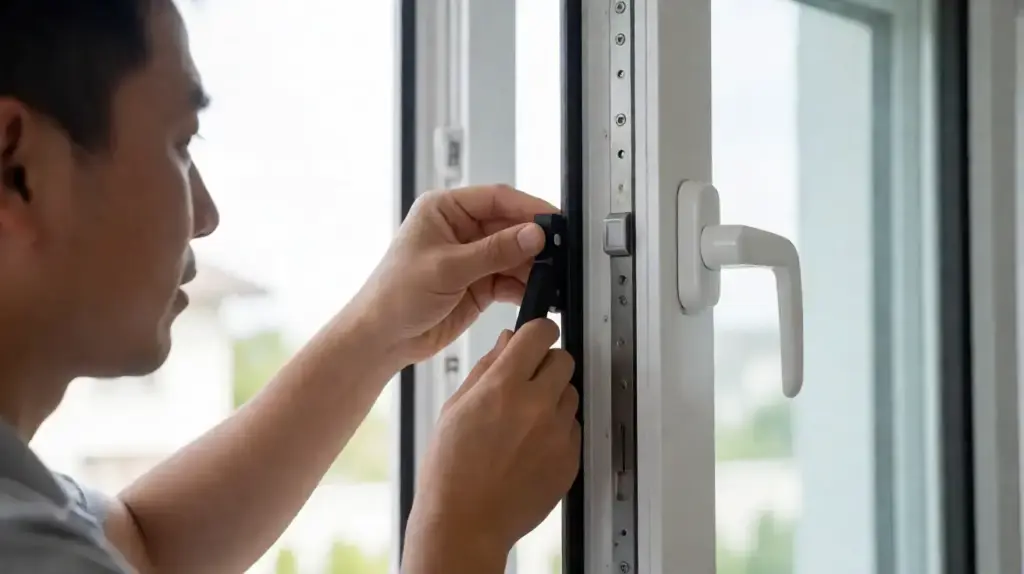
Compression seals dictate window thermal and weather performance. Matching the right elastomer profile with balanced multi-point latch tension prevents systemic air and water leaks.
A weather seal depends on its raw elastomer characteristics. Different materials balance UV exposure, temperature cycles, and recovery forces differently:
- Borracha EPDM: 15 para 25 years of service with strong UV, ozônio, and temperature resistance.
- Silicone Gaskets: 20 para 30 anos, maintaining elasticity in extreme cold at higher material cost.
- Thermoplastic Elastomer (TPE): Weldable during fabrication but vulnerable to thermal creep, com 10 para 20 year expectancy.
Profile shapes match specific needs: hollow bulb profiles handle broad dimensional tolerances with low closing resistance, making them suitable for large commercial sashes where operating force must stay manageable. Wedge geometries seal compact glazing channels where space is limited. Co-extruded profiles resolve retention issues by pairing a hard attachment base with a soft, compliant sealing lip in a single extrusion step, eliminating the adhesive failure points that older clip-in designs presented.
Elastic recovery defines seal longevity. When gaskets suffer high compression set, they permanently flatten and lose their spring-back force. Tightening locking cams to chase the resulting draft warps the sash and accelerates failure. Replace the gasket instead.
Hardware and gaskets operate as one system. Per ASTM E283, standard air leakage limits sit at 0.30 cfm/ft² at 1.57 psf, though well-designed multi-point compression setups typically achieve 0.03 para 0.10 cfm/ft² at 6.24 psf. Multi-point locking cams distribute force across 3 para 6 engagement points for uniform gasket compression. Field failures show as hardened or cracked gaskets and stiff handles from over-tightened cams. Correct hinge alignment; do not over-torque the hardware.
Security Multi-Point Locking
Multi-point locking distributes physical resistance across the sash perimeter, converting localized weak spots into system-wide defensive barriers.
A central gearbox coordinates multiple locking points along the sash edge. Mushroom cams and compression rollers engage reinforced keeps to secure the frame and improve weather tightness simultaneously. The number of locking points typically ranges from 3 for standard residential sashes to 6 or more for commercial-grade installations subject to higher wind loads and security requirements. Without internal metal reinforcement in the frame profiles, high-security keeps can pull straight out under prying load. The lock delivers its rated security only when frame reinforcement, anchor spacing, and substrate all match the manufacturer’s specification.
- Tilt-and-Turn: Inward-opening designs protect hinges from exterior tampering and provide controlled, restricted ventilation in tilt mode.
- Casement Upgrades: Outward casements achieve equivalent protection when upgraded from single latches to multipoint systems with protected hinge hardware.
- Certified Standards: EM 1627 (RC2 or RC3) and PAS 24 establish verifiable protection levels for the complete assembly, incluindo quadro, vidro, and installation method.
Do not rely on window style alone to determine security level. Verify the tested certification of the full assembly — frame, glazing unit, and installation method — before making a procurement decision. Request the manufacturer’s test certificates and confirm that the rated performance covers the specific sash size and glass configuration you are ordering, not just a smaller reference panel used in the laboratory.
Cost and Hardware Supply Chain
Tilt-and-turn hardware typically costs 2 para 3 times more than casement systems due to dual-mode gearboxes, requiring tight fabrication tolerances and specialized European OEM supply chains.
| Custo & Logistics Metric | Tilt-and-Turn Systems | Casement Systems |
|---|---|---|
| Indicative Hardware Cost | $90 – $160 por unidade (premium branded) | $15 – $40 (padrão); $50 – $120 (mid-tier) |
| Fabrication Labor | Alto (multi-axis routing, timing alignment) | Baixo (simple hinge and operator mounting) |
| Supply Chain Origin | Concentrated (German/European OEMs) | Fragmented (global and domestic suppliers) |
| SKU Complexity | Alto (handing, limites de peso, gear lengths) | Baixo (standardized, interchangeable stays) |
Dual-mode mechanics drive up both bill-of-materials and assembly steps. A tilt-and-turn system requires a central gearbox, perimeter drive rods, corner transmissions, and scissor stays supporting the sash in both vertical and horizontal planes. Roto hardware runs $90 para $130 per set; Siegenia $110 para $160. Casement kits start at $15 para $40 for basic sets and $50 para $120 for branded multipoint versions.
The premium tilt-and-turn supply chain centers on European OEMs — Roto, Siegenia, Maco, Winkhaus — that dictate lead times and profile compatibility. Each brand uses proprietary groove dimensions and gear ratios, meaning hardware from one manufacturer does not interchange with another without full sash re-machining. Custom commercial aluminum orders typically run 12 para 18 weeks from specification approval to delivery. LCL shipping for European imports averages $3,000 para $3,500 per container segment, and budget OEMs often require 50 para 200 units per order, forcing fabricators to carry deeper inventory. Left-hand vs. right-hand configurations, varying sash weight ratings, and different spindle lengths effectively double the required warehouse slot count.
On-site installation adds specialized labor costs. Tilt-and-turn windows demand precise frame squaring and hinge compression cam adjustment at handover. Misalignment leads to user-error service calls during warranty periods — a risk that compounds on large projects with hundreds of openings. Long-term, casement repairs use generic local parts available from any glazing supplier, while tilt-and-turn requires system-specific spares. Gearboxes, corner drives, and handles must match the original OEM, so maintaining a spare parts inventory is standard practice for commercial facilities managing tilt-and-turn fleets.
Perguntas frequentes
Why are tilt-and-turn windows more expensive than casement windows?
Expect a 15% para 40% price premium over standard casements. You are paying for advanced engineering: a dual-function operating hardware system that allows the sash to both tilt and turn safely. This mechanical setup requires coordinated multi-point locking, corner drives, scissor stays, and heavy-duty hinges designed to carry glazing loads that can exceed 350 lbs in commercial configurations. Manufacturing demands tight tolerances to prevent sash binding in both operating modes, and installation requires technicians trained on the specific hardware platform. European hardware brands like Roto and Siegenia also carry higher import costs and low-volume distribution markups in domestic markets, which further widens the gap against commodity casement kits.
Can tilt-and-turn windows be repaired with local hardware?
Basic wear parts — handles (tipicamente 7 mm square spindle, 43 mm screw spacing), rubber gaskets, keeps, and screws — source readily from local glazing suppliers. But core operating hardware is system-specific. Gearboxes, corner drives, espagnolette strips, and scissor stays must match the original manufacturer (Roto, Siegenia, GU, Winkhaus, or Maco). Measure the exact backset, faceplate width, and locking positions before ordering replacement components.
Are tilt-and-turn windows better than casement windows for energy bills?
They do not automatically save more energy. While tilt-and-turn designs excel in draft resistance through continuous compression gaskets and multi-point locking, modern casement windows use similar sealing technologies. Actual savings depend on the whole-window U-factor, solar heat gain coefficient (SHGC), and glass specifications such as triple glazing and low-e coatings. A well-installed casement with superior glazing will outperform a basic tilt-and-turn model. Proper installation and air-sealing remain the real-world deciders.
Why do tilt-and-turn windows suit high-rise buildings better?
In tilt mode, the sash opens only a limited distance at the top, offering secure ventilation while resisting wind gusts without the risk of an uncontrolled outward swing into pedestrian zones or wind-shear zones. The inward-swinging sash avoids the vulnerability that outward-swinging casement sashes face at height, where sudden gusts can slam or damage the open panel. Turn mode lets maintenance staff clean the exterior glass safely from inside the room, eliminating the need for expensive exterior access rigs such as swing stages or bosun’s chairs. Multi-point locks also handle severe positive and negative wind pressures effectively across the large sash sizes common in commercial high-rise curtain wall applications.
Can tilt-and-turn sashes be cleaned from inside the building?
Sim. Turning the handle to the vertical position swings the sash inward like a door, exposing the entire exterior pane. You can wash both sides of the glass, clean the frames, wipe the EPDM gaskets, and clear debris from drainage tracks without ladders or exterior cleaning services. Note that tilt mode alone does not provide sufficient opening for cleaning; the window must be in the full turn position.
While generic windows offer lower upfront costs, specifying certified tilt-and-turn systems with Roto or Siegenia hardware is a proven approach to safeguard projects against systemic air leaks, sash sag, and high-rise maintenance liabilities. Investing in multi-point perimeter hardware ensures continuous gasket compression and verifiable thermal performance that basic single-point alternatives cannot match. For high-performance envelopes, this hardware standard protects your commercial reputation and reduces costly structural callbacks.
We recommend requesting our technical hardware catalog or a sample corner section to evaluate our multi-point locking cams and EPDM gasket integration firsthand. Contate nossa equipe de engenharia to review your project specifications and receive a detailed OEM quotation.